
Palm Kernel Expeller (PKE)
Indonesian & Malaysian PKE by protein, fibre, shell and aflatoxin
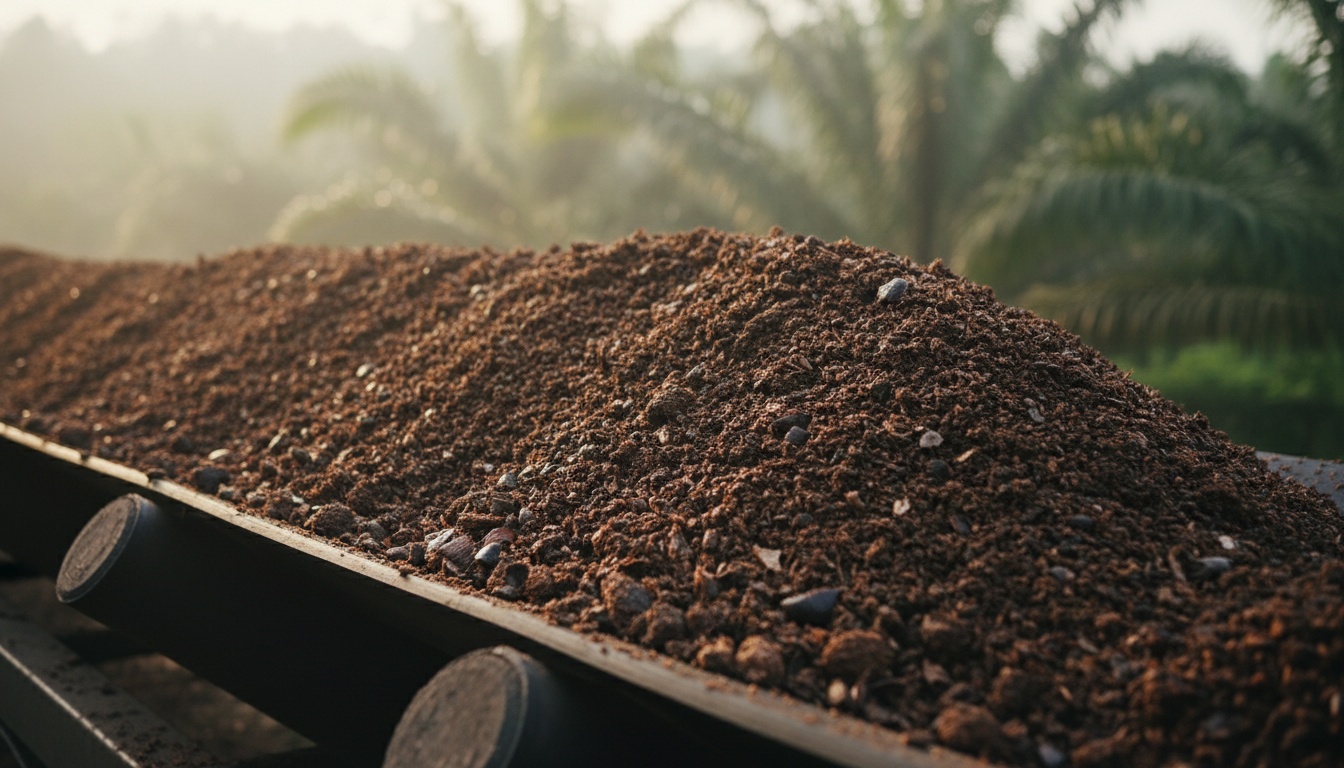
Palm kernel expeller is what is left when the kernel of the oil palm fruit is mechanically pressed for palm kernel oil, and it is bought as a cheap ruminant energy-and-fibre ingredient rather than as a protein meal. The sheet runs crude protein 14–18%, residual fat 6–10% (a solvent-extracted palm kernel meal would be nearer 2%, but the expeller route dominates), crude fibre 12–20%, moisture ≤ 10–12%, ash ≤ 5% and total shell 5–7% maximum — shell is the number a dairy buyer watches, because it is inert weight that does nothing in the rumen and a mill with worn screens pushes it up. Aflatoxin B1 is held to ≤ 20 ppb or the buyer's national limit, and the meal is checked for copper (naturally high in PKE, 20–30 mg/kg, which matters for sheep) and free fatty acid drift on long voyages. It is high in fibre but the fibre is digestible by ruminants, so it goes into pasture-supplement and feedlot rations at 20–40% inclusion with little else changed. UN Comtrade 2025 export declarations under HS 2306 show Indonesia at 5.37 million MT at an average USD 126/MT and Malaysia at 2.38 million MT at USD 130/MT; the two together are the world PKE trade. Indonesia's own 2025 destination list shows who buys it: New Zealand 1.79 million MT (33%) at USD 126/MT, the Netherlands 1.24 million MT (23%) at USD 133, Vietnam 0.59 million MT at USD 109, China 0.58 million MT, Korea 0.56 million MT at USD 126, Saudi Arabia 0.17 million MT at USD 122, Thailand 0.15 million MT and India 0.10 million MT at USD 158. New Zealand's dairy herd is the anchor customer and sets the seasonal shape of the market.
A feed mill or an integrator in Vietnam, Saudi Arabia, Bangladesh or East Africa buys PKE because it is the cheapest ruminant energy on the water — roughly a third of the price of soybean meal per tonne — and the question is whether the delivered price and the shell and fat numbers hold. CBIL is a commodity brokerage company and brokers palm kernel expeller from Indonesian and Malaysian crushing mills and trader positions against SGS or Intertek certification of protein, fat, fibre, moisture, ash, shell content and aflatoxin, with copper and FFA on request. Parcels are structured in Handysize and Supramax bulk lots on FOB and CFR terms out of Sumatra, Kalimantan and Peninsular Malaysia, and in jumbo bags or 50 kg bags in containers for trial lots and mills without a bulk berth; because CBIL also runs a chartering desk (LaycanDesk), the freight leg can be quoted alongside the cargo. Send your fat and shell limits, aflatoxin ceiling, monthly tonnage and discharge port and we will work the mill to it.
Need the ship as well? Our chartering desk prices bulk feed ingredient freight on LaycanDesk.
Indicative reference
$110–160 USD / MT
as at September 2026
Reference level only — not an offer, and reviewed quarterly. Levels shown are as at September 2026. Firm pricing is quoted per RFQ, subject to volume, terms and inspection.
Typical Specification
Specifications are indicative and adjusted to the agreed contract and destination requirements. Final spec confirmed on COA / SGS.
Available Grades
Applications
- Dairy pasture supplement
- Beef feedlot rations
- Sheep & goat feed
- Compound ruminant feed
- Biomass fuel (off-spec)
Category
Agriculture & Fertilizers
Incoterms
FOB · CFR · CIF
Pricing basis
USD / MT
Inspection
SGS / Intertek at load port
Palm Kernel Expeller (PKE) — buyer questions
What is the difference between palm kernel expeller and palm kernel meal?
The extraction route. Expeller (PKE, palm kernel cake) is mechanically pressed and keeps 6–10% residual fat, which is energy the ruminant uses. Solvent-extracted palm kernel meal has the fat taken down to around 2% and a slightly higher protein by difference. Almost all Indonesian and Malaysian export tonnage is expeller; specify which you mean, because the fat figure changes the energy value and the price.
Why does shell content matter so much?
Shell is the hard endocarp fragment that survives cracking, and it has no feed value. A mill with worn cracking and separation equipment sends more of it into the expeller. At 5% you are paying for a tonne that is 950 kg of feed; at 10% the delivered cost per unit of usable energy has risen by a twentieth and the buyer notices in the ration. Fix a shell ceiling in the contract and have the surveyor sample for it at the load port.
Who buys PKE and at what price?
UN Comtrade 2025 export declarations from Indonesia show New Zealand at 1.79 million MT (33% of the total) at USD 126/MT, the Netherlands at 1.24 million MT, Vietnam at 0.59 million MT at USD 109, China and Korea at around 0.57 million MT each and Saudi Arabia at 0.17 million MT at USD 122. The declared averages are FOB and sit in a narrow band; freight and the shell and fat numbers do the rest.
What parcel sizes and freight terms do you work?
Handysize (25–35,000 MT) and Supramax (50–55,000 MT) out of Sumatra, Kalimantan and Peninsular Malaysia on FOB and CFR terms; combination cargoes with soybean meal or DDGS into the same discharge port can be worked. Trial lots go in jumbo bags or 50 kg bags in containers. Because CBIL also runs a chartering desk, the freight can be quoted with the cargo.
Ready to source PKE?
Send your quantity, specification, preferred Incoterms and destination port. We'll verify supply and respond with a workable offer — usually within one business day.
Have PKE to sell? Submit an offer — we'll match it against live buyer demand.