
DRI & HBI (Direct Reduced Iron)
Hot briquetted iron and DRI by metallisation, carbon and gangue for EAF melt shops
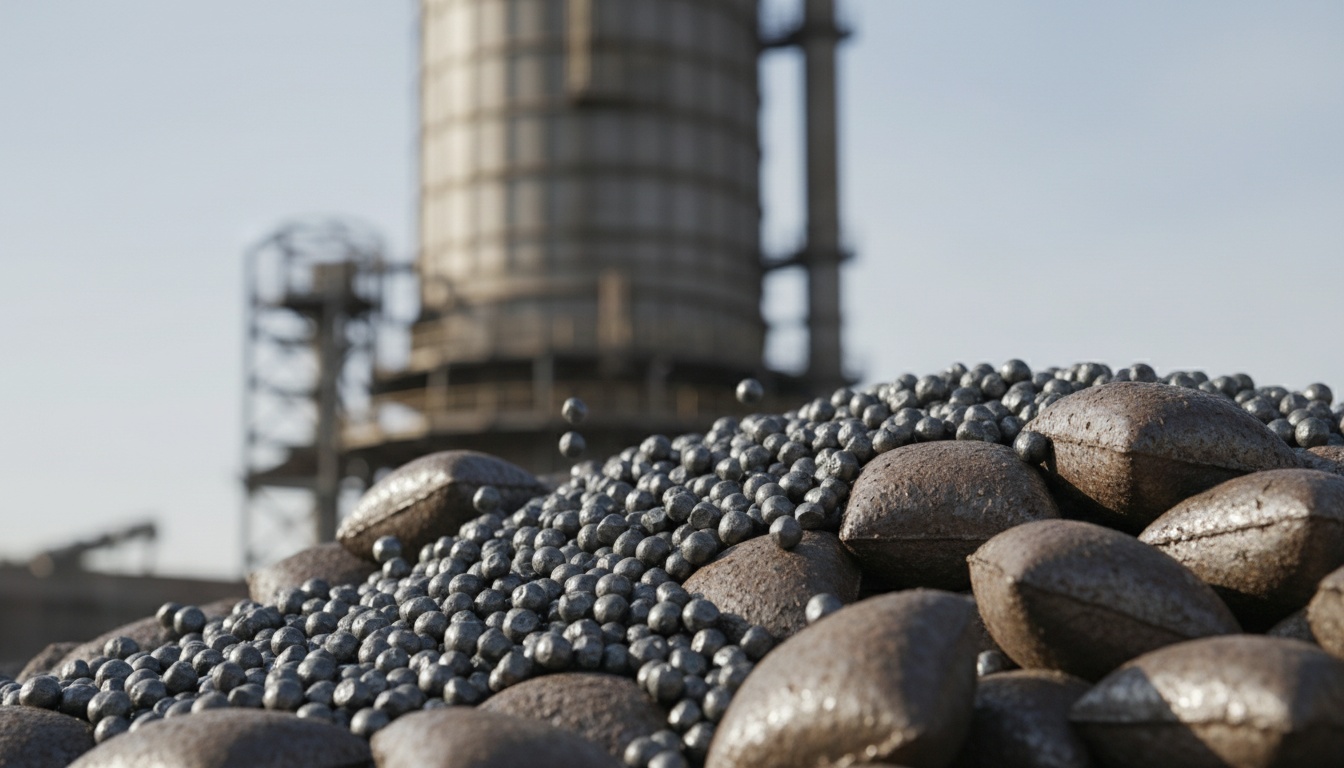
Direct reduced iron is iron ore reduced to metal in a shaft or rotary kiln without melting, and it is bought as a chemistry sheet. Metallisation (the share of total iron present as metallic iron, 90–94% for shaft-furnace DRI and HBI, 85–90% for coal-based rotary-kiln sponge iron) sets the yield; total Fe (90–94%) and metallic Fe (83–88%) follow from it; carbon (1.0–2.5% for gas-based, ≤ 0.2% for coal-based) is a bonus for an electric-arc furnace that would otherwise buy charge carbon and a penalty where it is absent; gangue (3–6% silica plus alumina, carried straight through from the pellet) is slag the furnace melts and phosphorus (0.02–0.05%) and sulphur (≤ 0.01% gas-based, up to 0.03% coal-based) are what the pellet and the reductant left behind. Residuals — copper, tin, nickel, chromium — are essentially zero, which is the whole reason a melt shop buys it. The form matters as much as the sheet. Cold DRI pellets are porous and re-oxidise: they generate heat and hydrogen in contact with water, and the IMSBC Code lists DRI (B) as a Group B cargo that must be carried under inert gas or with holds sealed and monitored, aged and cooled before loading, with a moisture ceiling and a certificate from a competent authority — and many owners decline it. Hot briquetted iron is the same iron compacted at over 650°C into 90–130 mm briquettes of density above 5 g/cm³; it is IMSBC DRI (A), far less reactive, carried in ordinary bulk holds and stockpiled in the open, which is why HBI is the seaborne product and cold DRI mostly moves short-haul. UN Comtrade 2025 export declarations under HS 7203 put India at 1.61 million MT at an average USD 294/MT, the USA at 0.93 million MT at USD 351, Malaysia at 0.76 million MT at USD 354, Oman at 23,575 MT at USD 250 and Kazakhstan at 3,690 MT, out of 10 declaring origins. India's own 2025 destination list shows its book is overland coal-based sponge iron, not seaborne HBI: Nepal 1.16 million MT at USD 282/MT, Bangladesh 0.34 million MT at USD 326 and Bhutan 0.10 million MT at USD 305, with every seaborne destination below 4,000 MT. The seaborne HBI trade in that data is the American and Malaysian tonnage at USD 350/MT.
The buyer is an electric-arc furnace rolling a product with a residual limit — low-carbon wire rod, flat products, special bar — or a mill in a scrap-short market that wants a metallic it can contract for a year at a time; induction furnaces buy coal-based sponge iron for the same reason at the cheaper end. That buyer prices HBI against pig iron and premium scrap on a delivered-metallic-iron basis, netting the value of the carbon and the cost of the gangue, and the arithmetic is why a 92% metallised HBI at USD 350 can beat a busheling cargo at USD 300 for one mill and lose for another. CBIL is a commodity brokerage company and brokers HBI and DRI from Malaysian, Indian, US and Gulf direct-reduction plants and trader positions to electric-arc and induction melt shops against producer analysis and SGS or Intertek verification of metallisation, total and metallic Fe, carbon, gangue, phosphorus, sulphur, size and moisture, sampled at the load port with the load-port certificate governing. Parcels are structured in Handysize and Supramax bulk lots on FOB and CFR terms; because CBIL also runs a chartering desk (LaycanDesk), the freight leg is quoted alongside the cargo and the desk fixes only tonnage whose owners accept the IMSBC schedule for the form being shipped — HBI is straightforward, cold DRI needs an owner who has carried it. Send your metallisation floor, carbon target, gangue ceiling and whether your furnace is arc or induction, and we will work the plant to it.
Need the ship as well? Our chartering desk prices bulk ore and metallics freight on LaycanDesk.
Indicative reference
$280–380 USD / MT
as at September 2026
Reference level only — not an offer, and reviewed quarterly. Levels shown are as at September 2026. Firm pricing is quoted per RFQ, subject to volume, terms and inspection.
Typical Specification
Specifications are indicative and adjusted to the agreed contract and destination requirements. Final spec confirmed on COA / SGS.
Available Grades
Applications
- Electric-arc furnace charge (low-residual steel)
- Induction furnace charge (sponge iron)
- Blast-furnace burden supplement (HBI)
- Basic oxygen furnace coolant (HBI)
Category
Metals & Recycled Scrap
Incoterms
FOB · CFR
Pricing basis
USD / MT
Inspection
SGS / Intertek at load port
DRI & HBI (Direct Reduced Iron) — buyer questions
What is the difference between DRI and HBI?
The same reduced iron in two forms. DRI leaves the shaft as porous pellets or lump with a very large internal surface, which re-oxidises in air and, wet, generates heat and hydrogen; it is an IMSBC Group B cargo (DRI (B)) that must be aged, cooled, kept dry and carried under inert gas or sealed and monitored holds, and many owners will not take it. HBI is DRI hot-compacted at over 650°C into dense briquettes, which closes the pores; it is IMSBC DRI (A), carried in ordinary bulk holds and stockpiled in the open. That is why HBI is the seaborne product and cold DRI is mostly consumed at or near the plant, and why HBI carries a premium over DRI of the same metallisation.
How do I compare HBI against pig iron and scrap?
On delivered metallic iron with the carbon and gangue priced in. Divide the delivered price by the metallic Fe fraction (about 0.85 for 92% metallised HBI, 0.93–0.95 for pig iron, and whatever your yield is on scrap), then credit the carbon HBI or pig iron brings against your charge-carbon cost and debit the extra slag from HBI gangue in power and flux. For a furnace rolling low-residual product, add the value of the residuals avoided. The answer differs by mill, which is why we ask what you are rolling before we quote.
Is Indian sponge iron the same as gas-based DRI?
No. Indian sponge iron is mostly coal-based rotary-kiln DRI: metallisation 85–90%, carbon near zero, sulphur up to 0.03% from the coal, and a size range with a high fines fraction. It is the right feed for an induction furnace at the cheaper end and the bulk of India's HS 7203 exports go overland to Nepal, Bangladesh and Bhutan, per UN Comtrade 2025 declarations. Gas-based shaft DRI and HBI from Malaysia, the Gulf and the USA run 92–94% metallisation with 1–2.5% carbon and very low sulphur, and are what an electric-arc furnace buys seaborne.
What parcel sizes and carriage terms do you work?
Handysize (25–35,000 MT) and Supramax (45–55,000 MT) out of Kemaman and Labuan in Malaysia, the US Gulf and Sohar, on FOB and CFR terms. HBI stows as ordinary bulk; cold DRI needs an owner who accepts IMSBC DRI (B), with the shipper's certificate on ageing, moisture and temperature and nitrogen inerting arranged before loading. Because CBIL also runs a chartering desk, the freight leg — and the owner's acceptance of the cargo schedule — is settled alongside the cargo rather than after it.
Ready to source DRI / HBI?
Send your quantity, specification, preferred Incoterms and destination port. We'll verify supply and respond with a workable offer — usually within one business day.
Have DRI / HBI to sell? Submit an offer — we'll match it against live buyer demand.
More in Iron Ore, Pig Iron & DRI