
Iron Ore Lumps & Pellets
Direct-charge lump and blast-furnace / DR-grade pellets by Fe, tumble index and CCS
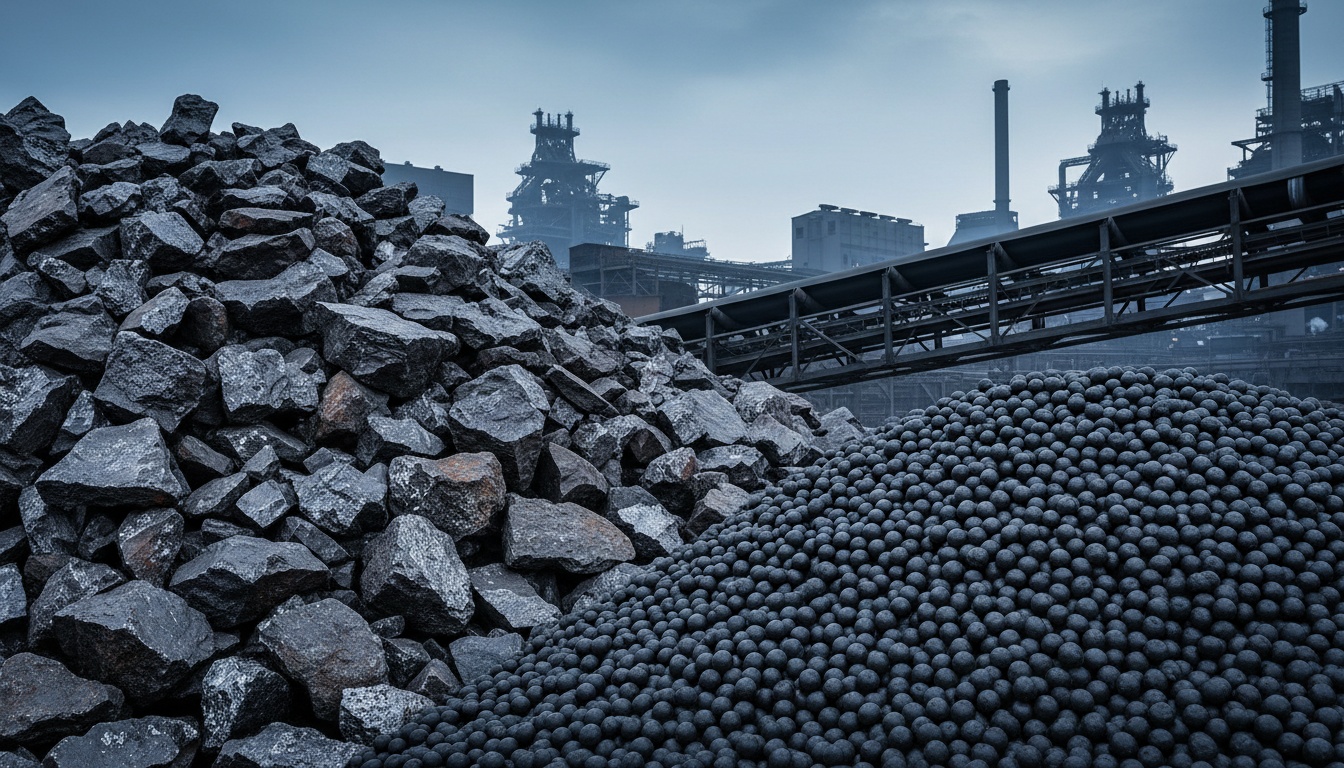
Lump and pellets are the ore a furnace can charge without sintering, and that is what the premium over fines buys. Lump (6–40 mm, or 10–40 mm for stricter burdens) is bought on Fe (60–64%), silica, alumina and phosphorus like fines, plus two mechanical numbers: a decrepitation index, because a lump that shatters when it hits the furnace heat becomes fines in the wrong place, and a fines fraction below 6.3 mm at discharge, which is why it is bought on a dry, screened basis and re-screened at the receiving end. Pellets (9–16 mm, 63–67% Fe) are a manufactured product and carry a manufactured specification: cold compression strength (CCS, ≥ 250 daN per pellet for blast-furnace grade, higher for direct reduction), tumble index (≥ 94% above 6.3 mm) and abrasion index (≤ 5% below 0.5 mm), reducibility, swelling index and, for DR-grade pellets, a silica-plus-alumina ceiling of about 2–3% and Fe of 67% or better because a direct-reduction shaft has no slag to hide gangue in. Basicity (CaO/SiO₂) is written for fluxed pellets. UN Comtrade 2025 export declarations under HS 2601 put Oman at 10.7 million MT at an average USD 137/MT — the highest declared value among the second-tier origins and consistent with a pellet-weighted book out of Sohar — against South Africa at USD 93/MT and Canada at USD 98/MT across their mixed lump, fines and pellet books, and Malaysia at USD 59/MT for a fines-weighted one. The spread between USD 59 and USD 137 is the spread between sinter feed and a pellet the furnace can charge as it arrives; pellets are priced as the 62% Fe CFR China index plus a pellet premium, and lump as the index plus a lump premium, both moving with the sinter-plant economics of the buyer.
The buyer of lump is a blast furnace that wants to lift its direct-charge ratio and cut sinter cost; the buyer of blast-furnace pellets is the same furnace, or a mill without a sinter plant; the buyer of DR-grade pellets is a direct-reduction plant in the Gulf, India or Southeast Asia, and that last buyer is the strictest of the three. CBIL is a commodity brokerage company and brokers lump and pellets from South African, Canadian, Omani, Indian and Kazakh miners and pellet plants and trader positions against SGS, Intertek or Bureau Veritas certification of chemistry, size distribution, CCS, tumble and abrasion indices and moisture, sampled at the load port to ISO 3082 with the load-port certificate governing. Lump is worked in Supramax and Panamax lots; pellets in Panamax and Capesize out of Sohar, Saldanha and the Canadian Atlantic terminals, and pellets are handled with the same care as fines because a pellet cargo fractured in loading is a fines cargo on arrival. Because CBIL also runs a chartering desk (LaycanDesk), the freight leg is quoted alongside the cargo on FOB and CFR terms. Send your CCS and tumble floors, silica-plus-alumina ceiling and whether the pellet is for a blast furnace or a direct-reduction shaft, and we will work the plant to it.
Need the ship as well? Our chartering desk prices bulk ore and metallics freight on LaycanDesk.
Indicative reference
$95–160 USD / MT
as at September 2026
Reference level only — not an offer, and reviewed quarterly. Levels shown are as at September 2026. Firm pricing is quoted per RFQ, subject to volume, terms and inspection.
Typical Specification
Specifications are indicative and adjusted to the agreed contract and destination requirements. Final spec confirmed on COA / SGS.
Available Grades
Applications
- Blast-furnace direct charge (lump & BF pellets)
- Direct-reduction shafts (DR-grade pellets)
- Mills without sinter plants
- Burden blending to cut coke rate
Category
Metals & Recycled Scrap
Incoterms
FOB · CFR
Pricing basis
USD / MT
Inspection
SGS / Intertek at load port
Iron Ore Lumps & Pellets — buyer questions
What is the difference between blast-furnace pellets and DR-grade pellets?
Gangue and iron. A blast furnace makes slag and can flux silica and alumina out; a direct-reduction shaft does not melt anything, so every unit of gangue in the pellet lands in the DRI and then in the electric-arc furnace as slag volume and power. DR-grade pellets therefore run 67% Fe or better with silica plus alumina at 2–3% or less, phosphorus at 0.03% or less, higher CCS and a controlled swelling index. They are a scarcer product, priced at a premium over blast-furnace pellets, and are bought almost entirely by the Gulf, Indian and Southeast Asian direct-reduction plants.
Why is a lump premium paid at all?
Because lump goes straight into the blast furnace without passing through a sinter plant, saving the sinter cost, coke breeze and emissions of agglomeration. The premium moves with those savings: when sinter-plant margins are tight or emission limits bind, lump premia rise. What eats the premium is fines generation — lump that decrepitates in the furnace or breaks in handling arrives as fines and is worth fines. That is why decrepitation index and the minus 6.3 mm fraction at discharge are contractual terms.
Which surveyor tests are certified on a pellet cargo?
Chemistry (Fe, SiO₂, Al₂O₃, CaO, MgO, P, S) to ISO 2597 and ISO 11536 for loss on ignition; size distribution by screening; cold compression strength to ISO 4700; tumble and abrasion indices to ISO 3271; moisture to ISO 3087; and, on request, reducibility and swelling to ISO 4695 and ISO 4698. Samples are drawn at the load port to ISO 3082 by SGS, Intertek or Bureau Veritas and the load-port certificate governs unless discharge-port re-analysis is written in.
What parcel sizes and load ports do you work?
Lump in Supramax and Panamax lots out of Saldanha, the Indian east coast and Kazakh transit ports; pellets in Panamax and Capesize out of Sohar, Saldanha and Sept-Îles or Port-Cartier in Canada. On FOB and CFR terms. Because CBIL also runs a chartering desk, the freight leg is quoted with the cargo so a CFR offer and an FOB-plus-fixture number can be compared on the same day.
Ready to source Lumps & Pellets?
Send your quantity, specification, preferred Incoterms and destination port. We'll verify supply and respond with a workable offer — usually within one business day.
Have Lumps & Pellets to sell? Submit an offer — we'll match it against live buyer demand.
More in Iron Ore, Pig Iron & DRI