
Calcined Petroleum Coke
Anode & recarburiser grade by real density and S
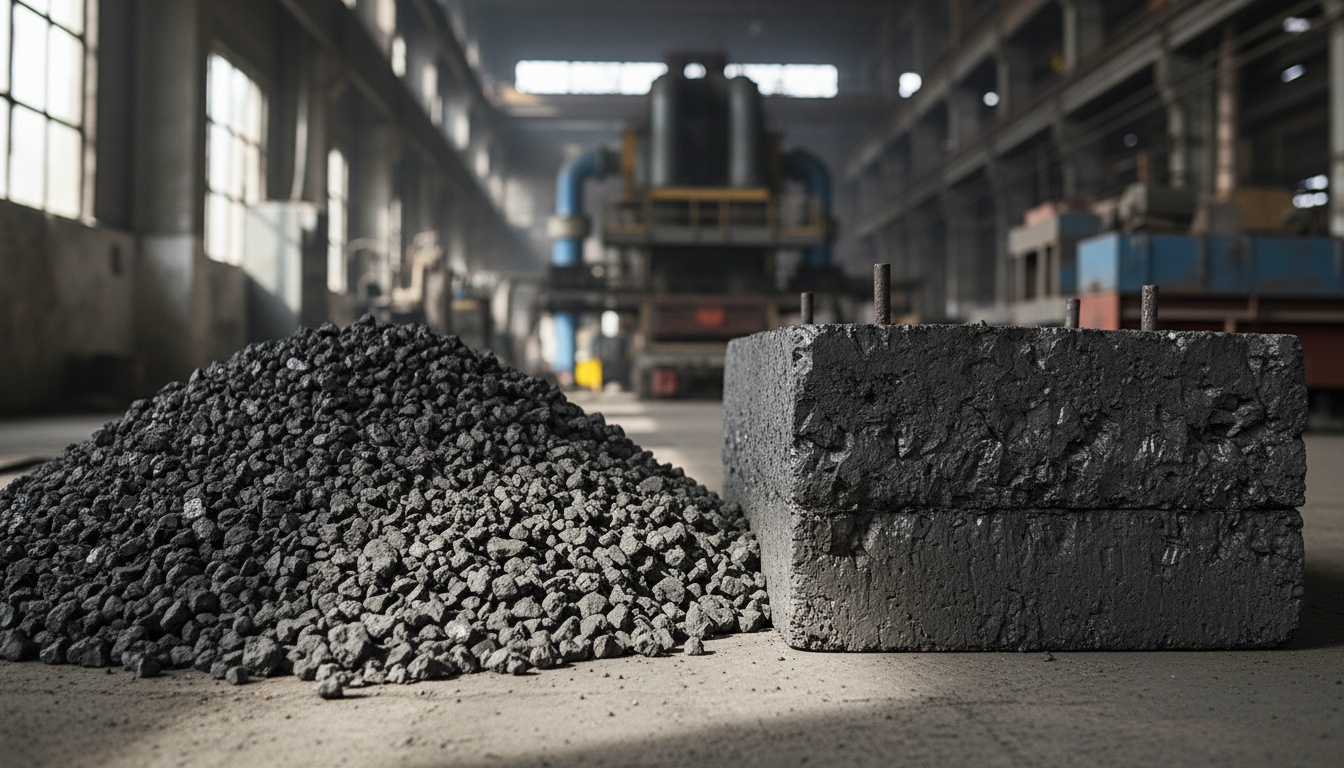
Calcined petroleum coke is green coke that has been through a rotary kiln or hearth at 1,200–1,350°C, and calcination changes what you are buying entirely. Volatiles are driven off to ≤ 0.5% VCM, moisture to ≤ 0.5%, fixed carbon rises to ≥ 98.5%, and — the number that actually matters — real density lifts to 2.04–2.08 g/cm³. Real density is the anode industry's master specification because it predicts baked-anode density, electrical resistivity and carbon consumption in the pot. Alongside it sit sulphur (1–3.5% for anode grade, ≤ 1% for premium recarburiser and TiO₂ work), ash (≤ 0.4%), and the trace metals that a smelter treats as gating: vanadium, nickel, sodium, calcium and silicon, because vanadium catalyses airburn on the anode and sodium drives carboxy reactivity. Nobody who buys CPC buys it on calorific value.
The fuel-grade versus calcined decision is not a grade choice within one market — they are two different trades. Fuel-grade green coke is a thermal fuel bought for kcal per dollar and burned. CPC is a carbon raw material bought for structure and purity: roughly 0.4 tonnes of it goes into every tonne of primary aluminium as prebaked anode, and the rest of the market is steel and foundry recarburising, titanium dioxide chloride-route reduction, carbon and graphite products and silicon carbide. That is why CPC prices at a multiple of fuel grade — you are paying for the calcination energy, the yield loss and the sulphur and metals selection of the green feed, not for heat. CBIL brokers calcined coke from US and Chinese calciners against SGS certification of real density, fixed carbon, sulphur, ash, VCM, moisture and the full trace-metals panel, in bulk Handysize and Supramax parcels on FOB and CFR terms. Send your real-density floor, sulphur ceiling and vanadium and sodium limits, and we will work supply against them rather than against a generic anode-grade sheet.
Need the ship as well? Our chartering desk prices coal and petcoke bulk freight on LaycanDesk.
Excluded origins are not offered, including product re-exported, blended or re-processed through a third country. Every lot moves with a certificate of origin naming the producing plant, mine or grower country, and nothing is quoted before the seller and loading point are known.
Indicative reference
$430–560 USD / MT
as at September 2026
Reference level only — not an offer, and reviewed quarterly. Levels shown are as at September 2026. Firm pricing is quoted per RFQ, subject to volume, terms and inspection.
Typical Specification
Specifications are indicative and adjusted to the agreed contract and destination requirements. Final spec confirmed on COA / SGS.
Available Grades
Applications
- Aluminium prebaked anodes
- Steel & foundry recarburising
- Titanium dioxide reduction
- Carbon & graphite products
- Silicon carbide manufacture
Category
Petroleum & Energy
Incoterms
FOB · CFR
Pricing basis
USD / MT
Inspection
SGS / Intertek at load port
Calcined Petroleum Coke — buyer questions
Why is calcined coke several times the price of fuel-grade?
Three reasons stack up. Calcination itself costs energy at 1,200–1,350°C; it carries a real yield loss as volatiles and moisture leave, so you start with materially more green coke than you ship; and the green feed has to be selected for sulphur and trace metals before it ever enters the kiln, which is a much narrower pool than fuel-grade material. You are buying carbon structure and purity, not heat.
What is real density and why do anode buyers lead with it?
Real density (2.04–2.08 g/cm³ typical) measures how well the carbon structure has ordered during calcination. It predicts baked-anode density, electrical resistivity and how fast the anode is consumed in the pot. Under-calcined coke shows low real density and residual volatiles; over-calcined coke desulphurises and puffs. It is the single specification that best forecasts anode performance, which is why it sits at the top of every CPC contract.
Which trace metals should I set limits on?
Vanadium, nickel, sodium, calcium and silicon. Vanadium catalyses airburn on the anode surface; sodium and calcium drive carboxy reactivity and dusting. A CPC lot that meets real density and sulphur but carries high vanadium will still cost you carbon consumption in the potline. Give us your metals panel with your enquiry — it changes which calciner's material fits.
Can I use calcined coke as a fuel if the price is right?
You can, but it makes no commercial sense. CPC has had its volatiles driven off, so it is harder to ignite and holds no advantage in a burner over green coke, while costing several times more per tonne. If you are burning it, buy fuel-grade green coke. Calcined material only pays for itself where carbon purity and density are the point.
Ready to source Calcined Pet Coke?
Send your quantity, specification, preferred Incoterms and destination port. Qualified requirements receive a workable offer against verified supply.
Have Calcined Pet Coke to sell? Submit an offer — we'll match it against live buyer demand.
More in Petroleum Coke, Graphite Electrodes & Needle Coke