
Artificial Graphite Anode Material (Synthetic Graphite Anode Powder)
Synthetic graphite anode powder graphitised from needle and petroleum coke at about 2,800 °C, bought on capacity, first-cycle efficiency and particle size, with China's export-control status stated
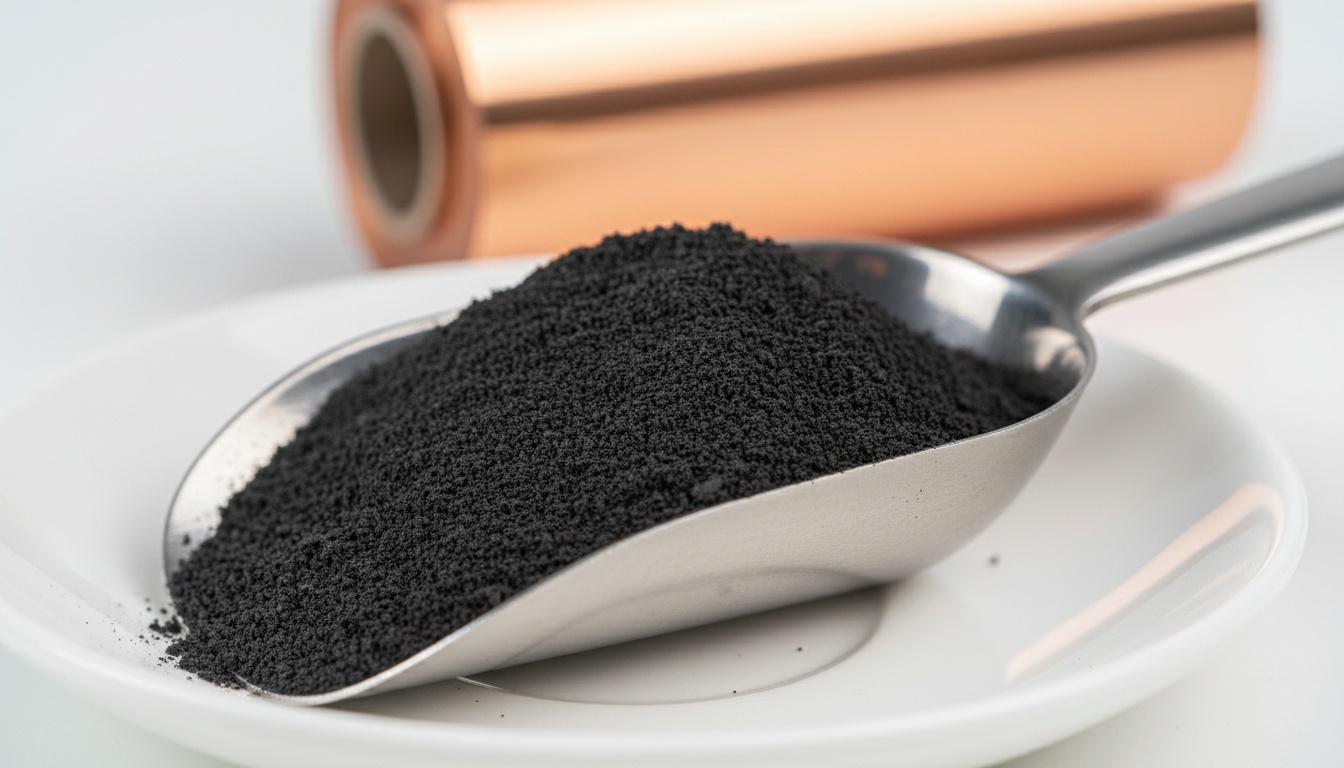
Artificial graphite anode material is the powder that most lithium-ion cell makers now coat onto copper foil, and it is made rather than mined: low-sulphur, highly aromatic feedstocks are delayed-coked into green needle coke or petroleum coke, calcined at 1,000–1,500 °C to drive off volatiles, milled and granulated, graphitised in Acheson, box or continuous furnaces at about 2,800 °C, and then surface-coated with pitch or by chemical vapour deposition. The buyer reads four numbers. Synthetic graphite at a D50 of 12–20 µm delivers 355–365 mAh/g reversible capacity with 90–93% first-cycle efficiency and over 85% capacity retention after 1,000 cycles at 1C in one published study, and a cell-maker patent specifies artificial graphite anode material at a Dv50 of 15–18 µm and 350–358 mAh/g; particle size, tap and compaction density, specific surface area, ash and moisture complete the certificate, and each cell maker qualifies a grade before contracting. Feedstock sets the tiers: needle-coke-based, coated grades sit at the top for fast-charge and long-cycle cells, petroleum-coke-based grades below them, and SMM reports artificial graphite anode prices stable through September 2026 with petroleum coke and needle coke costs holding at highs and graphitisation tolling fees steady with expectations of increases. Artificial graphite is declared under HS 3801.10.
The supply chain is Chinese. China controls about 74% of the graphite anode supply chain by one 2024 industry infographic and is projected to hold over 85% of anode market share by 2030; it produced 69% of the world's low-sulphur petroleum coke in 2023 against 11% for Japan and 10% for the USA; and less than 1% of uncoated spherical graphite is made outside China. Korea hosts anode producers outside China and Japan supplies coke and anode material to cell makers. The export rules therefore decide what a buyer can contract. Since 1 December 2023, MOFCOM has required a dual-use export licence, renewable every six months and naming the purchaser, contract and end use, for high-purity, high-strength, high-density synthetic graphite materials and for natural flake graphite and its products; on 5 December 2024, Announcement No. 46 added stricter end-user and end-use review for graphite dual-use items bound for the United States. On 9 October 2025, Announcement No. 58 added artificial graphite anode materials (item 3C901.b.1), mixed artificial-and-natural anode materials (3C902.b.2), granulation kettles of 5 m³ and above, graphitisation furnaces, fusion-coating equipment above 300 L, spray dryers above 60 m³ and CVD rotary kilns above 0.5 m diameter (3B901.c), and the granulation, continuous graphitisation and liquid-phase coating technologies (3E901.b), effective 8 November 2025. On 7 November 2025 MOFCOM and Customs suspended Announcement No. 58 until 10 November 2026, and on 9 November 2025 Announcement No. 72 suspended the 2024 US-specific end-user review until 27 November 2026; the December 2023 licence requirement itself remains in force. CBIL is a commodity brokerage company and brokers artificial graphite anode material from producer and trader allocations in China, Japan and Korea against the producer's certificate of analysis (capacity, first-cycle efficiency, D50, tap density, specific surface area, ash, moisture), the export licence and end-user certificate where the origin requires them, a certificate of origin and a safety data sheet. US buyers also check the UFLPA entity list, which added Xinjiang carbon and anode-material producers in July 2026. Anode powder moves in 25 kg bags or lined 500 kg to 1 MT big bags in 20-foot containers on FOB, CFR and CIF terms; minimum lots are confirmed per grade and pack. Send the capacity and efficiency you are qualified to, D50 and coating requirement, monthly tonnage and discharge port, and the enquiry is screened and worked against it.
Excluded origins are not offered, including product re-exported, blended or re-processed through a third country. Every lot moves with a certificate of origin naming the producing plant, mine or grower country, and nothing is quoted before the seller and loading point are known.
Indicative reference
Per MT, on grade and qualification USD / MT
as at September 2026
Reference level only — not an offer, and reviewed quarterly. Levels shown are as at September 2026. Firm pricing is quoted per RFQ, subject to volume, terms and inspection.
Typical Specification
Specifications are indicative and adjusted to the agreed contract and destination requirements. Final spec confirmed on COA / SGS.
Available Grades
Applications
- Lithium-ion cell anodes for EVs and energy storage
- Fast-charge and long-cycle cell designs (coated needle-coke grades)
- Consumer-electronics cells
- Blended artificial-natural graphite anodes
Category
Metals & Recycled Scrap
Incoterms
FOB · CFR · CIF
Pricing basis
USD / MT
Inspection
SGS / Intertek at load port
Artificial Graphite Anode Material (Synthetic Graphite Anode Powder) — buyer questions
What is the difference between artificial and natural graphite anode material?
Artificial graphite is made from needle or petroleum coke that is calcined, granulated, graphitised at about 2,800 °C and coated; natural anode material is flake graphite milled into spheres, purified to 99.95% carbon and coated. Artificial grades give better cycle life and fast-charge behaviour and now take most of the market; natural spherical graphite is cheaper per tonne and is often blended in. Both are lithium-ion anode powders bought on capacity, first-cycle efficiency and particle size.
Does Chinese artificial graphite anode material need an export licence?
Yes, under the dual-use regime in force since 1 December 2023 for high-purity, high-strength, high-density synthetic graphite, which requires a MOFCOM licence renewable every six months and naming the buyer, contract and end use. The specific October 2025 controls on artificial graphite anode materials and their production equipment (Announcement No. 58) were suspended on 7 November 2025 until 10 November 2026, and the stricter review for US-bound graphite (Announcement No. 46 of December 2024) was suspended on 9 November 2025 until 27 November 2026. A contract for Chinese material carries the licence and end-user certificate as conditions.
What does a cell maker qualify on anode powder?
Reversible capacity, first-cycle efficiency, particle size distribution (D10, D50, D90), tap and compaction density, specific surface area, ash, moisture and magnetic impurities, then slurry behaviour and cycle life in coin and pouch cells. Published values for synthetic graphite are 350 to 365 mAh/g at a D50 of 12 to 20 µm with 90 to 93% first-cycle efficiency. Qualification takes months, so a producer's grade is bought once approved, not switched lot to lot.
Why does China dominate synthetic graphite anode supply?
Because it holds the feedstock and the energy-intensive middle steps. China produced 69% of the world's low-sulphur petroleum coke in 2023, hosts many graphitisation facilities in Inner Mongolia, and by one 2024 industry infographic controls about 74% of the graphite anode supply chain, projected to exceed 85% of anode market share by 2030. Korea hosts anode producers outside China, and Japan is the second coke producer at 11%.
Ready to source Synthetic Graphite Anode?
Send your quantity, specification, preferred Incoterms and destination port. Qualified requirements receive a workable offer against verified supply.
Have Synthetic Graphite Anode to sell? Submit an offer — we'll match it against live buyer demand.
More in Battery Minerals: Lithium, Cobalt, Graphite & Nickel Intermediates
Spodumene Concentrate (SC6, 6% Li₂O Lithium Concentrate)
SC6 lithium concentrate at 6% Li₂O, bought on lithium oxide, iron and moisture and shipped in bulk
Lithium Carbonate & Lithium Hydroxide Monohydrate (Battery & Technical Grade)
Battery-grade Li₂CO₃ at 99.5% and LiOH·H₂O at 56.5% LiOH, plus technical grades, in bags by container
Cobalt Hydroxide & Cobalt Sulphate (Battery Cobalt Intermediates)
Cobalt hydroxide intermediate and cobalt sulphate, bought on cobalt content and a responsible-sourcing file
Natural Flake Graphite (+80 / +100 / -100 Mesh) & Spherical Graphite
Natural flake graphite by mesh size and carbon content, and spherical graphite for battery anodes
Nickel Pig Iron (NPI) & Ferronickel (8–15% Ni NPI, 20–40% Ni FeNi)
High-grade NPI at 8–15% Ni and ferronickel at 20–40% Ni, bought per nickel unit or against LME nickel for stainless steel melting
Mixed Hydroxide Precipitate (MHP, Nickel-Cobalt Hydroxide Intermediate)
HPAL nickel-cobalt hydroxide intermediate, paid as a percentage of the LME nickel price with cobalt paid separately
Nickel Matte (RKEF Converter Matte & Sulphide Smelter Matte)
Nickel sulphide matte from Indonesian RKEF converters and sulphide smelters, sold on contained nickel, cobalt and copper to refiners
Rare Earth Permanent Magnet Feedstocks (NdPr Metal & Oxide, Dy, Tb)
Neodymium-Praseodymium (NdPr) metal and oxide, dysprosium and terbium for EV traction motors, wind turbines and defense systems
Electrolytic Manganese Dioxide (EMD) & Electrolytic Manganese Metal Flakes
Alkaline-battery and lithium-manganese-oxide grade EMD (HS 2820.10), and 99.7% electrolytic manganese metal flakes (HS 8111.00), in bags by container
Battery-Grade Nickel Sulphate (NiSO₄·6H₂O) & Manganese Sulphate (MnSO₄·H₂O)
Nickel sulphate hexahydrate at 22% Ni min and manganese sulphate monohydrate at 32% Mn min, to precursor-cathode impurity limits, priced against Fastmarkets and Platts