
Rare Earth Permanent Magnet Feedstocks (NdPr Metal & Oxide, Dy, Tb)
Neodymium-Praseodymium (NdPr) metal and oxide, dysprosium and terbium for EV traction motors, wind turbines and defense systems
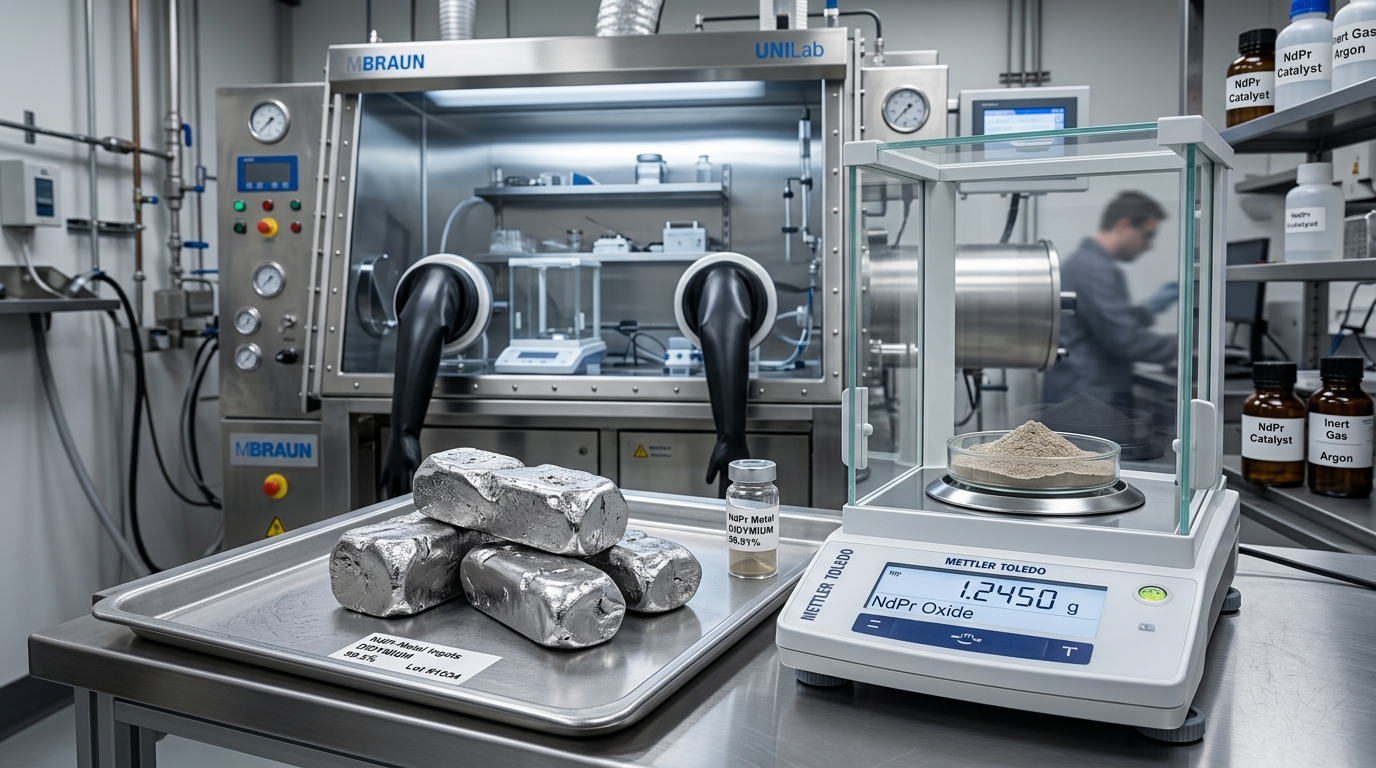
Rare earth permanent magnet feedstocks under HS 2805.30 (rare-earth metals) and HS 2846.90 (rare-earth compounds/oxides) are the strategic bottleneck for clean energy transition motors and advanced defense systems. Sintered NdFeB permanent magnets require high-purity Neodymium-Praseodymium (NdPr oxide at 99.0% to 99.5% purity with TREO ≥ 99.0%, or Didymium metal alloy at 75:25 Nd:Pr ratio), combined with heavy rare earths Dysprosium (Dy₂O₃ ≥ 99.5%) and Terbium (Tb₄O₇ ≥ 99.99%) to maintain magnetic coercivity and resist demagnetization at high operating temperatures in electric vehicle traction motors and direct-drive offshore wind turbine generators. Non-rare-earth impurities—specifically iron (Fe ≤ 0.01%), silicon (Si ≤ 0.02%), calcium (Ca ≤ 0.02%), and moisture—are strictly capped to avoid pinhole oxidation and grain boundary corrosion during vacuum induction melting (VIM) and jet milling.
Geopolitically, the rare earth permanent magnet supply chain is undergoing structural decoupling driven by China MOFCOM export restrictions on separation technologies and heavy rare earths, alongside statutory Western defense mandates. Under US DFARS 225.7018, the US Department of Defense prohibits the procurement of defense hardware (including F-35 fighter aircraft actuators, Virginia-class submarine propulsion, and precision missile guidance systems) containing permanent magnets sourced from the countries named in the rule. In parallel, the EU Critical Raw Materials Act (CRMA) mandates that by 2030 at least 40% of strategic raw materials consumed in Europe be processed within the Union and not more than 65% originate from a single third country. Non-Chinese supply corridors are anchored by Lynas Rare Earths (mining carbonatite ore at Mt Weld, Western Australia, and refining at the Lynas Advanced Materials Plant / LAMP in Gebeng, Kuantan, Malaysia via the Port of Kuantan), MP Materials (Mountain Pass, California, shipping bastnäsite concentrate and separated oxides via the Port of Long Beach), and emerging heavy rare earth separation at Iluka's Eneabba refinery. CBIL is a commodity brokerage company and brokers separated NdPr oxide, didymium metal ingots, dysprosium oxide, and terbium oxide from certified non-Chinese and compliant merchant separation platforms to permanent magnet manufacturers (in Japan, Germany, and the US) and Tier-1 automotive and aerospace primes. Cargoes move in 50 kg or 200 kg airtight steel drums fitted with argon- or nitrogen-purged double polyethylene liners in 20-ft ocean containers (15 to 20 MT/box) on FOB, CFR, and CIF terms, backed by ICP-MS trace-element assays, chain-of-custody provenance certificates, and non-military EUC clearance where applicable. Send your required oxide or metal grade, heavy REE doping ratios, and discharge port to match against available uncommitted lots.
Excluded origins are not offered, including product re-exported, blended or re-processed through a third country. Every lot moves with a certificate of origin naming the producing plant, mine or grower country, and nothing is quoted before the seller and loading point are known.
Indicative reference
NdPr Oxide $65–95/kg; Metal $80–120/kg USD / kg
as at September 2026
Reference level only — not an offer, and reviewed quarterly. Levels shown are as at September 2026. Firm pricing is quoted per RFQ, subject to volume, terms and inspection.
Typical Specification
Specifications are indicative and adjusted to the agreed contract and destination requirements. Final spec confirmed on COA / SGS.
Available Grades
Applications
- Sintered NdFeB permanent magnets for EV traction motors
- Direct-drive offshore wind turbine permanent magnet generators
- Defense actuators, precision-guided munitions and radar systems
- Consumer electronics acoustic transducers and miniature voice coil motors
- Specialty optical glass, laser crystals and capacitor dielectrics
Category
Metals & Recycled Scrap
Incoterms
FOB · CFR · CIF
Pricing basis
USD / kg
Inspection
SGS / Intertek at load port
Rare Earth Permanent Magnet Feedstocks (NdPr Metal & Oxide, Dy, Tb) — buyer questions
What is didymium metal and why is it preferred over pure neodymium?
Didymium metal is the natural alloy of Neodymium and Praseodymium (typically 75% Nd and 25% Pr). Because neodymium and praseodymium have nearly identical chemical properties and magnetic performance in sintered NdFeB magnets, leaving them unseparated eliminates a costly separation stage and provides the optimal, cost-effective feedstock for EV traction motor magnets.
Why are Dysprosium and Terbium required in EV motor magnets?
Pure NdFeB magnets rapidly lose their magnetic strength and suffer permanent demagnetization at temperatures above 80°C. Adding small percentages (2% to 6%) of heavy rare earths Dysprosium (Dy) or Terbium (Tb) drastically boosts high-temperature magnetic coercivity, allowing EV traction motors to operate continuously at 150°C to 200°C under severe driving loads.
What compliance standards govern Western defense rare earth sourcing?
Under US DFARS 225.7018, defense contractors are legally barred from delivering weapon systems containing rare earth permanent magnets originating from the countries listed in the rule. Every parcel must be backed by a certified chain of custody tracing the material back to non-prohibited extraction and separation assets such as Lynas (Australia/Malaysia) or MP Materials (USA).
How are rare earth metals packaged to prevent oxidation?
Neodymium-Praseodymium metal is highly reactive and oxidizes rapidly upon contact with ambient atmospheric oxygen and humidity. It is packaged under vacuum in airtight heavy-gauge steel drums backfilled with high-purity argon or nitrogen gas and sealed with food-grade silicone gaskets inside 20-ft ocean containers.
Ready to source Rare Earths (NdPr)?
Send your quantity, specification, preferred Incoterms and destination port. Qualified requirements receive a workable offer against verified supply.
Have Rare Earths (NdPr) to sell? Submit an offer — we'll match it against live buyer demand.
More in Battery Minerals: Lithium, Cobalt, Graphite & Nickel Intermediates
Spodumene Concentrate (SC6, 6% Li₂O Lithium Concentrate)
SC6 lithium concentrate at 6% Li₂O, bought on lithium oxide, iron and moisture and shipped in bulk
Lithium Carbonate & Lithium Hydroxide Monohydrate (Battery & Technical Grade)
Battery-grade Li₂CO₃ at 99.5% and LiOH·H₂O at 56.5% LiOH, plus technical grades, in bags by container
Cobalt Hydroxide & Cobalt Sulphate (Battery Cobalt Intermediates)
Cobalt hydroxide intermediate and cobalt sulphate, bought on cobalt content and a responsible-sourcing file
Natural Flake Graphite (+80 / +100 / -100 Mesh) & Spherical Graphite
Natural flake graphite by mesh size and carbon content, and spherical graphite for battery anodes
Nickel Pig Iron (NPI) & Ferronickel (8–15% Ni NPI, 20–40% Ni FeNi)
High-grade NPI at 8–15% Ni and ferronickel at 20–40% Ni, bought per nickel unit or against LME nickel for stainless steel melting
Mixed Hydroxide Precipitate (MHP, Nickel-Cobalt Hydroxide Intermediate)
HPAL nickel-cobalt hydroxide intermediate, paid as a percentage of the LME nickel price with cobalt paid separately
Nickel Matte (RKEF Converter Matte & Sulphide Smelter Matte)
Nickel sulphide matte from Indonesian RKEF converters and sulphide smelters, sold on contained nickel, cobalt and copper to refiners
Electrolytic Manganese Dioxide (EMD) & Electrolytic Manganese Metal Flakes
Alkaline-battery and lithium-manganese-oxide grade EMD (HS 2820.10), and 99.7% electrolytic manganese metal flakes (HS 8111.00), in bags by container
Battery-Grade Nickel Sulphate (NiSO₄·6H₂O) & Manganese Sulphate (MnSO₄·H₂O)
Nickel sulphate hexahydrate at 22% Ni min and manganese sulphate monohydrate at 32% Mn min, to precursor-cathode impurity limits, priced against Fastmarkets and Platts
Artificial Graphite Anode Material (Synthetic Graphite Anode Powder)
Synthetic graphite anode powder graphitised from needle and petroleum coke at about 2,800 °C, bought on capacity, first-cycle efficiency and particle size, with China's export-control status stated