
Distillers Corn Oil (DCO / Technical Corn Oil)
Low-CI technical corn oil from ethanol dry mills for HVO, SAF, biodiesel and poultry feed formulations
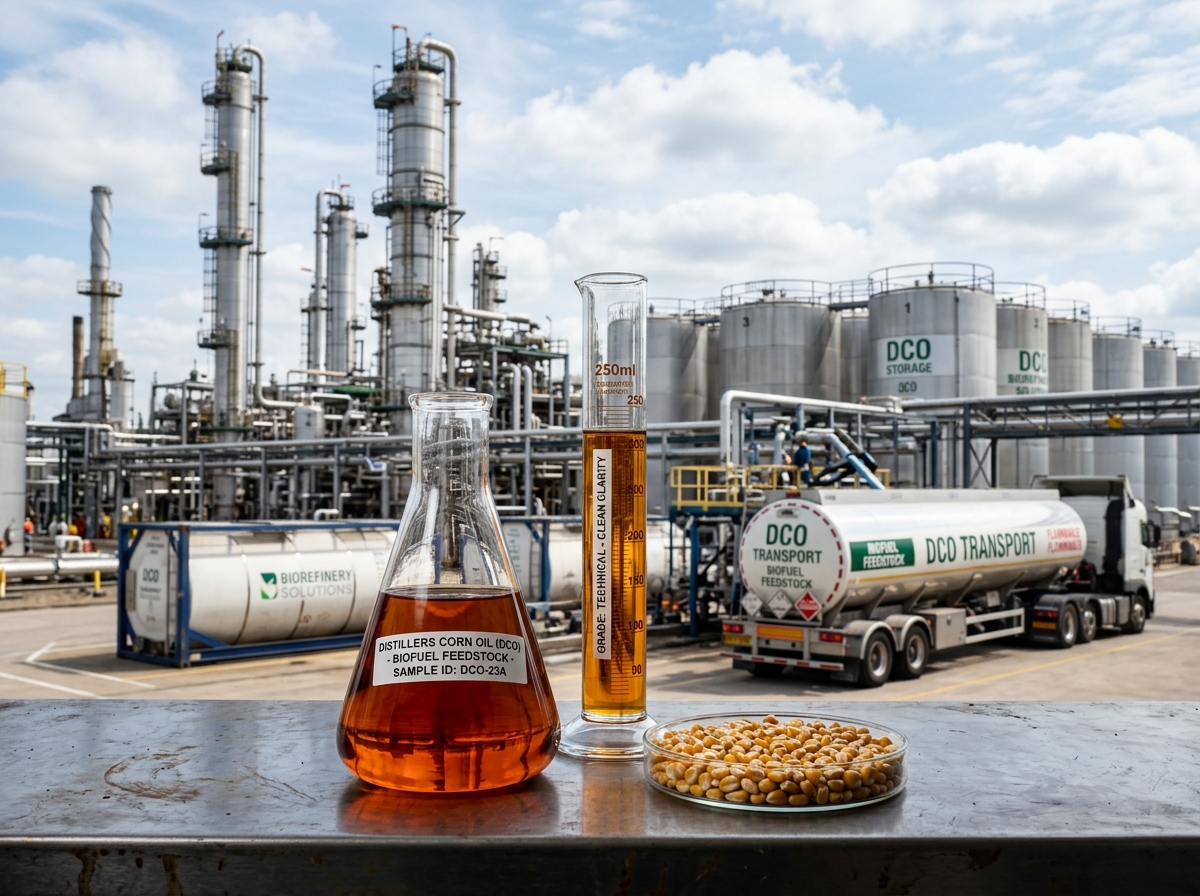
Distillers corn oil (DCO), also marketed as technical corn oil (TCO) or inedible corn oil, is extracted as a secondary coproduct in the dry-mill ethanol manufacturing process. In modern dry-mill ethanol facilities, ground yellow corn is fermented to produce fuel ethanol and whole stillage; after centrifugation removes coarse distillers grains, the resulting thin stillage is processed through high-speed disc-stack centrifuges to separate crude corn oil prior to final syrup evaporation. Because the oil has passed through industrial thermal distillation and fermentation, it is categorised as a non-food, technical lipid feedstock, distinguished by its amber-reddish tint, elevated free fatty acid content, and distinctively low carbon intensity (CI) score.
In global biofuel refining, DCO is one of the most sought-after second-generation feedstocks for Hydrotreated Vegetable Oil (HVO renewable diesel) and Sustainable Aviation Fuel (SAF / HEFA-SPK). Under the European Union's Renewable Energy Directive (RED II / RED III) and national decarbonisation schemes (such as the US Renewable Fuel Standard, California LCFS, and UK RTFO), distillers corn oil qualifies as an advanced, non-food agro-industrial coproduct. Its carbon intensity (typically 20–35 g CO2e/MJ) yields dramatic lifecycle greenhouse gas savings compared to virgin vegetable oils (such as palm or soy), generating premium regulatory credit values (RINs, LCFS credits, and GHG abatement premiums) without triggering indirect land-use change (ILUC) penalties.
Trading contracts standardise on three critical analytical parameters: 1. Free Fatty Acids (FFA): Quoted as % oleic acid. Low-FFA cuts (5–12% or 10–15% FFA) are sought by conventional FAME biodiesel producers using acid esterification or enzymatic routes; standard and high-FFA cuts (15–25% FFA) are favoured by hydroprocessing units (HVO/SAF refineries), where free fatty acids and triglycerides undergo catalytic deoxygenation directly into paraffinic straight-chain hydrocarbons. 2. Moisture, Insoluble Impurities and Unsaponifiables (MIU): Standard commercial delivery contracts guarantee total MIU ≤ 2.0% maximum (typically Moisture ≤ 1.0%, Insoluble impurities ≤ 0.1%, Unsaponifiables ≤ 1.0%). Elevated moisture causes hydrolytic splitting and increases transport weight; sediment fouling must be strictly excluded before receipt at refinery pre-treatment units (PTUs). 3. Trace Contaminants & Catalyst Poisons: Refineries screen phosphorus (P, typically 20–100 ppm) and trace metals (sodium, potassium, calcium, magnesium ≤ 10–30 ppm total), which are removed in the refiner's acid-degumming and bleaching pretreatment earth stage.
Beyond renewable fuels, DCO serves as a high-density energy and linoleic acid supplement in animal nutrition, particularly in poultry broiler rations and swine feeding, where its natural xanthophyll pigments enhance yolk colour. UN Comtrade trade flows place technical and industrial corn oil under HS 1515.29 / 1515.21 / 2303.30, with major production and export originating from the US Midwest ethanol belt (Illinois, Iowa, Nebraska, Minnesota), Brazilian corn ethanol clusters in Mato Grosso and Goiás, and European ethanol mills in Germany, France and Hungary.
CBIL is a commodity brokerage company and brokers distillers corn oil on FOB, CFR and CIF terms directly between dry-mill ethanol producers, primary blenders, and HVO/SAF refiners. Ocean transport is arranged in bulk liquid parcel tankers (3,000 to 10,000 MT chemical tankers from US Gulf or Brazilian terminals), dedicated ISO tank containers (21–24 MT net), or 24,000-litre multi-layer flexitanks in standard 20-ft dry containers (~21.5 MT net). Through CBIL's specialized chartering desk (LaycanDesk), vessel chartering and freight legs are quoted concurrently. Every shipment carries an independent inspection report (SGS, Intertek, or Camin Cargo) verifying FFA, MIU, IV, flash point, and metals, alongside a valid ISCC EU or ISCC PLUS Proof of Sustainability (PoS) detailing certified GHG savings, feedstock origin, and supply-chain traceability. Send your required FFA band, monthly tonnage, delivery mode and destination port, and the enquiry is screened and worked against it.
Excluded origins are not offered, including product re-exported, blended or re-processed through a third country. Every lot moves with a certificate of origin naming the producing plant, mine or grower country, and nothing is quoted before the seller and loading point are known.
Indicative reference
Per MT, on FFA band, MIU and ISCC certification USD / MT
as at September 2026
Reference level only — not an offer, and reviewed quarterly. Levels shown are as at September 2026. Firm pricing is quoted per RFQ, subject to volume, terms and inspection.
Typical Specification
Specifications are indicative and adjusted to the agreed contract and destination requirements. Final spec confirmed on COA / SGS.
Available Grades
Applications
- HVO renewable diesel and SAF (HEFA-SPK) refining feedstock
- FAME biodiesel manufacturing (via acid esterification or enzymatics)
- High-energy lipid nutrition in poultry and swine feed rations
- Oleochemical fatty acid distillation and technical lubricants
Category
Petroleum & Energy
Incoterms
FOB · CFR · CIF
Pricing basis
USD / MT
Inspection
SGS / Intertek at load port
Distillers Corn Oil (DCO / Technical Corn Oil) — buyer questions
How is Distillers Corn Oil (DCO) produced and why is it considered a low-CI feedstock?
DCO is extracted from whole corn at dry-mill ethanol plants. After starch is converted to ethanol, the remaining whole stillage is centrifuged to yield wet distillers grains and thin stillage. Heavy-duty disc-stack centrifuges extract the oil from this thin stillage before it is concentrated into syrup. Because the primary grain energy is allocated to fuel ethanol and animal feed (DDGS), the extracted oil carries an ultra-low secondary lifecycle carbon intensity (CI), making it exceptionally valuable for HVO and SAF refiners targeting high greenhouse gas abatement percentages under RED II/III and LCFS.
What is the difference between Low-FFA and High-FFA DCO?
Free Fatty Acid (FFA) content reflects the residence time and heat conditions in the ethanol processing stream. Low-FFA DCO (5–12% FFA) requires less caustic stripping or pre-esterification, making it suitable for conventional FAME biodiesel producers. High-FFA DCO (15–25% FFA) is ideally matched to hydrotreatment (HVO/SAF) units, where fatty acids are catalytically converted directly into paraffinic alkanes without esterification losses, typically trading at an attractive price differential.
Can DCO be used in animal feed as well as biofuel?
Yes. In animal nutrition, DCO is highly regarded as a concentrated energy ingredient in commercial poultry (broiler and layer) and swine diets. It contains high levels of linoleic acid (polyunsaturated fatty acids) and natural xanthophylls that enhance egg yolk pigmentation, provided antioxidant stability (BHT or ethoxyquin) and feed safety parameters (aflatoxin and heavy metal limits) meet local agricultural feed standards.
What logistics and shipping methods are used for bulk DCO trades?
DCO moves internationally across three modal sizes: full chemical tanker parcels (3,000 to 10,000 MT) loading at deepwater river and coastal bulk liquid terminals (such as US Gulf / Mississippi River or Santos, Brazil); dedicated ISO tank containers (21–24 MT) for precise multi-destination deliveries; and 24,000-litre food/technical grade flexitanks loaded into 20-ft dry containers (approx. 21.5 MT net) for containerised container lines.
Ready to source Distillers Corn Oil (DCO)?
Send your quantity, specification, preferred Incoterms and destination port. Qualified requirements receive a workable offer against verified supply.
Have Distillers Corn Oil (DCO) to sell? Submit an offer — we'll match it against live buyer demand.
More in Biofuels: Ethanol, Biodiesel & Feedstocks
Fuel Ethanol (Anhydrous, Denatured & Undenatured)
Anhydrous fuel-grade ethanol bought on water, ethanol content and denaturant
Extra Neutral Alcohol & Industrial Ethanol (ENA, Rectified Spirit)
Pharmaceutical, sanitiser and solvent-grade ethyl alcohol to USP and BP monographs
Biodiesel (FAME: RME, SME, PME, UCOME)
FAME to EN 14214 and ASTM D6751, bought on feedstock, CFPP and certification
Used Cooking Oil (UCO)
ISCC-EU certified UCO bought on FFA, MIU, chlorides and verifiable chain of custody
Palm Oil Mill Effluent Oil (POME Oil) & Advanced Waste Lipids
ISCC-EU certified Annex IX Part A advanced feedstocks for HVO & ReFuelEU SAF with verified methane capture
HVO Renewable Diesel & Sustainable Aviation Fuel (SAF)
Paraffinic diesel to EN 15940 and HEFA-SPK to ASTM D7566 for blenders and airlines' fuel suppliers