
Industrial Wood Pellets
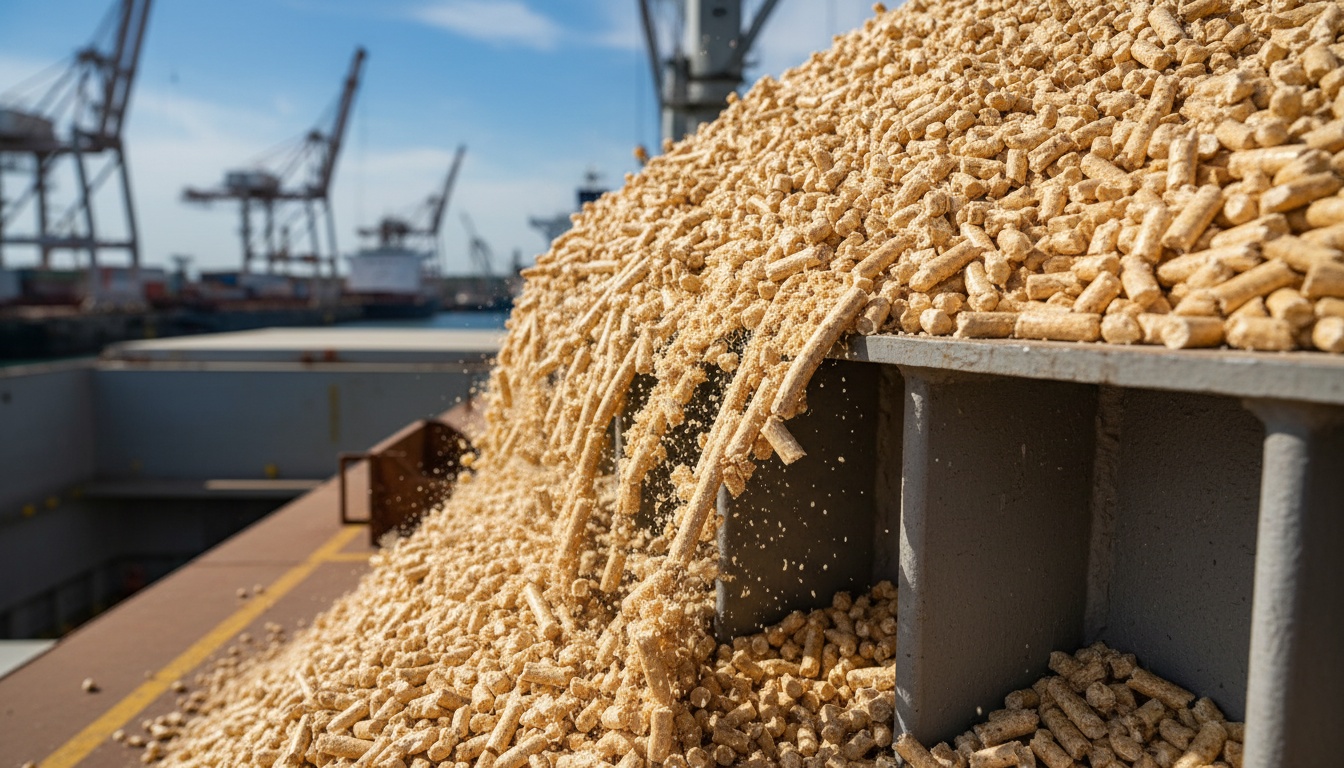
Bulk industrial pellets for co-firing and biomass power
Industrial wood pellets are compressed sawmill and plantation residues, 6–8 mm in diameter, made to burn in utility boilers that were designed for coal. They are the biggest seaborne biomass trade in Asia: Japan imported 8.6 million MT under HS 4401.31 in 2025, two-thirds from Vietnam and the rest mainly from Canada, the USA, Malaysia and Indonesia, at landed values of roughly USD 177–236 per MT, and Korea took a further 3.9 million MT, led by Vietnam and Indonesia at around USD 135–141 per MT (UN Comtrade). Buyers contract on net calorific value as received (4,100–4,400 kcal/kg), total moisture (under 10%), ash (industrial grades allow up to 3%, premium under 1.5%), mechanical durability (97.5% or better, because fines are lost as dust and clog handling) and chloride and sulphur, and they audit the sustainability chain as closely as the analysis certificate.
The two grades that matter are ENplus-style premium pellets for smaller boilers and industrial pellets for utilities, and they are priced apart. Vietnamese and Indonesian pellets from acacia and rubberwood residues sell on cost per gigacalorie and short freight to North Asia; North American pellets carry a longer haul but a deeper certification record. CBIL brokers industrial pellets from certified mills and exporters against independent analysis and draft survey at load, in 10,000–50,000 MT parcels on FOB, CFR and CIF terms, and prices the freight leg through our own chartering desk so the delivered cost per gigacalorie is a single number rather than two guesses.
Need the ship as well? Our chartering desk prices PKS and wood pellet bulk freight on LaycanDesk.
Indicative reference
$135–235 USD / MT
as at September 2026
Reference level only — not an offer, and reviewed quarterly. Levels shown are as at September 2026. Firm pricing is quoted per RFQ, subject to volume, terms and inspection.
Typical Specification
Specifications are indicative and adjusted to the agreed contract and destination requirements. Final spec confirmed on COA / SGS.
Available Grades
Applications
- Utility co-firing with coal
- Dedicated biomass power plants
- District heating & industrial boilers
- Pellet-fired kilns and dryers
Category
Petroleum & Energy
Incoterms
FOB · CFR · CIF
Pricing basis
USD / MT
Inspection
SGS / Intertek at load port
Industrial Wood Pellets — buyer questions
What is the difference between industrial and ENplus pellets?
Industrial pellets are made for utility boilers and allow higher ash (up to 3%) and looser size tolerances; ENplus A1 and A2 are premium grades for smaller boilers with ash under 0.7–1.2%. Utilities buy industrial grade on cost per gigacalorie. Specifying ENplus for a co-firing plant pays for quality the boiler cannot use.
Why is mechanical durability in every contract?
Because pellets that break up in handling become fines, and fines are lost as dust, block conveyors and raise the explosion risk in storage. Durability of 97.5% or better is the normal floor, and a cargo that arrives with excess fines is discounted or rejected regardless of its calorific value.
Which origins serve Japan and Korea?
Vietnam is the largest by far, followed by Canada, the USA, Malaysia and Indonesia for Japan, and Vietnam, Indonesia, Canada and Malaysia for Korea. Origins that fall under sanctions or export restrictions are excluded from our book without discussion.
What parcel sizes do you work?
10,000–50,000 MT in Handysize and Supramax tonnage for utility programmes; trial lots in jumbo bags or containers where a lane already exists. Because pellets absorb moisture, holds are inspected and the cargo is covered on loading; we quote the freight leg with the cargo.
Ready to source Wood Pellets?
Send your quantity, specification, preferred Incoterms and destination port. We'll verify supply and respond with a workable offer — usually within one business day.
Have Wood Pellets to sell? Submit an offer — we'll match it against live buyer demand.
More in Biomass Fuels