
Polyester Staple Fibre (Virgin PSF 1.4D x 38 mm)
Virgin semi-dull and full-dull PSF for ring and open-end spinning, bought on denier, cut length and tenacity
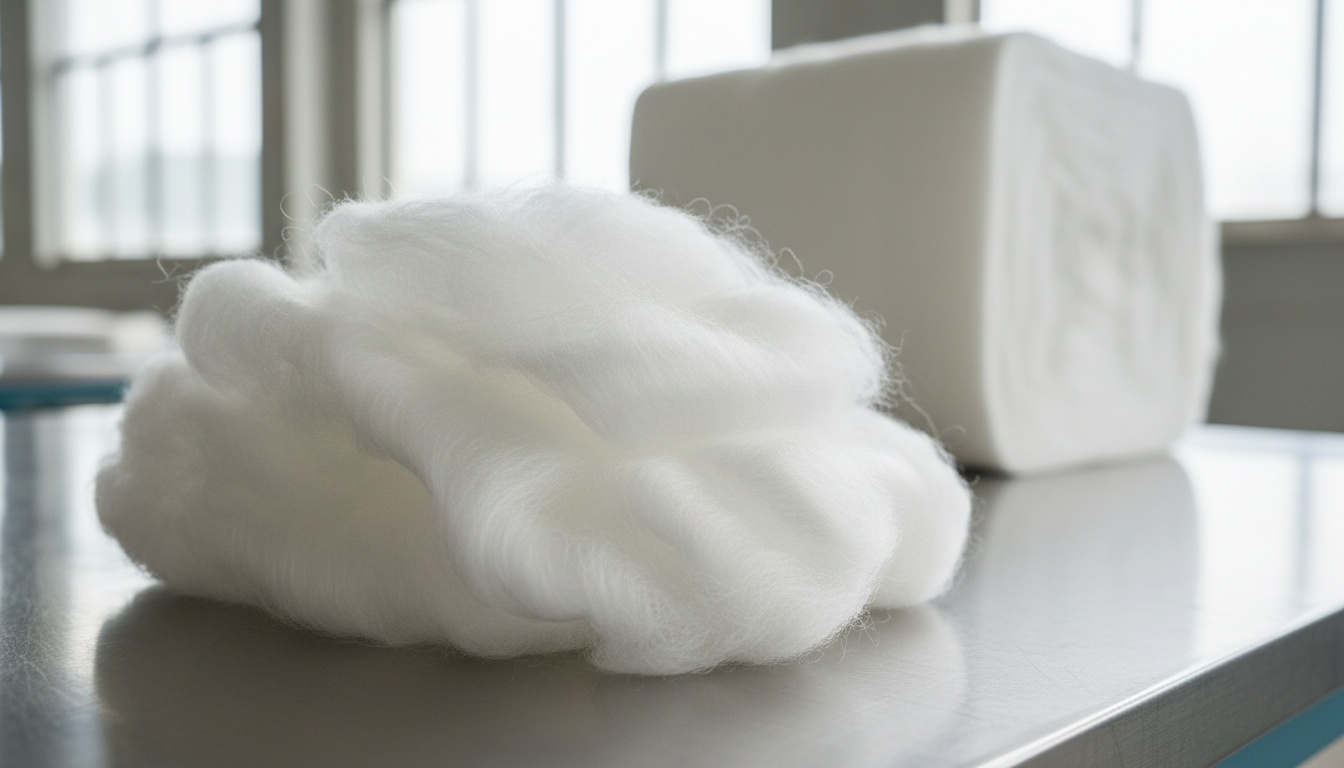
Polyester staple fibre is melt-spun from PTA and MEG, drawn, crimped, heat-set and cut, and a spinning mill buys it on the same two numbers as any staple: denier (grams per 9,000 m of one filament) and cut length. The spinning workhorse is 1.4 denier at 38 mm, which runs on cotton-system ring and open-end frames blended with cotton (polyester-cotton and CVC 70/30 yarns) or viscose, or spun 100% polyester for sewing thread, knits and workwear; 1.2 and 1.0 denier give finer counts and softer handle, and 32, 44 and 51 mm cuts follow the blend partner's staple. Lustre is semi-dull (the default), full-dull for a cotton look and bright for a few knit yarns; colour is raw white, optical white or dope-dyed black. A virgin producer's sheet for 1.2 denier x 38 mm (Zimmer standard test) reads tenacity 6.6 ± 0.2 g/denier, elongation 23 ± 3%, crimp 10 ± 2 per cm and dry heat shrinkage 3 ± 2%, and the mill adds limits on oil pick-up, over-length fibres and merge consistency. Virgin fibre spins with fewer breaks and steadier dye uptake than recycled fibre; where the buyer wants bottle-based fibre for fill or lower-count yarns, see our recycled polyester staple fibre page (/commodities/recycled-plastics/recycled-polyester-staple-fibre-rpsf). The heading is HS 5503.20, polyester staple fibres not carded or combed, which does not itself separate virgin from recycled. UN Comtrade 2024 export declarations under HS 5503.20 total USD 3.92 billion and about 3.5 million MT across 84 reporters, virgin and recycled together: China USD 1.32 billion and 1.32 million MT, the Republic of Korea USD 668 million and 560,000 MT, Thailand USD 426 million and 405,000 MT, India USD 274 million and 259,000 MT, Indonesia USD 218 million, Türkiye USD 163 million and 138,000 MT and Malaysia USD 131 million. Those are declared export values, not offers.
Trade rules differ by market. Türkiye keeps anti-dumping duties on polyester staple fibre from China (USD 0.21 per kg, confirmed in August 2024) and on fibre from Indonesia and South Korea after a sunset review, so Turkish mills price Chinese fibre with the duty. India withdrew its BIS Quality Control Order on polyester staple fibre (IS 17263) on 12 November 2025, so BIS certification is no longer a customs condition for imports into India, though buyers still specify to the standard. CBIL is a commodity brokerage company and brokers virgin PSF from producers in China, India, Indonesia, Türkiye, Pakistan, Korea and Thailand against the producer's test report per merge (denier, cut length, tenacity, elongation, crimp, shrinkage, oil pick-up), packing list with bale numbers, and a certificate of origin, in compressed, strapped bales in 40-ft containers, on FOB, CFR and CIF terms. Price is per MT on denier, cut and lustre; minimum orders are confirmed per product and pack. Send the denier, cut length, lustre, colour, tonnage and discharge port.
Excluded origins are not offered, including product re-exported, blended or re-processed through a third country. Every lot moves with a certificate of origin naming the producing plant, mine or grower country, and nothing is quoted before the seller and loading point are known.
Indicative reference
Per MT, on denier, cut and lustre USD / MT
as at September 2026
Reference level only — not an offer, and reviewed quarterly. Levels shown are as at September 2026. Firm pricing is quoted per RFQ, subject to volume, terms and inspection.
Typical Specification
Specifications are indicative and adjusted to the agreed contract and destination requirements. Final spec confirmed on COA / SGS.
Available Grades
Applications
- Polyester-cotton and CVC spun yarns
- Polyester-viscose suiting yarns
- 100% polyester spun yarn and sewing thread
- Knitwear, workwear and home-textile yarns
Category
Agri-Foods, Spices & Nuts
Incoterms
FOB · CFR · CIF
Pricing basis
USD / MT
Inspection
SGS / Intertek at load port
Polyester Staple Fibre (Virgin PSF 1.4D x 38 mm) — buyer questions
Why is 1.4D x 38 mm the standard spinning fibre?
Because it matches medium-staple cotton on the cotton spinning system: 38 mm sits with the cotton staple in a polyester-cotton blend, and 1.4 denier gives the strength-to-count balance most ring and open-end mills want. Finer 1.2 and 1.0 denier fibre spins finer counts; 44 and 51 mm cuts pair with viscose and longer staples.
What is the difference between virgin PSF and recycled PSF?
Virgin fibre is spun from PTA and MEG and gives steadier tenacity, dye uptake and fewer breaks in fine spinning; recycled fibre is spun from PET bottle flake and serves fill, nonwovens and lower-count yarns at a lower cost. Both are HS 5503.20; the recycled claim is proven by a GRS or RCS transaction certificate. See our recycled PSF page for that trade.
Are there duties or certification rules on PSF?
Türkiye keeps anti-dumping duties on polyester staple fibre from China (USD 0.21 per kg, confirmed August 2024) and on Indonesian and Korean fibre. India withdrew its BIS Quality Control Order on PSF (IS 17263) on 12 November 2025. Other markets are checked against their own tariff schedule before an offer.
Who exports polyester staple fibre?
UN Comtrade 2024 export declarations under HS 5503.20 are led by China at USD 1.32 billion and 1.32 million MT, then Korea, Thailand, India, Indonesia, Türkiye and Malaysia, for a total of USD 3.92 billion across 84 reporters, virgin and recycled together.
Ready to source Virgin PSF?
Send your quantity, specification, preferred Incoterms and destination port. Qualified requirements receive a workable offer against verified supply.
Have Virgin PSF to sell? Submit an offer — we'll match it against live buyer demand.
More in Cotton
US Upland Cotton
Memphis, Texas & California growths — USDA HVI classed
Pima & Supima Cotton
American ELS — 1-3/8 inch and above, 40+ g/tex
Egyptian Giza Cotton
Giza 86, 88, 92 & 94 — hand-picked ELS from the Delta
Indian Cotton (Shankar-6)
Shankar-6, MCU-5 & DCH-32 — the volume medium staple
Brazilian Cotton
Mato Grosso & Bahia — machine-picked, low contamination
West African Cotton
CFA zone — hand-picked, notably clean, medium staple
Cotton Yarn
Carded & combed, ring and open-end, Ne 10 to Ne 80