
US Upland Cotton
Memphis, Texas & California growths — USDA HVI classed
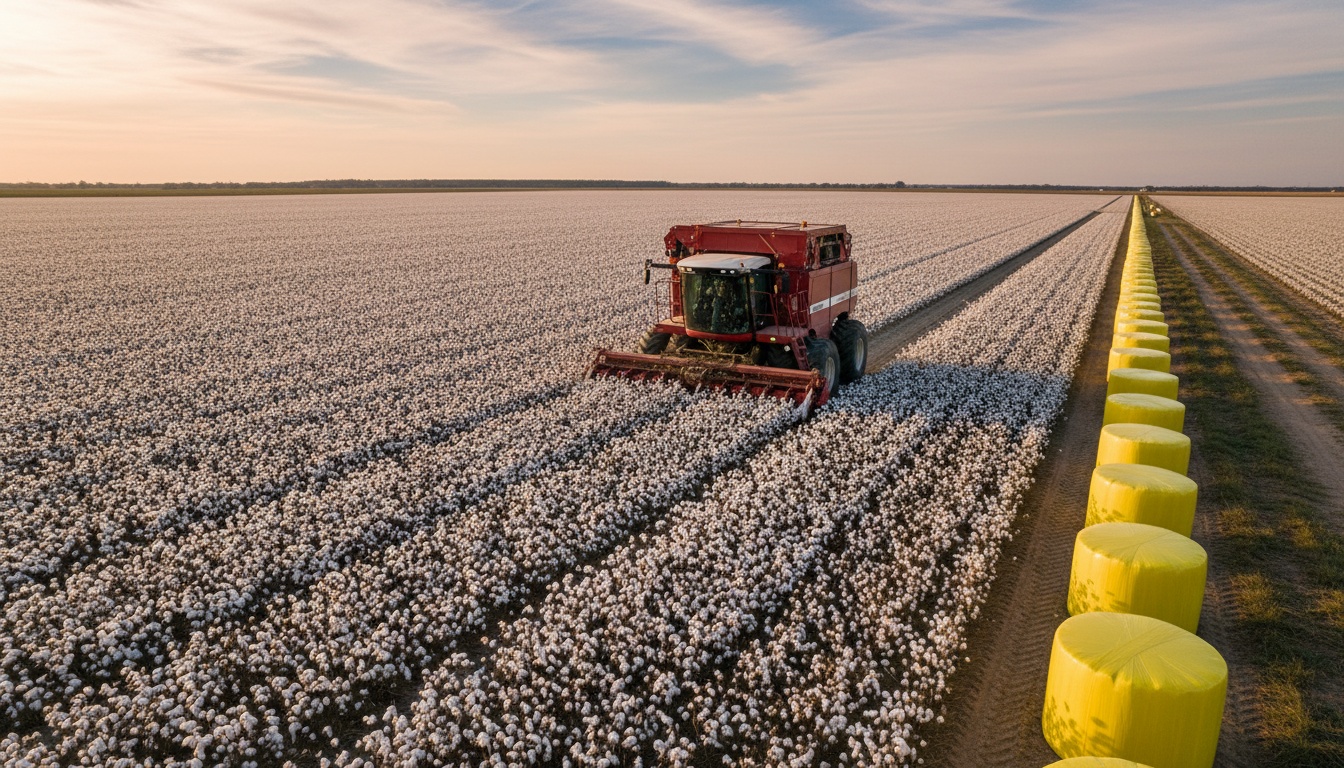
US Upland is the physical the ICE Cotton No. 2 contract is written against, and its defining commercial advantage is not the fibre but the classing. Every American bale is HVI tested by the USDA under a single national programme, so a buyer receives an instrument-measured sheet for the exact bales shipped rather than a merchant's assurance — upper half mean length, micronaire, strength in grams per tex, uniformity, and colour by reflectance and yellowness against the grade ladder from Good Middling through Strict Middling and Middling to Strict Low Middling, plus leaf grade and trash. The growths differ in character: Memphis territory and the Mid-South give longer, stronger fibre; Texas and the plains produce huge volume with more variability; California and the West produce the highest-quality Upland in the country alongside its Pima crop. Bales run around 227 kg pressed.
Buy US Upland where classing transparency and contract security matter as much as the lint itself: ring and open-end spinning at scale, mills that need consistent supply against a documented specification, and any programme that hedges on ICE, since the physical and the futures are directly connected. Machine picking also means low contamination, which is a real cost saving in the mill. The trade-offs are honest ones. It is rarely the cheapest cotton on a landed basis — Indian and Brazilian lint frequently undercuts it — and Texas growths in a dry year can bring micronaire and strength variability that a mill spinning fine counts will not tolerate. Specify the growth as well as the grade if consistency matters. For anything above 1-3/8 inch staple you need Pima, which is a different species and a different page. CBIL brokers US Upland against USDA HVI classing sheets, growth, grade, staple, micronaire and strength, on FOB US Gulf and West Coast, CFR and CIF terms.
Excluded origins are not offered, including product re-exported, blended or re-processed through a third country. Every lot moves with a certificate of origin naming the producing plant, mine or grower country, and nothing is quoted before the seller and loading point are known.
Indicative reference
$1,650–2,100 USD / MT
as at September 2026
Reference level only — not an offer, and reviewed quarterly. Levels shown are as at September 2026. Firm pricing is quoted per RFQ, subject to volume, terms and inspection.
Typical Specification
Specifications are indicative and adjusted to the agreed contract and destination requirements. Final spec confirmed on COA / SGS.
Available Grades
Applications
- Ring & open-end spinning
- Woven fabric & denim
- Knitted apparel
- Home textiles
- Hedged mill programmes
Category
Agri-Foods, Spices & Nuts
Incoterms
FOB · CFR · CIF · CIP
Pricing basis
USD / MT
Inspection
SGS / Intertek at load port
US Upland Cotton — buyer questions
Why pay a premium for US cotton over Indian or Brazilian?
Classing and contract security. Every American bale is HVI tested by the USDA under one national programme, so you get instrument data on the exact bales shipped rather than a merchant's representation. Add low contamination from machine picking and a direct link to the ICE contract for hedging, and the premium is buying certainty rather than better fibre.
Does the growth region actually matter?
Yes, and it is worth specifying. Memphis and Mid-South growths give longer, stronger fibre; Texas produces enormous volume with more variability, particularly in dry years when micronaire and strength scatter; California produces the best Upland in the country. A mill spinning fine counts should name the growth, not just the grade.
What do the colour grade numbers mean?
They combine reflectance, meaning brightness, with yellowness on the USDA scale — Good Middling at the top, then Strict Middling, Middling and Strict Low Middling. Colour affects dyeing and finished appearance rather than spinning performance. For a white or pale finished fabric it matters considerably; for a dark dyed product, less so, and a lower colour grade can be a sensible saving.
Is micronaire a quality measure?
It is a combined fineness and maturity reading, and it is a band rather than a ladder. 3.5 to 4.9 is the premium range; below 3.5 the fibre is immature and dyes unevenly, above 5.0 it is coarse and spins to fewer, thicker yarns. Both ends are discounted. Higher is not better — specify the band your spinning system needs.
Ready to source US Upland?
Send your quantity, specification, preferred Incoterms and destination port. Qualified requirements receive a workable offer against verified supply.
Have US Upland to sell? Submit an offer — we'll match it against live buyer demand.
More in Cotton
Pima & Supima Cotton
American ELS — 1-3/8 inch and above, 40+ g/tex
Egyptian Giza Cotton
Giza 86, 88, 92 & 94 — hand-picked ELS from the Delta
Indian Cotton (Shankar-6)
Shankar-6, MCU-5 & DCH-32 — the volume medium staple
Brazilian Cotton
Mato Grosso & Bahia — machine-picked, low contamination
West African Cotton
CFA zone — hand-picked, notably clean, medium staple
Cotton Yarn
Carded & combed, ring and open-end, Ne 10 to Ne 80
Polyester Staple Fibre (Virgin PSF 1.4D x 38 mm)
Virgin semi-dull and full-dull PSF for ring and open-end spinning, bought on denier, cut length and tenacity