
Fresh Bananas (Cavendish) & Plantains
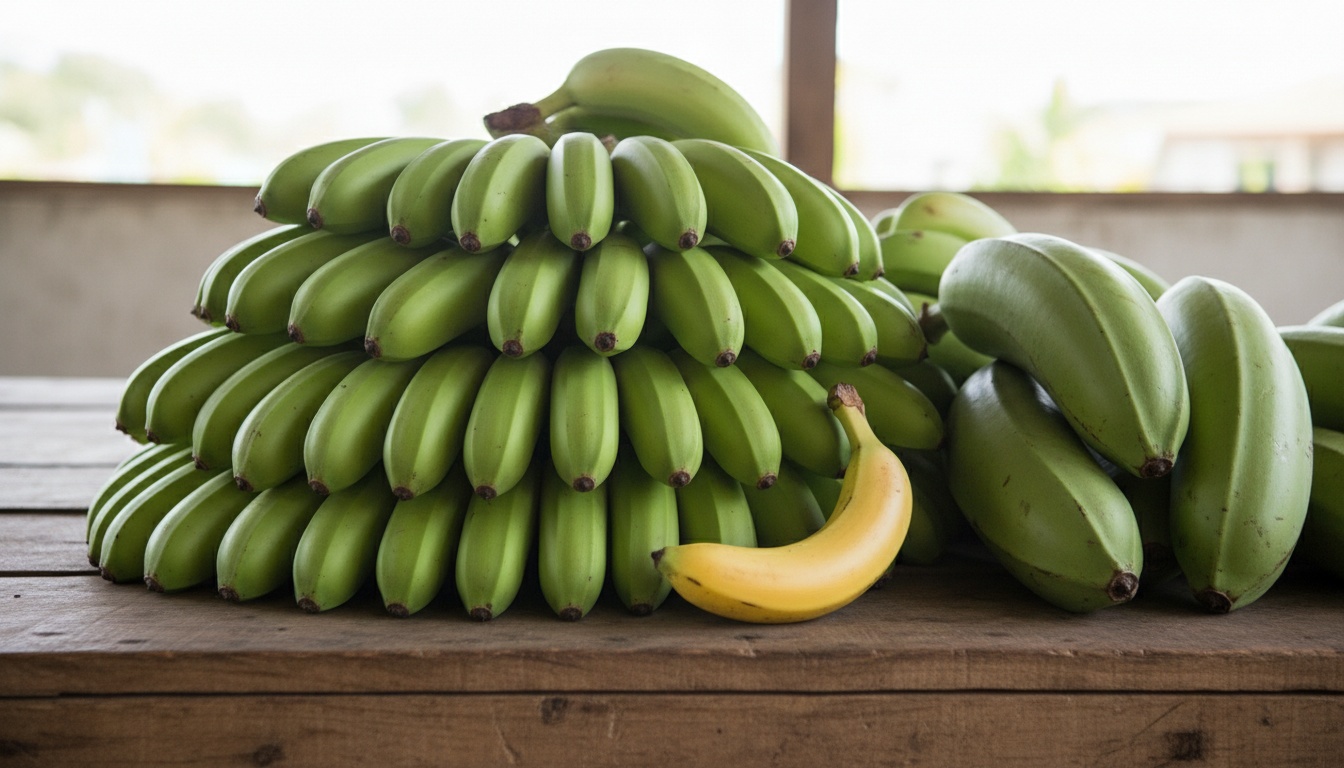
Green Cavendish bananas in 13.5 kg and 18.14 kg boxes at 13-14 °C, and green plantains, from Ecuador, the Philippines, Costa Rica, Guatemala and Colombia
Bananas are shipped green and ripened at destination, so the whole trade is built around keeping the fruit asleep in transit. The reefer set point is 13.2-14.0 °C for green Cavendish, with chilling injury below about 12.8 °C and premature ripening above the band; relative humidity is held at 85-95% and fresh-air ventilation at about 25 m3 per hour, and the fruit produces ethylene and is highly sensitive to it, so it never shares a box with ripening cargo. The box is the unit of sale: Ecuador's standard 22XU carton holds 18-19 kg net (41.5 and 43 lb variants) and Costa Rica packs 18.14 kg (40 lb) cartons with polyethylene liners, while the 13 kg and 13.5 kg box is the Asian and Middle Eastern standard used by Philippine and Indian packers, with four to eight hands per box. The EU marketing standard (Regulation (EU) No 1333/2011) sets a minimum finger length of 14 cm and a minimum grade of 27 mm, classes the fruit Extra, Class I and Class II on shape and skin defects, and allows 10% by number outside the sizing. Plantains are a separate line, HS 0803.10: larger, starchier cooking bananas shipped green in cartons on the same reefer lanes, and Ecuador, Guatemala and Colombia were the three largest exporters in 2024 at about 31%, 28% and 15% of the world trade, with the United States taking the largest share.
UN Comtrade 2024 export declarations put fresh bananas (HS 0803.90) at 21.8 million MT worth USD 12.6 billion: Ecuador 5.71 million MT worth USD 3.35 billion, Guatemala 2.84 million MT, the Philippines 2.33 million MT, Costa Rica 2.23 million MT, Colombia 2.15 million MT, India 764,000 MT, Honduras 464,000 MT, Cote d'Ivoire 367,000 MT, Mexico 365,000 MT and the Dominican Republic 255,000 MT, with the Netherlands' 799,000 MT and the USA's 589,000 MT being largely re-exports through ripening hubs. The importers are the ripeners: the USA 4.73 million MT, China 1.69 million MT, Germany 1.35 million MT, the Netherlands 1.13 million MT, Japan 1.04 million MT, the UK 807,000 MT, Italy 789,000 MT, Canada 600,000 MT, Poland 516,000 MT, Argentina 454,000 MT, Spain 436,000 MT and the Republic of Korea 401,000 MT. Plantains (HS 0803.10) added 1.23 million MT worth USD 826 million: Guatemala 333,000 MT, Ecuador 262,000 MT, Colombia 173,000 MT, Nicaragua 64,000 MT, Mexico 19,000 MT and Sri Lanka 19,000 MT, with Saudi Arabia declaring 11,800 MT of exports. The Philippines shipped 2.278 million MT of bananas in 2024 by its own statistics, down 3% on 2023 after weather and Fusarium TR4 losses, and Philippine fruit is the short-haul supply for Japan, China, Korea and the Red Sea and Omani ports, where Ecuadorian fruit competes on the long haul. The documents follow the destination: a phytosanitary certificate from the origin's plant protection organisation, GlobalG.A.P. for European and Japanese retail, residues within the destination's maximum residue levels and a packing list by box count and pallet. CBIL is a commodity brokerage company and brokers green Cavendish bananas and plantains from packers and exporters in these origins against the phytosanitary certificate and an independent check of pulp temperature, calibre, finger length and condition at stuffing where the buyer wants it. Cargo moves on FOB, CFR and CIF terms in 40-ft high-cube reefer containers at the set point above, with the carrier's ventilation and controlled-atmosphere settings written into the booking. The buyer is a ripener-importer at Jeddah, Sohar, Fujairah or Mersin, an East Asian importer at Yokohama, Busan or Dalian, or a plantain distributor in the United States or Spain. Send the box weight, class, calibre, weekly volume, season and discharge port.
Excluded origins are not offered, including product re-exported, blended or re-processed through a third country. Every lot moves with a certificate of origin naming the producing plant, mine or grower country, and nothing is quoted before the seller and loading point are known.
Indicative reference
Per box, on weight, class and season USD / box
as at September 2026
Reference level only — not an offer, and reviewed quarterly. Levels shown are as at September 2026. Firm pricing is quoted per RFQ, subject to volume, terms and inspection.
Typical Specification
Specifications are indicative and adjusted to the agreed contract and destination requirements. Final spec confirmed on COA / SGS.
Available Grades
Applications
- Ripening rooms and importer-distributors
- Supermarket retail programmes
- Wholesale markets and foodservice
- Plantain distribution and processing (chips, frozen)
Category
Agri-Foods, Spices & Nuts
Incoterms
FOB · CFR · CIF
Pricing basis
USD / box
Inspection
SGS / Intertek at load port
Fresh Bananas (Cavendish) & Plantains — buyer questions
At what temperature are bananas shipped?
Green Cavendish travels at 13.2-14.0 °C. Below about 12.8 °C for a few hours to a few days the fruit takes chilling injury, browning and failing to ripen; above the band it starts to ripen in the box. Humidity is held at 85-95% and fresh air at about 25 m3 per hour, and because bananas both produce and react to ethylene they are never stowed with ripening cargo.
Why are there 13.5 kg and 18.14 kg banana boxes?
Two lanes, two standards. The Americas-to-Europe and US trade runs on the 18.14 kg (40 lb) carton and Ecuador's 22XU box of 18-19 kg net. Philippine and Indian packers serving Japan, China, Korea and the Middle East use 13 kg and 13.5 kg boxes holding four to eight hands. Offers are compared per box only on the same net weight, class and calibre.
Which countries export the most bananas?
In 2024 (UN Comtrade) Ecuador exported 5.71 million MT, Guatemala 2.84 million MT, the Philippines 2.33 million MT, Costa Rica 2.23 million MT and Colombia 2.15 million MT, followed by India, Honduras, Cote d'Ivoire, Mexico and the Dominican Republic. The USA imported 4.73 million MT, China 1.69 million MT, Germany 1.35 million MT and Japan 1.04 million MT.
How do plantains differ from bananas in trade?
They are a separate customs line, HS 0803.10, and a cooking fruit: larger, starchier and shipped green in cartons on the same reefer lanes. Ecuador, Guatemala and Colombia held about 31%, 28% and 15% of world plantain exports in 2024, and the United States is the main destination, followed by Chile and Spain. They are sold by count and calibre rather than by hand.
Ready to source Bananas & Plantains?
Send your quantity, specification, preferred Incoterms and destination port. Qualified requirements receive a workable offer against verified supply.
Have Bananas & Plantains to sell? Submit an offer — we'll match it against live buyer demand.
More in Fresh Fruit: Citrus, Grapes, Avocados, Mangoes, Apples & Pears
Fresh Citrus: Oranges, Mandarins & Lemons
Oranges, mandarins and lemons by class, size and juice content, in 15 kg cartons by the reefer container
Fresh Table Grapes
Seedless and seeded table grapes by Brix, berry size and bunch weight, 8.2 kg cartons by the reefer container
Fresh Hass Avocados
Hass avocados by dry matter and count, 4 kg cartons by the reefer container
Fresh Mangoes
Kent, Keitt, Tommy Atkins, Ataulfo and South Asian varieties by weight band, in 4 kg cartons
Fresh Apples & Pears
Apples and pears by variety, diameter and count, from harvest or controlled atmosphere storage