
Bismuth, Selenium & Tellurium (Minor Metals, Ingot & Powder)
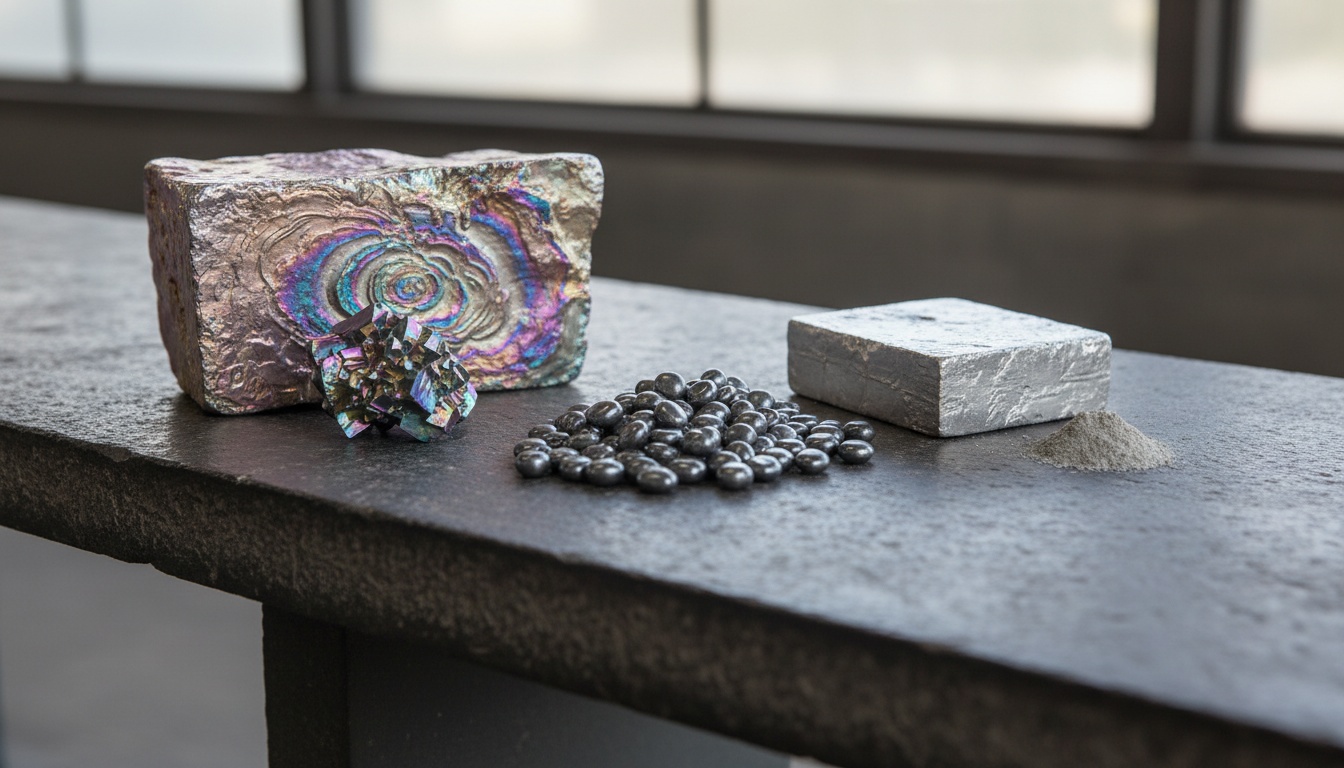
Three copper- and lead-refinery by-product metals on one page: 4N bismuth ingot, 99.5% selenium powder and 99.99%+ tellurium, from Japanese, Korean, Belgian, Canadian and Peruvian refiners
Bismuth, selenium and tellurium are by-products before they are commodities: none is mined for itself at scale, all three come out of the anode slimes of electrolytic copper refineries and, for bismuth, out of lead refining, and supply follows the copper and lead smelters rather than demand. That is why the refiners are the origins on this page, and why China, which refines the most copper and lead, dominates all three. Bismuth: USGS Mineral Commodity Summaries 2026 estimates 2025 world refinery production at about 16,000 MT, with China 14,000 MT (88%), Korea 1,000 MT, Japan 500 MT, Laos 500 MT and Kazakhstan 180 MT; end uses in 2024 were pharmaceuticals and chemicals 30%, metallurgical additives 24% (free-machining steels, aluminium and lead-free brass, where bismuth replaces lead), fusible alloys 17% (low-melting solders, sprinkler triggers, tube-bending fillers), catalysts 10% and pigments and cosmetics 9%. The trade grade is 99.99% (4N) ingot of about 10–14 kg, with 99.97% for pharmaceutical processing and needle and powder forms for alloying; Korea Zinc's Onsan smelter, Japanese lead and copper refiners and Belgian lead refining supply the non-Chinese ingot and bismuth-lead alloy, and a Canadian company runs the largest bismuth-chemicals business for pharmaceuticals from a plant in Germany. On 4 February 2025 China placed metallic bismuth and three bismuth compounds under export licensing (Announcement No. 10 of 2025), and USGS records the 2025 Rotterdam bismuth average at roughly four times the 2024 average, the highest on record. Selenium: refined from copper anode slimes at Japanese, Belgian (Hoboken), Canadian, German, Finnish, Polish and Peruvian refineries, with China at about 53% of 2025 world refinery output per USGS; trade forms are metal powder, granules and flakes at 99.5% minimum, crude selenium at about 85% from refineries, and selenium dioxide; end uses are metallurgy 40% (largely as an additive in electrolytic manganese metal production, which is why the selenium price tracks the manganese cycle), agriculture and animal health 20% (sodium selenite feed premixes), glass 20% (decolourising and the red colourant), electronics and photovoltaics 10% and chemicals and pigments 5%. Tellurium: the same slimes carry it, at up to a few percent, and China refined about 75% of the world's tellurium in 2024 with Canada, Japan, Peru and the USA the other refiners; commercial grade is 99.5% minimum and photovoltaic grade runs 99.99% to 99.99999%, because the largest use, about 70%, is cadmium telluride thin-film solar cells, followed by thermoelectric devices at 15% and metallurgy at 10% (free-machining steel and copper, lead-battery grid hardening); the Canadian refiner that supplies cadmium telluride to the largest thin-film module maker buys tellurium from copper refineries including a new 18 MT-a-year recovery circuit at a US copper smelter. Tellurium and its compounds were placed under Chinese export licensing in the same February 2025 announcement as bismuth.
The buyers are pharmaceutical and fine-chemical makers (bismuth subsalicylate, subcitrate and oxychloride), free-machining steel and brass mills, solder and fusible-alloy makers, feed-premix and fertiliser blenders, glass plants, electrolytic manganese producers, thermoelectric module makers and thin-film solar manufacturers. CBIL is a commodity brokerage company and brokers bismuth ingot, selenium and tellurium from Japanese, Korean, Belgian, Canadian and Peruvian refiner and trader lots, and from China only with the exporter's export licence, against the refiner's certificate of analysis per lot and SGS, Alfred H Knight or Bureau Veritas sampling and assay: for bismuth, Bi with Pb, Ag, Cu, Fe, As, Sb, Zn and Te; for selenium, Se with Te, Fe, Cu, Pb, S and Cl; for tellurium, Te with Se, Cu, Pb, Fe, S and, for photovoltaic grade, the full trace-element sheet by ICP. Because they are worth thousands of dollars a tonne and above, all three are lot-by-lot goods: minimum lots are confirmed per product and refiner, from a few hundred kilograms of tellurium in cases to 5–20 MT of bismuth ingot on pallets, and independent weighing and sealing at stuffing is part of every contract. Selenium powder ships as UN 2658 Class 6.1 and tellurium compounds may be classified, so packaging and declarations follow the material safety data sheet; bismuth metal is not classified. UN Comtrade 2024 export declarations under HS 2804.90 (selenium) total USD 95 million and 3,989 MT across 41 reporting countries, and under HS 2804.50 (boron and tellurium together) USD 218 million and 3,461 MT across 36 reporters; HS 8106 bismuth declarations were not retrievable at the time of writing and are not quoted. Fastmarkets and Argus publish Rotterdam assessments for bismuth 99.99%, selenium 99.5% and tellurium 99.99%. Send the metal, grade and form, your impurity ceilings, the lot size and delivery point, and the enquiry is worked against current refiner and warehouse positions.
Need the ship as well? Our chartering desk prices concentrate freight, Group A cargoes on LaycanDesk.
Excluded origins are not offered, including product re-exported, blended or re-processed through a third country. Every lot moves with a certificate of origin naming the producing plant, mine or grower country, and nothing is quoted before the seller and loading point are known.
Indicative reference
Per lot, on grade and refiner CoA USD / kg
as at September 2026
Reference level only — not an offer, and reviewed quarterly. Levels shown are as at September 2026. Firm pricing is quoted per RFQ, subject to volume, terms and inspection.
Typical Specification
Specifications are indicative and adjusted to the agreed contract and destination requirements. Final spec confirmed on COA / SGS.
Available Grades
Applications
- Pharmaceuticals: bismuth subsalicylate, subcitrate, oxychloride
- Free-machining steel, brass and aluminium (Bi, Te)
- Low-melting and lead-free solders, fusible alloys
- Electrolytic manganese metal additive (Se)
- Animal feed and fertiliser selenium (sodium selenite)
- Glass decolourising and red pigments (Se)
- Cadmium telluride thin-film solar cells and thermoelectrics (Te)
Category
Metals & Recycled Scrap
Incoterms
FCA · FOB · CIF · DAP
Pricing basis
USD / kg
Inspection
SGS / Intertek at load port
Bismuth, Selenium & Tellurium (Minor Metals, Ingot & Powder) — buyer questions
Where do bismuth, selenium and tellurium come from?
From the anode slimes of electrolytic copper refineries and, for bismuth, from lead refining; none is mined for itself at scale. USGS estimates 2025 refined bismuth at about 16,000 MT, 88% of it Chinese, with Korea, Japan, Laos and Kazakhstan the other reporters; China refined about 53% of the world's selenium in 2025 and about 75% of its tellurium in 2024. The non-Chinese origins are the copper and lead refiners: Japanese smelters, Korea Zinc's Onsan complex, Umicore's Hoboken plant in Belgium, Canadian refiners and Peru's copper industry. Supply therefore follows smelter output, not demand for the minor metal.
Are these metals under export controls?
Chinese bismuth metal and three bismuth compounds, and tellurium metal and its compounds including cadmium telluride, were placed under export licensing by China's Ministry of Commerce and customs administration on 4 February 2025 (Announcement No. 10 of 2025), and per market reports that licensing remained in force through 2026; USGS puts the 2025 Rotterdam bismuth average at roughly four times the 2024 average. Selenium was not in that announcement. Chinese-origin bismuth and tellurium are offered only with the exporter's licence in hand; Japanese, Korean, Belgian, Canadian and Peruvian material carries no such requirement.
What grades and forms are traded?
Bismuth as 99.99% ingots of about 10–14 kg, with 99.97% for pharmaceutical processing and needle or powder for alloying. Selenium as 99.5% minimum powder, granules or flakes, as crude selenium at about 85% from refineries, and as selenium dioxide. Tellurium as 99.5% commercial ingot or powder, 99.99% electronic grade, and 5N to 7N for photovoltaic and thermoelectric use, sold with a full ICP trace-element sheet. Each lot is sold on the refiner's certificate of analysis and an independent assay, and lot sizes are confirmed per product.
What drives the price of each?
Bismuth: Chinese export licensing since February 2025 and pharmaceutical and lead-replacement demand against by-product supply. Selenium: the electrolytic manganese metal cycle, since manganese producers are the largest single consumer, plus feed and glass demand; the MMTA notes the selenium price tracks manganese. Tellurium: thin-film solar demand, which takes about 70% of output and needs roughly 40–100 MT of tellurium per gigawatt of cadmium telluride modules, against copper-refinery by-product supply. Fastmarkets and Argus publish Rotterdam assessments for all three; the desk quotes only against the assessment current on the day.
Ready to source Bismuth, Selenium & Tellurium?
Send your quantity, specification, preferred Incoterms and destination port. Qualified requirements receive a workable offer against verified supply.
Have Bismuth, Selenium & Tellurium to sell? Submit an offer — we'll match it against live buyer demand.
More in Copper, Zinc, Lead & Molybdenum Concentrates, Moly Oxide & FeMo
Copper Concentrate (20–30% Cu)
Sulphide flotation concentrate by Cu, Au, Ag and penalty elements — priced on payable metal less TC/RC
Zinc & Lead Concentrates
Sphalerite concentrate at 48–55% Zn and galena concentrate at 55–70% Pb with silver — priced on payable metal less treatment charges
Molybdenum Concentrate (Molybdenite MoS₂, 45–57% Mo)
Molybdenite concentrate from primary and copper by-product mines, sold to roasters on contained Mo and graded on copper, lead and phosphorus
Technical Molybdenum Oxide (TMO) & Ferromolybdenum (FeMo 60–75% Mo)
Roasted molybdenum concentrate at 57% Mo min and ferromolybdenum at 60–75% Mo, the molybdenum additions for carbon, alloy, stainless and tool steels
Stibnite Antimony Concentrate (Sb₂S₃, 45–60% Sb)
Antimony sulphide flotation concentrate (HS 2617.10) priced on payable Sb minus TC and penalty elements
Tungsten Concentrate (Scheelite / Wolframite 65% WO₃) & Ammonium Paratungstate (APT)
Scheelite and wolframite concentrate at 65% WO₃ and APT 88.5% WO₃, priced per metric tonne unit, from non-Chinese mines with 3TG due diligence on file