
Stibnite Antimony Concentrate (Sb₂S₃, 45–60% Sb)
Antimony sulphide flotation concentrate (HS 2617.10) priced on payable Sb minus TC and penalty elements
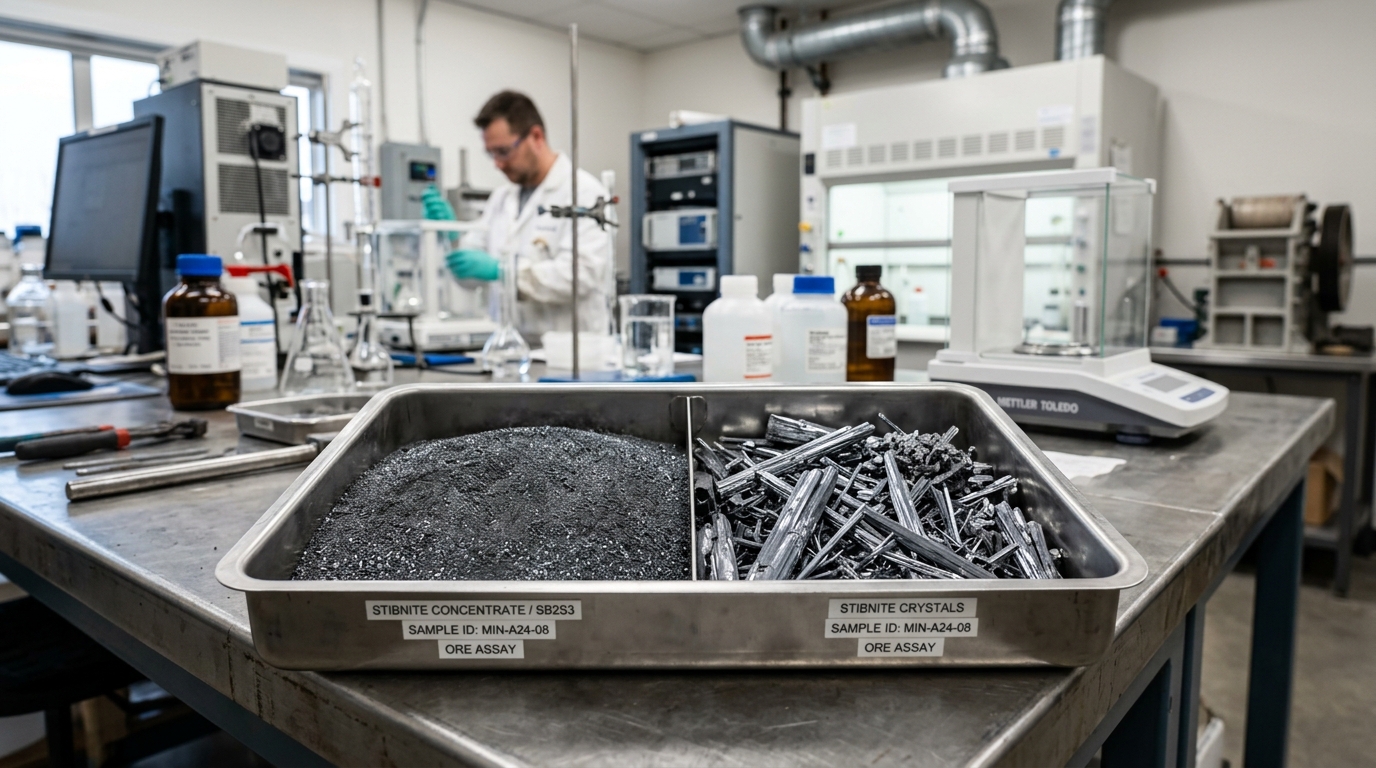
Stibnite flotation concentrate (antimonite, Sb₂S₃, HS 2617.10) is the principal upstream raw material for primary antimony metal and trioxide production. Pure stibnite mineral contains 71.68% Sb and 28.32% S; commercial flotation concentrates typically assay between 45.0% and 60.0% contained antimony (delivered as a dense, moist, grey-black fine sand with 80% passing 74 microns / 200 mesh), supplemented by hand-sorted lump "antimony crude" at 50% to 60% Sb.
Unlike refined metal, stibnite concentrate is never sold per gross tonne. It is settled against commercial payable formulas based on contained dry metric tonnes (DMT) of metal: Commercial Value ($/DMT) = [Base Metal Price × (Payable % / 100) × Contained Sb] + Precious Metal Credits - Treatment Charge (TC) - Impurity Penalties. The payable rate scales with head grade: 72.0% to 76.0% for Sb ≥ 55.0%, 68.0% to 72.0% for Sb 50.0%–54.9%, and 64.0% to 68.0% for Sb 45.0%–49.9% (or via a standard 4.0 to 5.0 unit deduction). Treatment charges (TC) are negotiated per DMT of dry concentrate, benchmarked against Fastmarkets Rotterdam or SMM 99.65% metal quotations. Gold is credited above 1.0 g/DMT at 80%–90% of LBMA PM Fix minus refining deductions ($6.00–$10.00/oz), and silver is credited above 30.0 g/DMT. Smelters enforce strict penalty escalations: Arsenic (free tolerance ≤ 0.30%, penalised at $3.50 per 0.10% over, outright reject > 1.50%), Lead (free ≤ 0.20%, reject > 1.00%), Mercury (free ≤ 50 ppm, reject > 200 ppm due to acid plant catalyst poisoning), Bismuth (free ≤ 0.05%, reject > 0.20%), and Selenium (free ≤ 50 ppm).
Crucially, stibnite flotation concentrate is classified under the IMO IMSBC Code as a Group A Cargo (cargoes that may liquefy if shipped at a moisture content exceeding their Transportable Moisture Limit [TML]). Consignments must undergo Flow Moisture Point (FMP) and TML testing within 7 days of loading, with moisture strictly controlled ≤ 8.0% (reject > 12.0%). To bypass Chinese MOFCOM dual-use export restrictions, CBIL mobilizes stibnite concentrates from verified non-Chinese producers: Tajikistan (Anzob complex / Jidjikrut deposit) evacuated via the Trans-Caspian International Transport Route (TITR / Middle Corridor) across the Caspian and Black Seas to Poti; Bolivian Altiplano cooperatives via Chilean ports (Arica and Antofagasta); and Turkish mines via Samsun. Shipments move in 1,000 kg UV-stabilized FIBC big bags with polyethylene liners stuffed 20–25 MT per 20ft container, or as Handysize bulk parcels with certified TML, moisture, and chemical assays.
Need the ship as well? Our chartering desk prices concentrate freight, Group A cargoes on LaycanDesk.
Excluded origins are not offered, including product re-exported, blended or re-processed through a third country. Every lot moves with a certificate of origin naming the producing plant, mine or grower country, and nothing is quoted before the seller and loading point are known.
Indicative reference
Payable formula based on Rotterdam metal price less TC/penalties USD / DMT (Payable Sb)
as at September 2026
Reference level only — not an offer, and reviewed quarterly. Levels shown are as at September 2026. Firm pricing is quoted per RFQ, subject to volume, terms and inspection.
Typical Specification
Specifications are indicative and adjusted to the agreed contract and destination requirements. Final spec confirmed on COA / SGS.
Available Grades
Applications
- Custom pyrometallurgical smelting to crude antimony metal
- Volatilization roasting to commercial antimony trioxide (Sb₂O₃)
- Gold and silver precious metal recovery circuits
- Direct synthesis of military percussion priming friction sensitizers
Category
Metals & Recycled Scrap
Incoterms
FOB · CFR · CIF
Pricing basis
USD / DMT (Payable Sb)
Inspection
SGS / Intertek at load port
Stibnite Antimony Concentrate (Sb₂S₃, 45–60% Sb) — buyer questions
How is stibnite concentrate priced and settled commercially?
Stibnite concentrate is settled on the payable contained antimony metal value rather than gross weight: Settlement Value ($/DMT) = [Fastmarkets Rotterdam Sb metal price × (Payable % / 100) × contained Sb] + Precious Metal Credits - Treatment Charge (TC) - Deleterious Penalties. The payable rate is typically 72–76% for material with Sb ≥ 55%, 68–72% for Sb 50–54.9%, and 64–68% for Sb 45–49.9%. Treatment charges run $800–$1,600/DMT.
What are the critical penalty elements and rejection limits for custom roasters?
Smelters penalize arsenic (free tolerance ≤ 0.30%, outright rejection > 1.50% because As volatilizes into trioxide fumes contaminating finished product), lead (free ≤ 0.20%, reject > 1.00%), mercury (free ≤ 50 ppm, reject > 200 ppm because Hg poisons acid plant catalysts), and bismuth (free ≤ 0.05%, reject > 0.20%).
Why is moisture certification critical for ocean shipment under the IMSBC Code?
Stibnite flotation concentrate is an IMSBC Code Group A cargo. If loaded at a moisture content exceeding its Transportable Moisture Limit (TML), ship vibration and wave action during ocean transit can cause liquefaction, shifting cargo and causing vessel capsize. Shippers must provide certified Flow Moisture Point (FMP) and moisture tests conducted within 7 days of loading, maintaining moisture strictly ≤ 8.0%.
Which non-Chinese transport corridors does CBIL utilize for stibnite concentrates?
CBIL moves stibnite concentrate from Tajikistan's Jidjikrut deposit via the Trans-Caspian International Transport Route (TITR / Middle Corridor: Aktau to Baku to Poti), bypassing sanctioned and Chinese transit restrictions. Bolivian concentrate is trucked down the Andes to Chilean Pacific ports (Arica and Antofagasta) for containerized liner shipment via the Panama Canal to Western European and Asian smelters.
Ready to source Stibnite Concentrate?
Send your quantity, specification, preferred Incoterms and destination port. Qualified requirements receive a workable offer against verified supply.
Have Stibnite Concentrate to sell? Submit an offer — we'll match it against live buyer demand.
More in Copper, Zinc, Lead & Molybdenum Concentrates, Moly Oxide & FeMo
Copper Concentrate (20–30% Cu)
Sulphide flotation concentrate by Cu, Au, Ag and penalty elements — priced on payable metal less TC/RC
Zinc & Lead Concentrates
Sphalerite concentrate at 48–55% Zn and galena concentrate at 55–70% Pb with silver — priced on payable metal less treatment charges
Molybdenum Concentrate (Molybdenite MoS₂, 45–57% Mo)
Molybdenite concentrate from primary and copper by-product mines, sold to roasters on contained Mo and graded on copper, lead and phosphorus
Technical Molybdenum Oxide (TMO) & Ferromolybdenum (FeMo 60–75% Mo)
Roasted molybdenum concentrate at 57% Mo min and ferromolybdenum at 60–75% Mo, the molybdenum additions for carbon, alloy, stainless and tool steels
Tungsten Concentrate (Scheelite / Wolframite 65% WO₃) & Ammonium Paratungstate (APT)
Scheelite and wolframite concentrate at 65% WO₃ and APT 88.5% WO₃, priced per metric tonne unit, from non-Chinese mines with 3TG due diligence on file
Bismuth, Selenium & Tellurium (Minor Metals, Ingot & Powder)
Three copper- and lead-refinery by-product metals on one page: 4N bismuth ingot, 99.5% selenium powder and 99.99%+ tellurium, from Japanese, Korean, Belgian, Canadian and Peruvian refiners