
Green Raisins
Shade-dried long green Kishmish & Sabz by berry length
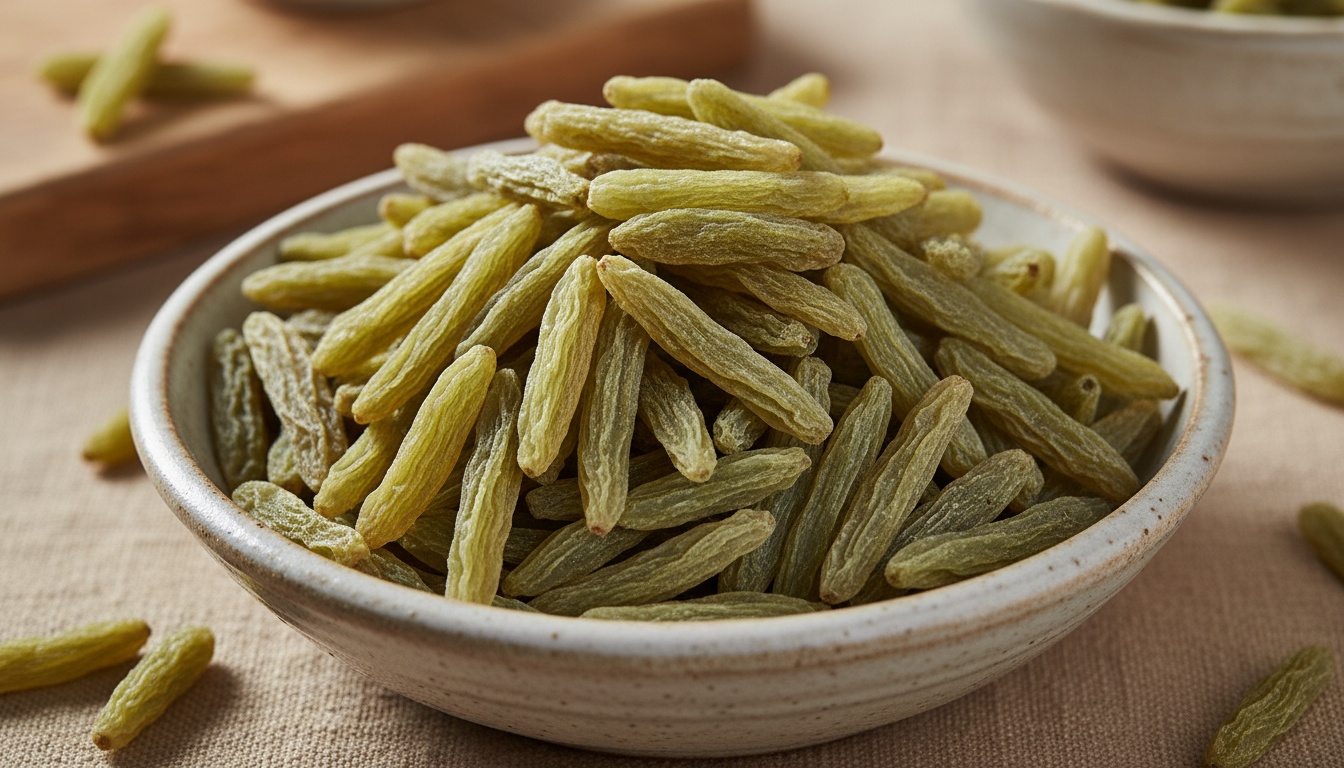
Green raisins are the shade-dried product of the raisin complex and that single fact explains both the price and the specification. Rather than being sun-dried in the field or tunnel-dried with SO₂, the bunches are hung in ventilated mud-brick drying houses (kishmishkhana) for four to six weeks, sometimes after a light dip in an oil-and-potash emulsion to speed water loss through the cuticle. Chlorophyll is retained instead of destroyed, so the berry stays green and develops the long, slender, translucent shape the grade is named for. CBIL arranges long green raisins — Uzbek green Kishmish, and Indian green from the Sangli and Nashik belts — graded principally on berry length and uniformity (long, medium and short), then on green colour intensity against the physical standard, then on Sortex class and stem/cap carry-over. Moisture runs tighter than golden at roughly 12–15% because the shade-drying takes it lower, sugar sits around 70–75% on a dry basis, and much traditional shade-dried material is genuinely SO₂-free — which is why clean-label buyers gravitate to it. Where a lot is sulphured we arrange it at ≤ 1,000 ppm and declare the number rather than leaving it to arrival testing.
Specify green over golden, black or sultana when the berry is the hero and the shape and colour are the reason someone is buying the pack: premium gifting, Middle East and South Asian retail, dry-fruit assortments, kulfi and dessert garnish, upmarket trail mixes and confectionery panning. It is the most expensive raisin type in the family for a real reason — a six-week drying cycle in a fixed-capacity drying house cannot be scaled the way a sun-drying field or a tunnel can, so supply is genuinely tight in a short crop. If you are grinding the berry into a paste or burying it in a dark bake, green is the wrong product and you are paying for a colour that will not survive your process. Every lot ships against SGS or Intertek certification of moisture, sugar, SO₂ ppm, berry length distribution, foreign matter, capstem count and pesticide residue to destination MRLs, with phytosanitary documentation, in 10 kg and 12.5 kg lined cartons or 14 kg bags, dry or reefer container, on FOB, CFR and CIF terms.
Excluded origins are not offered, including product re-exported, blended or re-processed through a third country. Every lot moves with a certificate of origin naming the producing plant, mine or grower country, and nothing is quoted before the seller and loading point are known.
Indicative reference
$1,950–2,300 USD / MT
as at September 2026
Reference level only — not an offer, and reviewed quarterly. Levels shown are as at September 2026. Firm pricing is quoted per RFQ, subject to volume, terms and inspection.
Typical Specification
Specifications are indicative and adjusted to the agreed contract and destination requirements. Final spec confirmed on COA / SGS.
Available Grades
Applications
- Premium retail packing & gifting
- Dry-fruit assortments
- Confectionery & panning
- Desserts & kulfi garnish
- HORECA
Category
Agri-Foods, Spices & Nuts
Incoterms
FOB · CFR · CIF
Pricing basis
USD / MT
Inspection
SGS / Intertek at load port
Green Raisins — buyer questions
Why are green raisins more expensive than golden or black?
Drying capacity. Green raisins are shade-dried for four to six weeks in fixed-capacity drying houses, which cannot be scaled up in a good crop the way a sun-drying field or a heated tunnel can. You are paying for a slow process with a hard ceiling on output, plus the yield loss from berries that fail the length and colour grade.
Are green raisins naturally SO₂-free?
Traditional Uzbek shade-dried material generally is — the green comes from retained chlorophyll, not from sulphuring, so there is no process reason to add SO₂. That said, some lots are sulphured to standardise appearance. We declare the SO₂ number on the contract rather than assuming, because 'green therefore unsulphured' is not a safe inference.
How are green raisins graded?
Primarily on berry length and uniformity — long, medium and short — then on green colour intensity against the physical standard, then on Sortex class for stems, caps and off-colour berries. Length is the variable that moves the price most, because the long slender berry is the visual signature buyers are paying for.
Ready to source Green Raisins?
Send your quantity, specification, preferred Incoterms and destination port. Qualified requirements receive a workable offer against verified supply.
Have Green Raisins to sell? Submit an offer — we'll match it against live buyer demand.