
Alfalfa Hay & Forage
US, Australian and Spanish alfalfa and oaten hay by RFV, protein, ADF/NDF and bale press
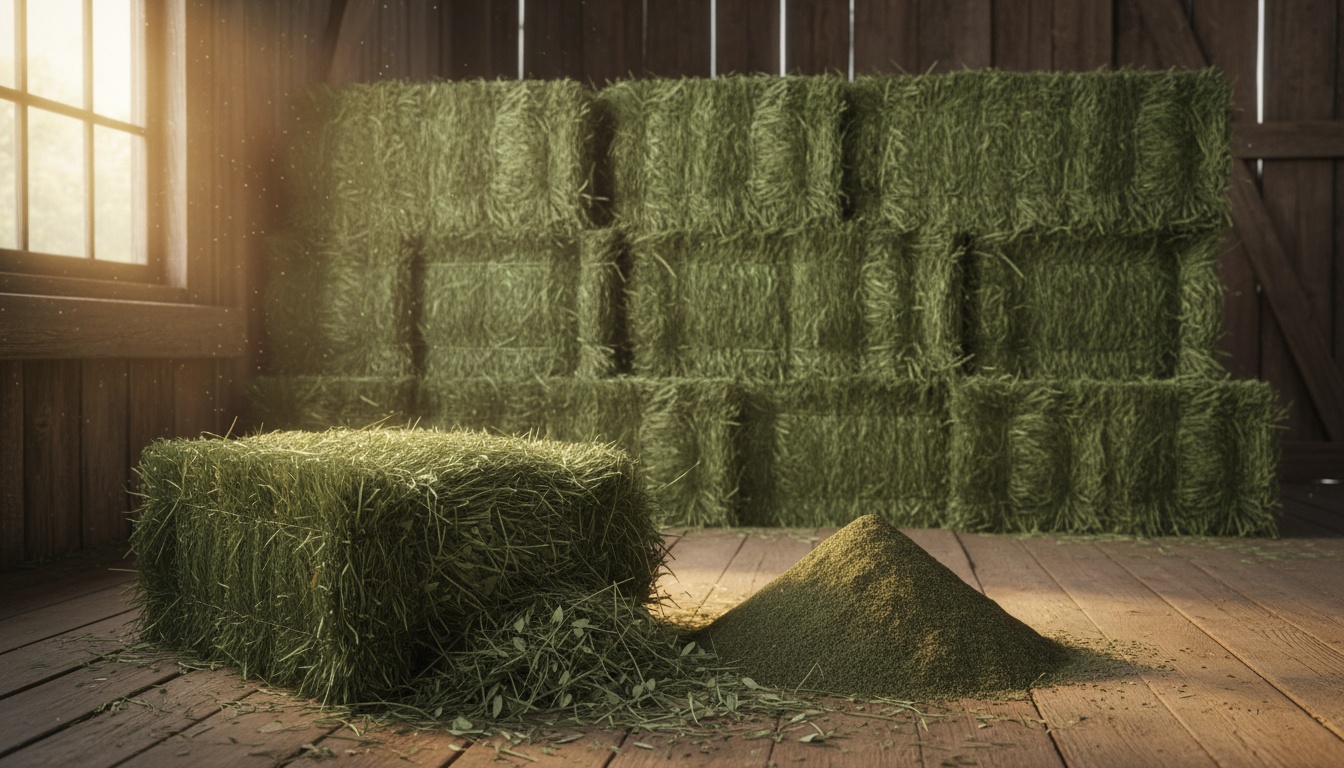
Alfalfa hay is sold on a forage analysis, and the USDA Agricultural Marketing Service grades that the export trade quotes are built from it: Supreme is under 27% ADF, under 34% NDF, above 22% crude protein and above 185 relative feed value (RFV); Premium is 27–29% ADF, 34–36% NDF, 20–22% protein and 170–185 RFV; Good is 29–32% ADF, 36–40% NDF, 18–20% protein and 150–170 RFV; Fair is 32–35% ADF, 40–44% NDF, 16–18% protein and 130–150 RFV, all on a dry-matter basis and read together with the visual grade (leaf retention, colour, weeds, mould). Moisture is held to 12–14% at pressing so the bale does not heat in the container, and the bale itself is the product: US export presses double-compress field bales into 25–30 kg or big-bale blocks so that a 40-foot container carries about 24–26 MT; Spanish dehydrated alfalfa comes as dried bales and 6–8 mm pellets; Australian oaten hay is the grass-hay alternative pressed the same way. UN Comtrade 2024 export declarations under HS 1214.90 (hay and forage) show the USA at 3.97 million MT at an average USD 335/MT, Australia 1.42 million MT at USD 359 (largely oaten hay), Canada 569,000 MT at USD 325, the Netherlands 205,000 MT, Romania 178,000 MT, Italy 114,000 MT and Germany 87,000 MT. USDA FAS data reported by Hay & Forage Grower put total US hay exports in 2025 at 2.7 million MT, down 17% on the year, and alfalfa at 1.747 million MT, down almost 20% and the third annual fall since the 2022 record of 2.847 million MT; China took 730,239 MT (about 42% of US alfalfa exports, down 22%), Japan 329,559 MT, Saudi Arabia 277,987 MT (down 30%) and South Korea 210,746 MT, with US hay to China hit by a 125% tariff during the 2025 dispute. Spain's dehydrated-alfalfa association AEFA reports 2024 exports up 15.3% on the year, with Saudi Arabia taking 121,122 MT of bales and 38,608 MT of pellets in the 2024/25 campaign.
The buyer is a dairy farm or feed centre in Saudi Arabia receiving through Jeddah on the Red Sea, a Chinese dairy group or a Japanese or Korean forage importer, or a camel and horse feed distributor, buying Premium and Supreme alfalfa on a delivered-per-tonne basis with the forage analysis attached, and the questions are RFV, protein and moisture on the certificate and whether the press can hold a monthly container programme. CBIL is a commodity brokerage company and brokers double-compressed alfalfa hay, dehydrated alfalfa bales and pellets and oaten hay from US (Pacific Northwest, California, Arizona), Australian and Spanish presses and trader positions against a laboratory forage analysis (crude protein, ADF, NDF, RFV, moisture) and SGS or Intertek inspection of bale weight, colour, mould and foreign matter at the press, with GMO-free and pesticide-residue statements where the destination requires them. Shipments are structured in 40-foot containers on FOB, CFR and CIF terms — a container a week upward for a single farm, programmes of 50–200 containers a month for a dairy group — and in break-bulk Handysize lots of pressed big bales where a receiver has a bulk berth; because CBIL also runs a chartering desk (LaycanDesk), a break-bulk leg can be quoted with the cargo. Send your grade (Supreme, Premium or Good), protein and RFV floors, bale format, monthly container count and discharge port and we will work the press to it.
Need the ship as well? Our chartering desk prices Danube and Black Sea coaster freight on LaycanDesk.
Excluded origins are not offered, including product re-exported, blended or re-processed through a third country. Every lot moves with a certificate of origin naming the producing plant, mine or grower country, and nothing is quoted before the seller and loading point are known.
Indicative reference
Per MT, on USDA grade and bale format USD / MT
as at September 2026
Reference level only — not an offer, and reviewed quarterly. Levels shown are as at September 2026. Firm pricing is quoted per RFQ, subject to volume, terms and inspection.
Typical Specification
Specifications are indicative and adjusted to the agreed contract and destination requirements. Final spec confirmed on COA / SGS.
Available Grades
Applications
- Dairy cow rations
- Beef & calf feed
- Camel & horse feed
- Sheep & goat feed
- Alfalfa pellets & cubes for compound feed
Category
Agriculture & Fertilizers
Incoterms
FOB · CFR · CIF
Pricing basis
USD / MT
Inspection
SGS / Intertek at load port
Alfalfa Hay & Forage — buyer questions
How is alfalfa hay graded?
On a laboratory forage analysis read with a visual inspection. The USDA Agricultural Marketing Service guidelines put Supreme at under 27% ADF, under 34% NDF, over 22% crude protein and over 185 RFV; Premium at 27–29% ADF, 34–36% NDF, 20–22% protein and 170–185 RFV; Good at 29–32% ADF, 36–40% NDF, 18–20% protein and 150–170 RFV; Fair at 32–35% ADF, 40–44% NDF, 16–18% protein and 130–150 RFV, all on dry matter. Leaf retention, colour, weeds and mould are judged by eye. Buy on the analysis of the actual stack, not the press's typical sheet.
Who exports hay and who buys US alfalfa?
UN Comtrade 2024 export declarations under HS 1214.90: the USA 3.97 million MT at USD 335/MT, Australia 1.42 million MT at USD 359 (largely oaten hay), Canada 569,000 MT, the Netherlands 205,000 MT, Romania 178,000 MT and Italy 114,000 MT. USDA FAS figures for 2025 put US alfalfa exports at 1.747 million MT: China 730,239 MT, Japan 329,559 MT, Saudi Arabia 277,987 MT and South Korea 210,746 MT. Spain's AEFA reports Saudi Arabia took 121,122 MT of dehydrated bales and 38,608 MT of pellets in 2024/25.
Why is the bale press as important as the field?
Because forage is freight-heavy and moisture-sensitive. A double-compressed export bale puts about 24–26 MT into a 40-foot container against far less for loose field bales, which is what makes the trade pay its freight; and a press that bales at 12–14% moisture and stores under cover ships hay that arrives green and cool, while one that presses damp hay ships a container that heats and moulds in transit. Ask for the press's moisture log and a retained sample per stack, and inspect at the press before the containers close.
What shipment sizes and terms do you work?
From one 40-foot container a week for a single dairy or a horse-feed distributor to programmes of 50–200 containers a month for a Chinese or Saudi dairy group, on FOB, CFR and CIF terms out of the US Pacific Northwest and California, Australian and Spanish ports, into Jeddah on the Red Sea, Chinese, Japanese and Korean container ports. Break-bulk Handysize lots of pressed big bales can be worked where the receiver has a bulk berth; because CBIL also runs a chartering desk, that leg can be quoted with the cargo.
Ready to source Alfalfa Hay?
Send your quantity, specification, preferred Incoterms and destination port. Qualified requirements receive a workable offer against verified supply.
Have Alfalfa Hay to sell? Submit an offer — we'll match it against live buyer demand.
More in Barley & Sorghum
Feed Barley
Bulk feed barley by test weight, moisture and screenings
Malting Barley
Brewing-grade two-row barley by germination, protein and plumpness
Sorghum (Milo)
Red and white grain sorghum by test weight, tannin and damaged kernels
Oats (Milling & Feed)
Canadian, Nordic and Australian oats by test weight, moisture, hull and screenings