
Oats (Milling & Feed)
Canadian, Nordic and Australian oats by test weight, moisture, hull and screenings
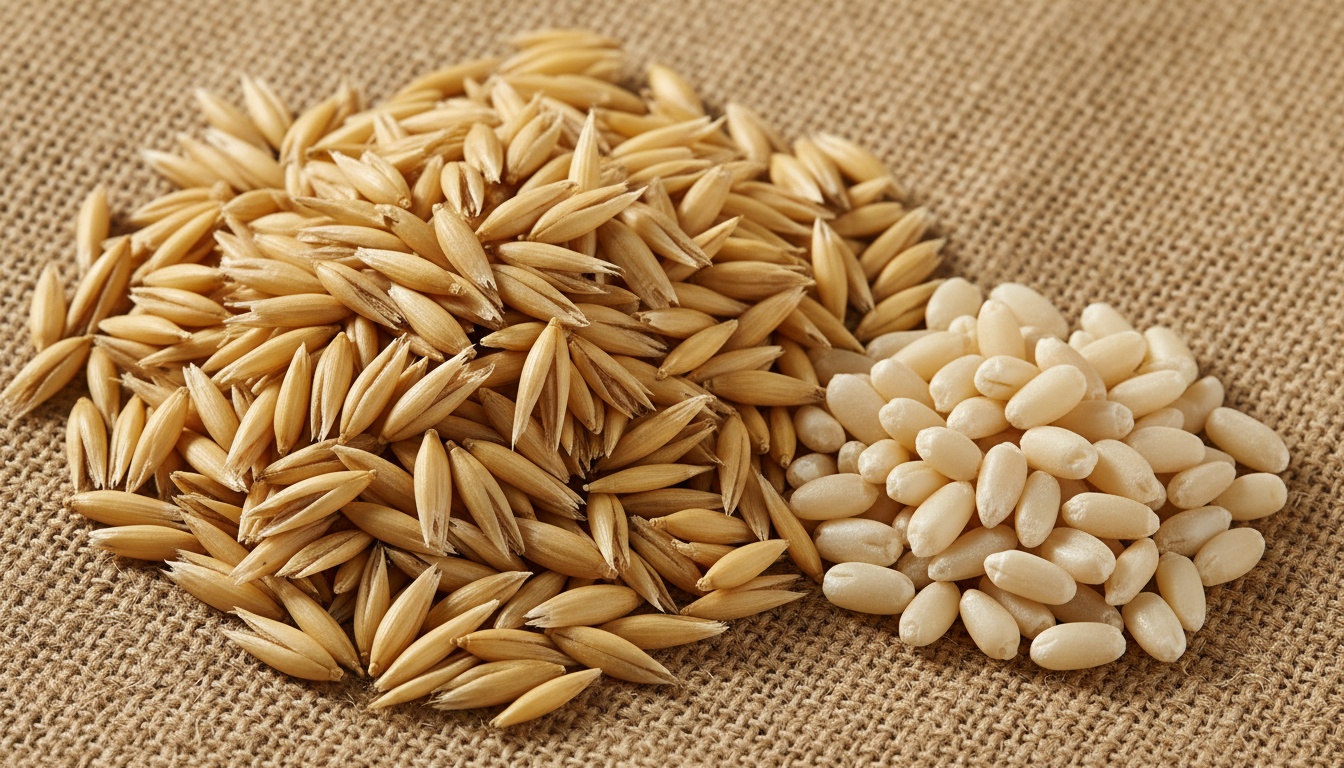
Oats are bought on test weight before anything else, because a plump, heavy kernel gives a miller more groat per tonne and a horse or a calf more energy per bucket. The Canadian Grain Commission's grades set the minimums the export trade quotes: No. 1 CW 56 kg/hl (260 g/0.5 L), No. 2 CW 53 kg/hl (245 g/0.5 L) and No. 3 CW 51 kg/hl (235 g/0.5 L), with wild oats, damaged kernels and foreign material stepping up grade by grade; the US standards under 7 CFR 810.1004 read No. 1 at 36 lb/bu, No. 2 at 33, No. 3 at 30 and No. 4 at 27, with sound oats of 97/94/90/80% minimum, heat-damaged 0.1/0.3/1.0/3.0% maximum, foreign material 2/3/4/5% and wild oats 2/3/5/10%; Western Australia's GIWA standard for Oats 1 asks 51 kg/hl minimum, 12.0% moisture maximum and 10% screenings below 2.0 mm. Moisture sits at 12–14% maximum by origin, and mycotoxins (DON, and T-2/HT-2, to which oats are the most exposed cereal) are tested on the load-port sample. Milling oats add what the mill needs: a hull share (groat yield) around 25–30%, a clean bright colour, no odour or heating, low screenings, and for the gluten-free market a purity protocol; feed oats are simply the grade that misses the milling sheet, and go to horses, calves, sheep and beef rations, where a thin oat at 47–49 kg/hl still feeds but sells at a discount. UN Comtrade 2024 export declarations under HS 1004.90 place Canada at 1.51 million MT at an average USD 300/MT, Finland 504,000 MT at USD 286, Australia 323,000 MT at USD 375, Estonia 110,000 MT at USD 305, Sweden 98,000 MT at USD 325, Poland 94,000 MT at USD 291 and France 61,000 MT at USD 331. Canada is the largest exporter and 85–90% of its oats go to the United States, largely by rail into US mills (Cereals Canada; OEC records USD 335 million of Canada's USD 446 million oat exports in 2024 to the US); Australia's higher average reflects milling oats into China, which took 64% of its exports, followed by Mexico at 16% and India at 6.7% (Tridge/OEC).
The buyer is an oat miller in China, Mexico, Japan or India making flakes, flour and beverage base, a Nordic or Baltic exporter's counterpart in Germany and Spain, or a feed mill and racing-stable supplier taking feed oats in containers. CBIL is a commodity brokerage company and brokers milling and feed oats from Canadian, Finnish, Swedish, Australian, Estonian and Polish exporters and trader positions against SGS or Intertek certification of test weight, moisture, wild oats, damaged kernels, foreign material, screenings and mycotoxins at the load port, on GAFTA terms with the load-port certificate governing. Parcels are structured as Handysize 15–30,000 MT and Supramax bulk out of Vancouver, Thunder Bay, Finnish and Swedish Baltic ports, Fremantle and Geraldton on FOB and CFR terms, and in 20-foot containers bulk-loaded with liners or in 50 kg bags for millers and feed mills taking 300–2,000 MT a month; because CBIL also runs a chartering desk (LaycanDesk), the freight leg can be quoted with the cargo. Send your test-weight floor, moisture and screenings limits, whether the lot is for milling or feed, and the monthly tonnage and we will work the origin against it.
Need the ship as well? Our chartering desk prices Danube and Black Sea coaster freight on LaycanDesk.
Excluded origins are not offered, including product re-exported, blended or re-processed through a third country. Every lot moves with a certificate of origin naming the producing plant, mine or grower country, and nothing is quoted before the seller and loading point are known.
Indicative reference
Per MT, on grade and test weight USD / MT
as at September 2026
Reference level only — not an offer, and reviewed quarterly. Levels shown are as at September 2026. Firm pricing is quoted per RFQ, subject to volume, terms and inspection.
Typical Specification
Specifications are indicative and adjusted to the agreed contract and destination requirements. Final spec confirmed on COA / SGS.
Available Grades
Applications
- Oat milling (flakes, flour, bran, beverage base)
- Horse feed
- Calf, sheep & beef rations
- Compound feed
- Gluten-free food (purity-protocol lots)
Category
Agriculture & Fertilizers
Incoterms
FOB · CFR · CIF
Pricing basis
USD / MT
Inspection
SGS / Intertek at load port
Oats (Milling & Feed) — buyer questions
What separates milling oats from feed oats?
Test weight and cleanliness. A milling lot has to make the grade minimum — 53 kg/hl for Canada No. 2 CW, 56 for No. 1 CW, 51 kg/hl for Australian Oats 1 — and come in bright, dry, free of odour and low in screenings, because the mill is paying for groat yield after the hull comes off. Oats that miss the sheet on test weight, colour or damage are feed oats and go to horses, calves and sheep at a discount. The two are the same grain at two prices; say which you are buying.
Who exports oats and where do they go?
UN Comtrade 2024 export declarations under HS 1004.90: Canada 1.51 million MT at USD 300/MT, Finland 504,000 MT at USD 286, Australia 323,000 MT at USD 375, Estonia 110,000 MT, Sweden 98,000 MT, Poland 94,000 MT and France 61,000 MT. Canada sends 85–90% of its exports to the United States, mostly by rail to US mills (Cereals Canada); Australia's milling oats go to China (64% of its exports), Mexico (16%) and India (6.7%). The Australian average is higher because it is weighted by milling grade into Asia.
Which tests are certified at the load port?
Test weight (kg/hl or g/0.5 L, and lb/bu on US lots), moisture, wild oats, damaged and heat-damaged kernels, foreign material and other cereal grains, screenings below 2.0 mm, colour and odour, and mycotoxins — DON and T-2/HT-2, to which oats are the most exposed cereal — plus phytosanitary and fumigation certificates, by SGS, Intertek or an equivalent surveyor on the contract's sampling standard. GAFTA terms with the load-port certificate governing are usual.
What parcel sizes and freight terms do you work?
Handysize 15–30,000 MT and Supramax lots out of Vancouver, Thunder Bay, Finnish and Swedish Baltic ports, Fremantle and Geraldton on FOB and CFR terms; 20-foot containers bulk-loaded with liners or in 50 kg bags for millers and horse-feed distributors taking 300–2,000 MT a month. Because CBIL also runs a chartering desk, the freight leg can be quoted with the cargo so the delivered price is on one sheet.
Ready to source Oats?
Send your quantity, specification, preferred Incoterms and destination port. Qualified requirements receive a workable offer against verified supply.
Have Oats to sell? Submit an offer — we'll match it against live buyer demand.
More in Barley & Sorghum
Feed Barley
Bulk feed barley by test weight, moisture and screenings
Malting Barley
Brewing-grade two-row barley by germination, protein and plumpness
Sorghum (Milo)
Red and white grain sorghum by test weight, tannin and damaged kernels
Alfalfa Hay & Forage
US, Australian and Spanish alfalfa and oaten hay by RFV, protein, ADF/NDF and bale press