
Ferrosilicon 75 & Silicomanganese
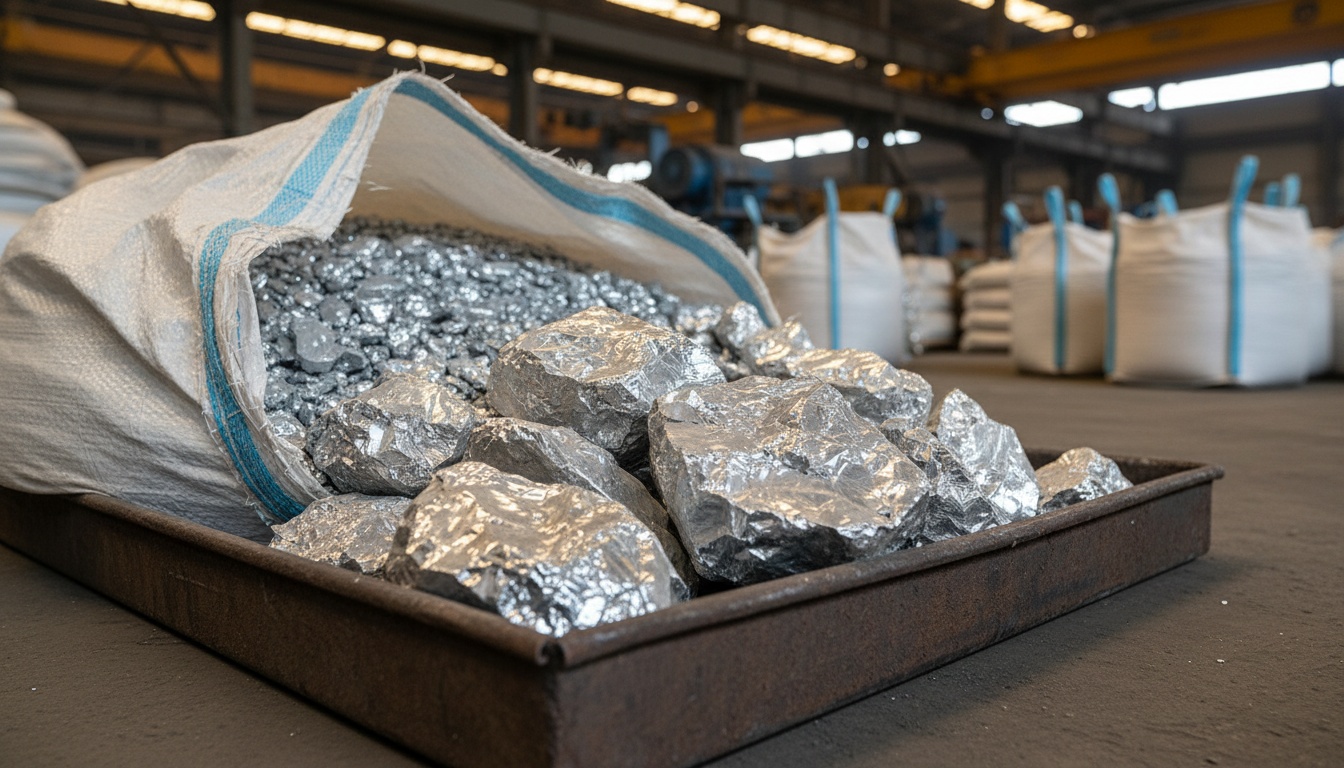
FeSi 75 by Si, Al and C; SiMn 65/17 by Mn, Si, C and P — deoxidisers in jumbo bags
Ferrosilicon and silicomanganese are the two alloys almost every steel mill buys every month, because they are how the melt is deoxidised and alloyed before casting, and they are bought on tight residuals rather than on headline metal content. Ferrosilicon 75 (FeSi 75) is 72–80% Si; the buyer's real numbers are aluminium (≤ 1.5% standard, ≤ 1.0% or ≤ 0.5% for low-Al grades used in wire-rod and tyre-cord steels, because Al forms alumina inclusions), carbon (≤ 0.1–0.2%), phosphorus (≤ 0.04%), sulphur (≤ 0.02%) and titanium and calcium for the cleanest grades; FeSi 65 and FeSi 45 are cheaper, lower-silicon alloys for foundries and less demanding steels. Silicomanganese 65/17 is 65–68% Mn with 16–18% Si and carries its own penalty elements — carbon (≤ 2.0%, or ≤ 1.5% for the low-carbon grade), phosphorus (≤ 0.20–0.35%, and every hundredth transfers to the steel) and sulphur (≤ 0.03%) — with the 60/14 grade a lower-priced alternative for rebar and structural mills. It is smelted from the manganese ore covered under our manganese ore page, blended to the 5:1 Mn/Fe ratio the alloy needs. Size for both is 10–50 or 10–100 mm lumps, with 3–10 mm and 0–3 mm fines and briquettes for ladle injection at a discount. On the trade, UN Comtrade 2025 export declarations under HS 7202 show India, the largest silicomanganese exporter, at 2.63 million MT of ferroalloys to 109 partners at an average USD 1,014/MT: Korea 241,000 MT at USD 1,107, the USA 224,000 MT at USD 1,091, Italy 201,000 MT, the UAE 193,000 MT at USD 1,021, Japan 183,000 MT, Turkiye 173,000 MT at USD 986, the Netherlands 151,000 MT, China 138,000 MT and Egypt 125,000 MT at USD 936, with Vietnam, Thailand, Indonesia, Brazil and Malaysia behind them.
The buyer is a steel mill's purchasing department working a monthly deoxidiser budget, or a foundry buying FeSi for inoculation and grey-iron chemistry, and the enquiry is a specification with ceilings, a monthly tonnage and a delivery port, not a one-off cargo. Gulf, Turkish and Egyptian mills — the UAE, Turkiye and Egypt are three of India's top nine destinations — buy container lots of jumbo bags on a rolling basis; Southeast Asian mills do the same out of Indian and Malaysian smelters. CBIL is a commodity brokerage company and brokers FeSi 75, FeSi 65 and silicomanganese 65/17 and 60/14 from Indian, Malaysian, Norwegian, Brazilian and Chinese smelter and trader allocations against SGS or Bureau Veritas certification of Si or Mn, Al, C, P, S and size distribution, on the mill's own ceiling sheet. Supply is structured in 1 MT jumbo bags in 20-foot containers for the standard 100–1,000 MT monthly lot, and in breakbulk for larger mills, on FOB, CFR and CIF terms into Jebel Ali, Iskenderun, Alexandria, Haiphong and Ho Chi Minh; because CBIL also runs a chartering desk (LaycanDesk), the freight leg on breakbulk lots is quoted alongside the alloy. Send your Si or Mn floor, aluminium and phosphorus ceilings, size band and monthly tonnage and we will work the smelter to it.
Need the ship as well? Our chartering desk prices bulk ore freight on LaycanDesk.
Indicative reference
$900–1,300 (SiMn) / $1,100–1,600 (FeSi 75) USD / MT
as at September 2026
Reference level only — not an offer, and reviewed quarterly. Levels shown are as at September 2026. Firm pricing is quoted per RFQ, subject to volume, terms and inspection.
Typical Specification
Specifications are indicative and adjusted to the agreed contract and destination requirements. Final spec confirmed on COA / SGS.
Available Grades
Applications
- Steel deoxidation & alloying (EAF, BOF, ladle)
- Rebar, wire-rod & structural steel
- Foundry inoculation & grey / ductile iron
- Electrical & silicon steels (low-Al FeSi)
- Magnesium production (FeSi, Pidgeon process)
Category
Metals & Recycled Scrap
Incoterms
FOB · CFR · CIF
Pricing basis
USD / MT
Inspection
SGS / Intertek at load port
Ferrosilicon 75 & Silicomanganese — buyer questions
Why do steel mills specify aluminium so tightly in ferrosilicon?
Because aluminium in the ferrosilicon goes into the steel as alumina inclusions, which break wire during drawing and show up as defects in tyre cord, spring wire and electrical steel. Standard FeSi 75 at ≤ 1.5% Al is fine for rebar and structural grades; a wire-rod or silicon-steel mill will specify ≤ 1.0% or ≤ 0.5% and pay a premium for it. Give us the grade of steel you are making and we will match the aluminium ceiling rather than quoting the standard alloy.
What is the difference between silicomanganese 65/17 and 60/14?
Five points of manganese and three of silicon, and a corresponding step in price. Both do the same job — adding manganese and silicon and deoxidising the melt in one addition — but 65/17 delivers more of each per tonne, so a mill compares them on cost per Mn unit landed and on the phosphorus that comes with it. 60/14 is the common grade into rebar and structural mills in the Gulf, Turkiye and Egypt; 65/17 into flat-product and higher-grade long-product mills. Both are smelted from manganese ore blended to a 5:1 Mn/Fe ratio.
How are ferrosilicon and silicomanganese packed and shipped?
In 1 MT jumbo bags, 20–25 MT to a 20-foot container, which is the standard unit for the 100–1,000 MT monthly lots most mills buy; breakbulk lots of 2–5,000 MT for larger works. Lumps are 10–50 or 10–100 mm; fines and briquettes go into ladle injection at a discount. Ferrosilicon is a UN 1408 dangerous-goods cargo in bulk because wet FeSi can evolve gas, so bulk and breakbulk shipments carry the IMSBC declaration and containers are stuffed dry.
Where does the seaborne supply come from?
India is the largest silicomanganese exporter — UN Comtrade's 2025 export declarations show 2.63 million MT of ferroalloys to 109 destinations at an average USD 1,014/MT, with the UAE, Turkiye and Egypt among the top nine — and Malaysia's Sarawak smelters supply Southeast Asia and East Asia. Norway and Brazil make the cleanest low-Al ferrosilicon grades, and Chinese smelters set the price floor on standard FeSi 75. Because CBIL also runs a chartering desk, breakbulk freight is quoted alongside the alloy.
Ready to source FeSi & SiMn?
Send your quantity, specification, preferred Incoterms and destination port. We'll verify supply and respond with a workable offer — usually within one business day.
Have FeSi & SiMn to sell? Submit an offer — we'll match it against live buyer demand.
More in Chrome & Nickel Ore, Ferroalloys
Chrome Ore (Chromite Lumpy & Concentrate)
Chromite lumpy, chips and concentrate by Cr₂O₃, Cr:Fe ratio and silica
Nickel Ore (Laterite Saprolite & Limonite)
Laterite saprolite and limonite by Ni, Fe, MgO and moisture — IMSBC Group A
Ferrochrome (High-Carbon & Charge Chrome)
High-carbon ferrochrome and charge chrome by Cr, C, Si, P and S in jumbo bags or breakbulk