
B24 & B30 Marine Bio-Bunker Fuel (Bio-VLSFO)
ISCC-EU certified UCOME blended into VLSFO to Singapore MPA SS 660 / WA 2:2022 and ISO 8217
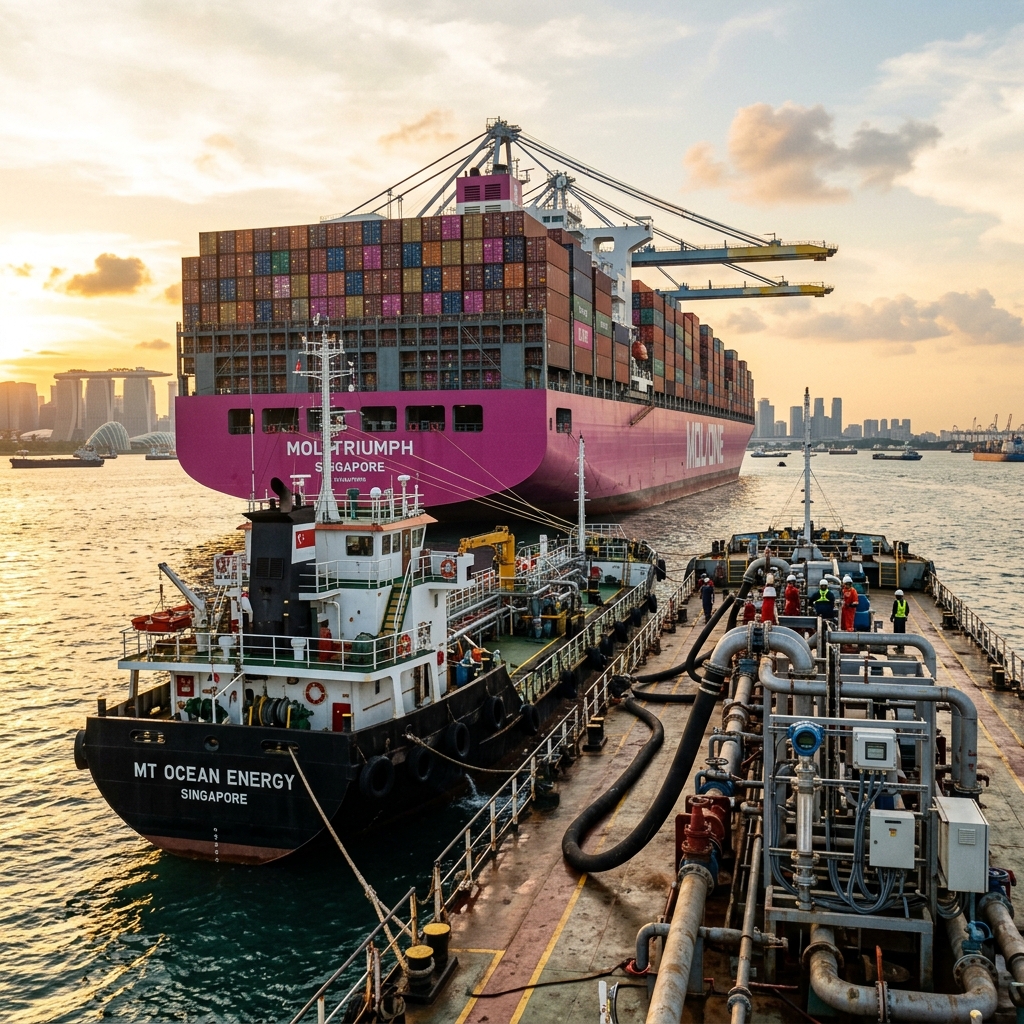
Marine bio-bunkering has emerged as the premier operational drop-in decarbonization solution for deep-sea container shipping and bulk ocean transport. B24 Bio-VLSFO consists of a 24% by volume blend of second-generation, waste-derived Used Cooking Oil Methyl Ester (UCOME, HS 3826.00) with 76% conventional Very Low Sulphur Fuel Oil (VLSFO 0.5% S, ISO 8217 RMG 380). B30 increases the bio-share to 30%. Under the European Union's FuelEU Maritime Regulation (Regulation EU 2023/1805), commercial vessels calling European ports face mandatory greenhouse gas (GHG) intensity reductions of 2% in 2025, ramping to 6% in 2030, 14.5% in 2035, and 80% by 2050, accompanied by severe non-compliance penalties (€2,400 per tonne of VLSFO equivalent). Burning B24 formulated with ISCC-EU certified Annex IX Part B waste lipids delivers a verified lifecycle GHG reduction exceeding 20% to 22% on a well-to-wake basis, immediately bringing container liners (Maersk, CMA CGM, ONE, Cosco, Evergreen) and Capesize bulkers into full regulatory compliance without engine modification. The commercial trade is concentrated at the Port of Singapore, the world's leading bunkering hub with over 54 million metric tonnes of marine fuel sales. The Maritime and Port Authority of Singapore (MPA) pioneered the regulatory framework through Singapore Technical Reference TR 56, Singapore Standard SS 660, and Provisional National Standard WA 2:2022 for Marine Biofuel Blends. In Singapore, all bio-bunkering transfers must occur via MPA-approved Mass Flow Meters (MFM) to eliminate volumetric discrepancies, with representative MARPOL drip samples taken continuously at the bunker manifold. Quality parameters strictly satisfy ISO 8217:2024 residual marine fuel specifications: kinematic viscosity ≤ 380 cSt at 50 °C, density ≤ 991.0 kg/m³, flash point ≥ 60 °C, and total sediment existent/potential (TSE/TSP) audited to guarantee thermal stability and filterability in shipboard purifiers. CBIL brokers physical B24 and B30 bunker stems and cargo blending parcels in Singapore (Jurong Island / Universal Anchorage), Rotterdam, and Zhoushan, contracting exclusively against named MPA-licensed bunker suppliers and ISCC-EU certified blenders, backed by complete Proof of Sustainability (PoS) mass-balance documentation.
Need the ship as well? Our chartering desk prices product tanker chartering on LaycanDesk.
Excluded origins are not offered, including product re-exported, blended or re-processed through a third country. Every lot moves with a certificate of origin naming the producing plant, mine or grower country, and nothing is quoted before the seller and loading point are known.
Indicative reference
VLSFO Singapore benchmark + $135–$175/MT bio-premium USD / MT
as at September 2026
Reference level only — not an offer, and reviewed quarterly. Levels shown are as at September 2026. Firm pricing is quoted per RFQ, subject to volume, terms and inspection.
Typical Specification
Specifications are indicative and adjusted to the agreed contract and destination requirements. Final spec confirmed on COA / SGS.
Available Grades
Applications
- Deep-sea container carrier decarbonization (FuelEU Maritime compliance)
- IMO Carbon Intensity Indicator (CII) rating optimization (A/B grade retention)
- Capesize and Newcastlemax dry bulk voyages
- Corporate Scope 3 maritime supply chain emissions abatement
- Green shipping corridor bunkering (Singapore–Rotterdam / Singapore–Shanghai)
Category
Petroleum & Energy
Incoterms
Delivered (Bunker) · FOB · CIF
Pricing basis
USD / MT
Inspection
SGS / Intertek at load port
B24 & B30 Marine Bio-Bunker Fuel (Bio-VLSFO) — buyer questions
What is B24 marine biofuel and how is it standardized in Singapore?
B24 is a marine drop-in fuel blend comprising 24% by volume of ISCC-EU certified Used Cooking Oil Methyl Ester (UCOME) and 76% Very Low Sulphur Fuel Oil (VLSFO 0.5% S). In Singapore, the world's bunkering capital, B24 is standardized under Singapore Standard SS 660 and Provisional Standard WA 2:2022. It complies fully with ISO 8217:2024, enabling conventional two-stroke marine diesel engines to burn the fuel without requiring modifications or retrofits.
How does bunkering B24 in Singapore fulfill European FuelEU Maritime requirements?
Under the EU FuelEU Maritime regulation, voyages entering, departing, or operating within European ports must reduce their energy GHG intensity by 2% starting in 2025. Because B24 incorporates waste-derived UCOME (RED III Annex IX Part B) with a verified lifecycle GHG savings exceeding 84% against fossil fuels, the blended stem reduces well-to-wake carbon intensity by over 20%, generating compliance surpluses that insulate shipowners from €2,400/MT compliance penalties.
How is quantity and quality verified during physical bunkering delivery in Singapore?
Under MPA Singapore regulations, all bunker tankers delivering marine biofuels must be equipped with calibrated Coriolis Mass Flow Meters (MFMs) sealed by authorized authorities. The delivered metric tonnage is recorded directly from the meter, eliminating traditional manual sounding disputes and volumetric temperature variations. Continuous drip samples are taken at the ship's receiving manifold and sealed under MARPOL Annex VI for certified laboratory analysis.
What sustainability documentation accompanies a B24 bio-bunker stem?
Every stem delivered through CBIL includes an official Bunker Delivery Note (BDN) indicating the exact bio-blend ratio, an independent laboratory Certificate of Analysis (COA), and an unbroken ISCC-EU Proof of Sustainability (PoS). The PoS traces the UCOME feedstock from approved collection points to the blending terminal, certifying compliance with EU RED II/III criteria and verifying the precise greenhouse gas emission reduction percentage.
Ready to source B24 Bio-Bunkers?
Send your quantity, specification, preferred Incoterms and destination port. Qualified requirements receive a workable offer against verified supply.
Have B24 Bio-Bunkers to sell? Submit an offer — we'll match it against live buyer demand.
More in Fuel Oil (D6 & Bunker Grades)
IFO 380 Bunker Fuel
ISO 8217 RMG 380 marine residual fuel, HSFO & VLSFO
VLSFO 0.5% Sulphur Marine Fuel
Very low sulphur fuel oil to ISO 8217 RMG 380, IMO 2020 compliant
HSFO 3.5% High Sulphur Fuel Oil
380 cSt and 180 cSt high sulphur fuel oil for scrubber ships and power plants
Marine Gasoil (MGO) DMA / DMZ 0.1%
ISO 8217 DMA and DMZ distillate at 0.10% sulphur for ECAs and EU berths