
Sorghum
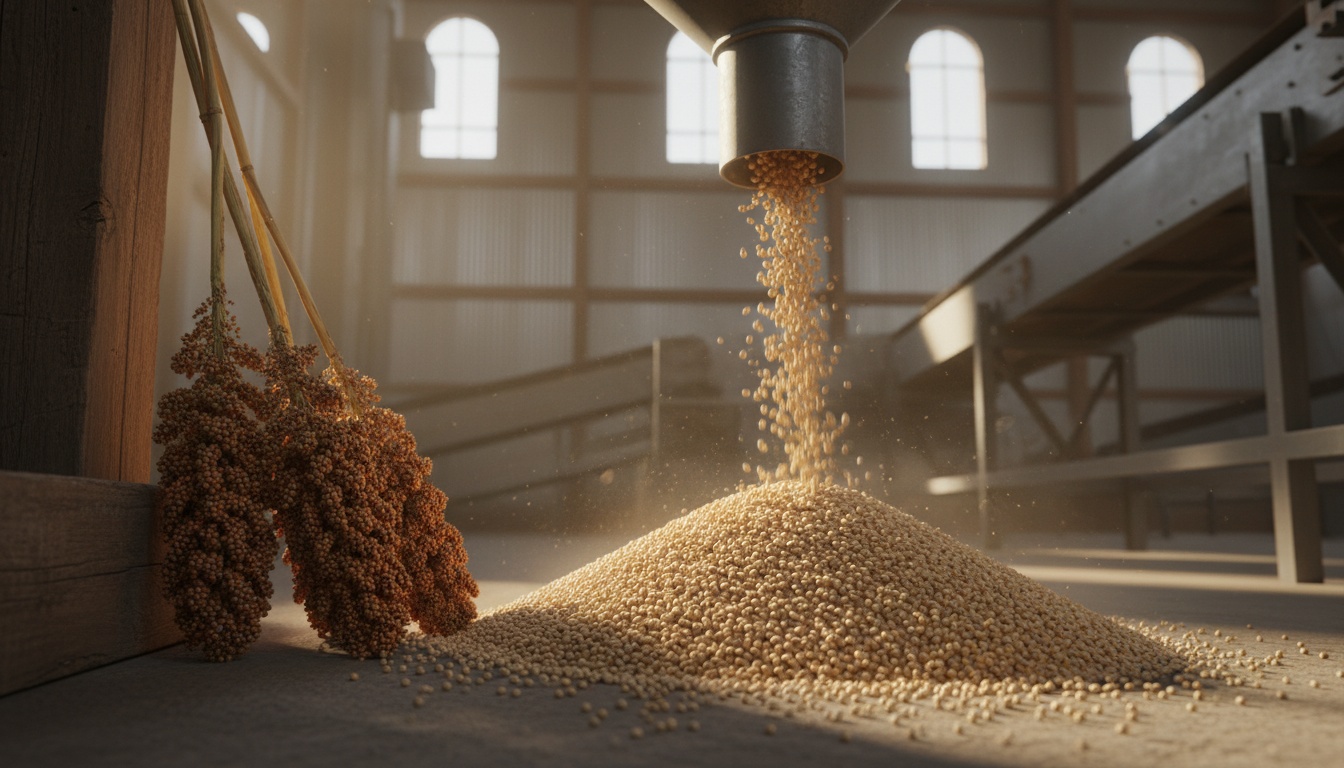
White food-grade & red feed-grade jowar
The whole sorghum trade turns on one fork: white versus red, which is really food versus feed. White sorghum (jowar) is the food grain — low-tannin, clean cream-white pericarp, milled into jowar flour and roti, extruded into gluten-free snacks and increasingly bought by Western food manufacturers who want a non-wheat, non-corn starch base. It is graded hard on colour uniformity and discoloured-grain percentage, because dark specks carry straight through into the flour. Red sorghum carries a coloured pericarp and higher tannin, which suppresses feed conversion in monogastrics but is fine for ruminants, so red trades as feed material at a substantially lower price. Tannin percentage is worth writing into the contract rather than assuming from colour.
Against the siblings on this page, sorghum is the volume calorie grain: buyers come to it instead of millets when they need feed economics at scale or a large-tonnage gluten-free milling base, and instead of maize when they want a drought-tolerant, non-GMO starch source. Feed compounders buy on test weight, moisture, broken and foreign matter and aflatoxin; food millers add colour, tannin and a tighter aflatoxin ceiling. Lots are machine-cleaned, destoned and gravity-separated, with Sortex colour-sorting on food-grade white, certified by SGS or Intertek for colour class, tannin, purity, moisture, test weight, broken and damaged grain, aflatoxin and crop year, plus phytosanitary and fumigation documentation. CBIL arranges 50kg PP bags, 1 MT jumbo bags and bulk-vessel supply on FOB, CFR and CIF terms.
Need the ship as well? Our chartering desk prices bagged and bulk grain freight on LaycanDesk.
Excluded origins are not offered, including product re-exported, blended or re-processed through a third country. Every lot moves with a certificate of origin naming the producing plant, mine or grower country, and nothing is quoted before the seller and loading point are known.
Indicative reference
$340–470 USD / MT
as at September 2026
Reference level only — not an offer, and reviewed quarterly. Levels shown are as at September 2026. Firm pricing is quoted per RFQ, subject to volume, terms and inspection.
Typical Specification
Specifications are indicative and adjusted to the agreed contract and destination requirements. Final spec confirmed on COA / SGS.
Available Grades
Applications
- Flour & roti milling
- Gluten-free snack extrusion
- Compound animal feed
- Poultry & aqua feed
Category
Agri-Foods, Spices & Nuts
Incoterms
FOB · CFR · CIF
Pricing basis
USD / MT
Inspection
SGS / Intertek at load port
Sorghum — buyer questions
White or red sorghum — how do I choose?
It is food versus feed. White is the low-tannin food grain milled into jowar flour, roti and gluten-free extruded snacks, and it is graded hard on colour uniformity because dark specks carry through into the flour. Red carries a coloured pericarp and higher tannin, trades at a substantially lower price, and is bought by feed compounders. Do not buy white for a feed ration — you are paying a milling premium the animal cannot use.
Why does tannin matter, and should I specify it?
Yes, specify it rather than inferring it from colour. Tannin suppresses feed conversion in monogastrics — poultry and pigs — while ruminants tolerate it. We certify tannin percentage on the lot, typically ≤ 0.4% on food-grade white, so the number is contracted rather than assumed.
Why is sorghum so much cheaper than the pulses on this page?
It is a bulk calorie grain, not a protein pulse. Sorghum competes with maize and feed wheat on price per tonne of starch, and it moves in bulk-vessel tonnage, whereas chickpeas, lentils and kidney beans are graded, sorted, bagged food pulses sold on calibre and appearance. The price gap reflects two genuinely different markets, not a quality difference.
Can sorghum replace maize in a feed ration?
Largely, yes — it is a well-established maize substitute on an energy basis and appeals where buyers want a drought-tolerant, non-GMO starch source. The caveats are tannin, which needs watching for monogastric rations, and test weight, which drives the energy density you are actually buying. Both are on the certificate, so the substitution can be modelled rather than guessed.
Ready to source Sorghum?
Send your quantity, specification, preferred Incoterms and destination port. Qualified requirements receive a workable offer against verified supply.
Have Sorghum to sell? Submit an offer — we'll match it against live buyer demand.
More in Pulses & Grains
Chickpeas
Kabuli by calibre in mm & Desi by count
Lentils
Red & green, whole and split, Laird to Eston
Pigeon Peas (Toor / Arhar)
Whole toor & toor dal from Myanmar and Tanzania
Mung Beans
Green gram by seed size, shine & sprouting grade
Kidney Beans (Rajma)
Light red, dark red & Rajma Chitra speckled
Millets
Pearl, foxtail, finger & the minor millets
Black-Eyed Beans (Cowpeas)
Cream cowpeas with a black eye, sold on count per 100 g, colour and Sortex cleaning
Dried Peas (Yellow & Green)
Whole and split yellow and green peas by grade, bleach and splits, in bulk vessels and containers