
Insoluble Sulphur (IS 60 / IS 90 / HD Grades)
Polymeric sulphur for tyre vulcanisation, bought on insoluble content and thermal stability
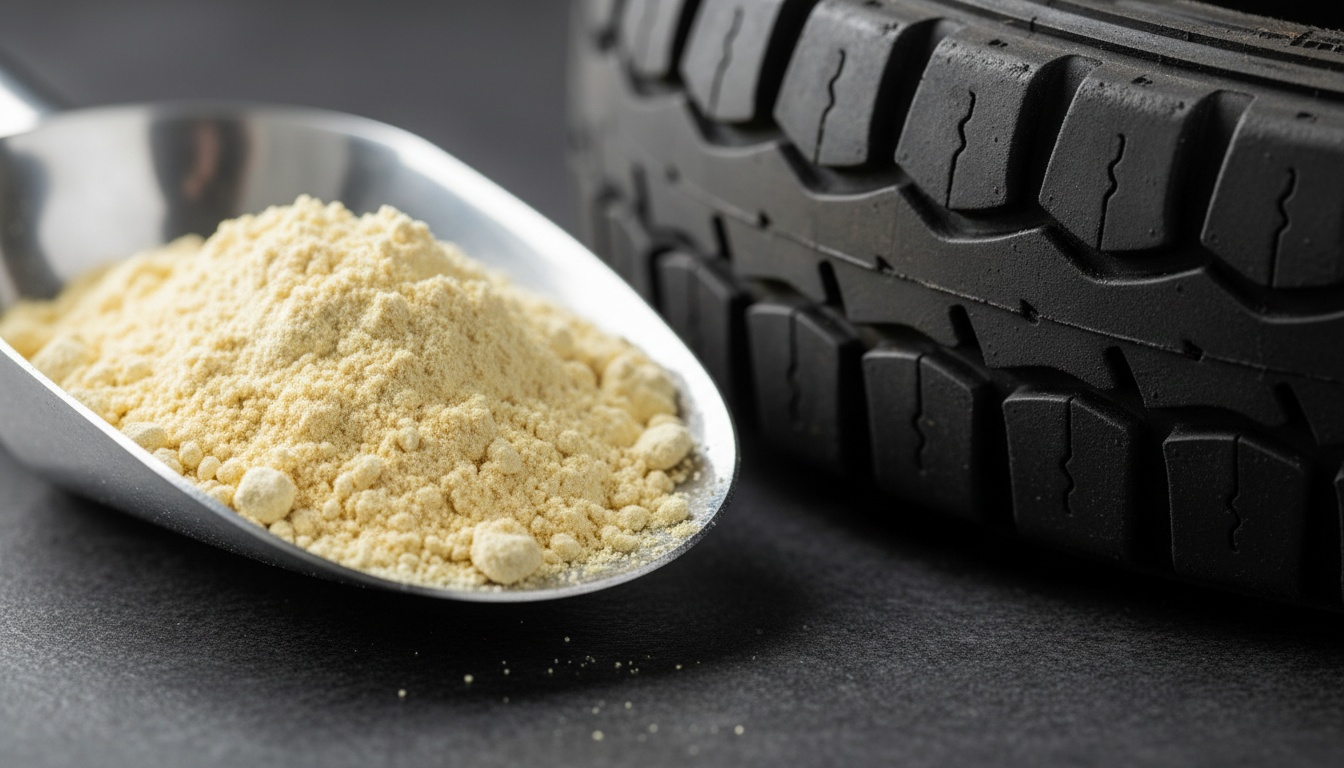
Insoluble sulphur is not a mined or recovered sulphur in the sense of the rest of this family; it is elemental sulphur heated above its polymerisation point, quenched and extracted so that the chain form (polymeric, µ-sulphur) is left behind and the crystalline rhombic form that dissolves in rubber is stripped out. That is the entire point of the product. Ordinary rhombic sulphur dissolves in a rubber compound and migrates to the surface as it cools — bloom — which destroys the tack between the plies of a radial tyre before the cure and gives an uneven crosslink density afterwards; the polymeric form stays put until the cure temperature converts it, so steel-cord skim, belt and carcass compounds are built on it. The grade sheet has four lines that matter. Insoluble content is the fraction of the sulphur that does not dissolve in carbon disulphide, 60% or better for IS 60 and 90% or better for IS 90, tested after a fixed heat-ageing; thermal stability is the insoluble content retained after holding at 105°C for 15 minutes (or a similar producer method), the number that separates a grade that survives a hot mixing cycle from one that reverts to rhombic in the Banbury; oil content is the naphthenic or aromatic process oil the powder is treated with to suppress dust and static, 10% for the standard IS 60 and IS 90 oil-treated grades and 20% for the higher-treated grades; and dispersion, for the HD grades, is a mixing-test rating that predicts whether the powder distributes through a high-viscosity skim compound without agglomerates. Behind those sit acidity (≤ 0.05% as H₂SO₄), ash (≤ 0.3%), heating loss, and a particle size expressed as residue on a 100 or 150 mesh sieve. Classification follows the grade: untreated and oil-treated insoluble sulphur is declared under HS 2802.00 as sublimed or precipitated sulphur, while some producers and customs authorities put the oil-treated and pre-dispersed rubber grades under HS 3812.39, the prepared rubber-compounding heading; check which your importer's tariff line expects before the shipment is documented.
The producers are a short list: China (the volume supplier and the source of most Asian and Middle Eastern tonnage), India, Japan, Germany and the USA, with the Western producers holding the high-dispersion and high-thermal-stability end where the passenger-radial and truck-tyre plants specify by producer name. The buyer is a tyre plant in India, Turkiye, Egypt, Thailand or Vietnam, a conveyor-belt or hose maker, or a rubber-chemicals distributor supplying all of them, and the desk holds two rubber-chemicals enquiries at present. CBIL is a commodity brokerage company and brokers insoluble sulphur from Chinese, Indian, Japanese, German and US producers and distributor positions against SGS or Intertek certification of insoluble content, thermal stability, oil content, acidity, ash and sieve residue at load, with the producer's certificate of analysis and, where the plant requires it, a pre-shipment sample for a mixing trial. The product moves in 25 kg polyethylene-lined paper or PP bags on pallets, 18–20 MT to a 20-foot container, on FOB, CFR and CIF terms; it is a container cargo and the chartering desk is not the point here. Send your grade, the thermal-stability method you test against and the plant it is going into and we will work the producer to it.
Need the ship as well? Our chartering desk prices Gulf to India sulphur and fertilizer freight on LaycanDesk.
Indicative reference
$1,400–2,200 USD / MT
as at September 2026
Reference level only — not an offer, and reviewed quarterly. Levels shown are as at September 2026. Firm pricing is quoted per RFQ, subject to volume, terms and inspection.
Typical Specification
Specifications are indicative and adjusted to the agreed contract and destination requirements. Final spec confirmed on COA / SGS.
Available Grades
Applications
- Radial tyre steel-cord skim & belt compounds
- Tyre carcass & sidewall compounds
- Conveyor belts & hoses
- Rubber-coated cables & footwear
- Rubber-chemicals distribution
Category
Petroleum & Energy
Incoterms
FOB · CFR · CIF
Pricing basis
USD / MT
Inspection
SGS / Intertek at load port
Insoluble Sulphur (IS 60 / IS 90 / HD Grades) — buyer questions
IS 60 or IS 90 — which grade do I need?
IS 90 for anything that touches steel cord or where bloom would cost you adhesion: skim, belt and bead compounds in radial tyres, and most truck-tyre work. IS 60 is the economy grade for carcass, sidewall, tread and general mechanical goods where the compound tolerates some soluble fraction. Both are quoted with an oil content, so state it — 10% is standard, 20% where your mixing line needs the extra dust suppression and flow. Send the compound and the cure profile and we will match the grade rather than guess.
Why does thermal stability matter more than the headline insoluble figure?
Because insoluble sulphur reverts to the soluble rhombic form when it is held hot, and a compound spends its life in the mixer, the extruder and the calender before it ever reaches the press. A grade that tests 90% insoluble out of the bag and 60% after fifteen minutes at 105 °C is an IS 60 by the time it is in the tyre. Ask for the retained-insoluble figure by the producer's method and ours, and buy on that; the high-thermal-stability grades cost more because that number holds.
Which HS code should the shipment travel under?
Most producers declare insoluble sulphur under HS 2802.00 as sublimed or precipitated sulphur, and most importers accept that. Some customs authorities treat the oil-treated and pre-dispersed rubber grades as a prepared compounding additive under HS 3812.39, and the duty rate can differ. It is an importer's question: tell us which line your broker clears against and the documents will match it from the start rather than being amended at the port.
What is the minimum order and how is it shipped?
One 20-foot container of 18–20 MT in 25 kg bags on pallets, on FOB, CFR and CIF terms; tyre plants on contract take several containers a month against a call-off. This is a container cargo, not a bulk one, so the chartering side of our desk does not come into it — the freight is a container rate and the lead time from a Chinese or Indian producer is typically three to six weeks to the Gulf, Egypt or Turkiye. Keep it dry and below 40 °C in storage; it does not like heat.
Ready to source Insoluble Sulphur?
Send your quantity, specification, preferred Incoterms and destination port. We'll verify supply and respond with a workable offer — usually within one business day.
Have Insoluble Sulphur to sell? Submit an offer — we'll match it against live buyer demand.
More in Sulphur (Granular & Lump)
Lump Sulphur (Crushed)
Crushed block sulphur, 99.8% min, bulk & jumbo bags
Granular Sulphur
Formed 2–6 mm granules, low friability, deep-sea grade
Prilled Sulphur
Uniform 1–4 mm prills for bagged & blended use
Sulphur Powder (Micronized)
Micronized 200–325 mesh for agriculture & rubber
Sulphur Bentonite 90%
90% S pastilles that disperse on contact with moisture
Liquid Sulphur (Molten)
Molten sulphur at 135–145°C, no forming, no dust