
Liquid Sulphur (Molten)
Molten sulphur at 135–145°C, no forming, no dust
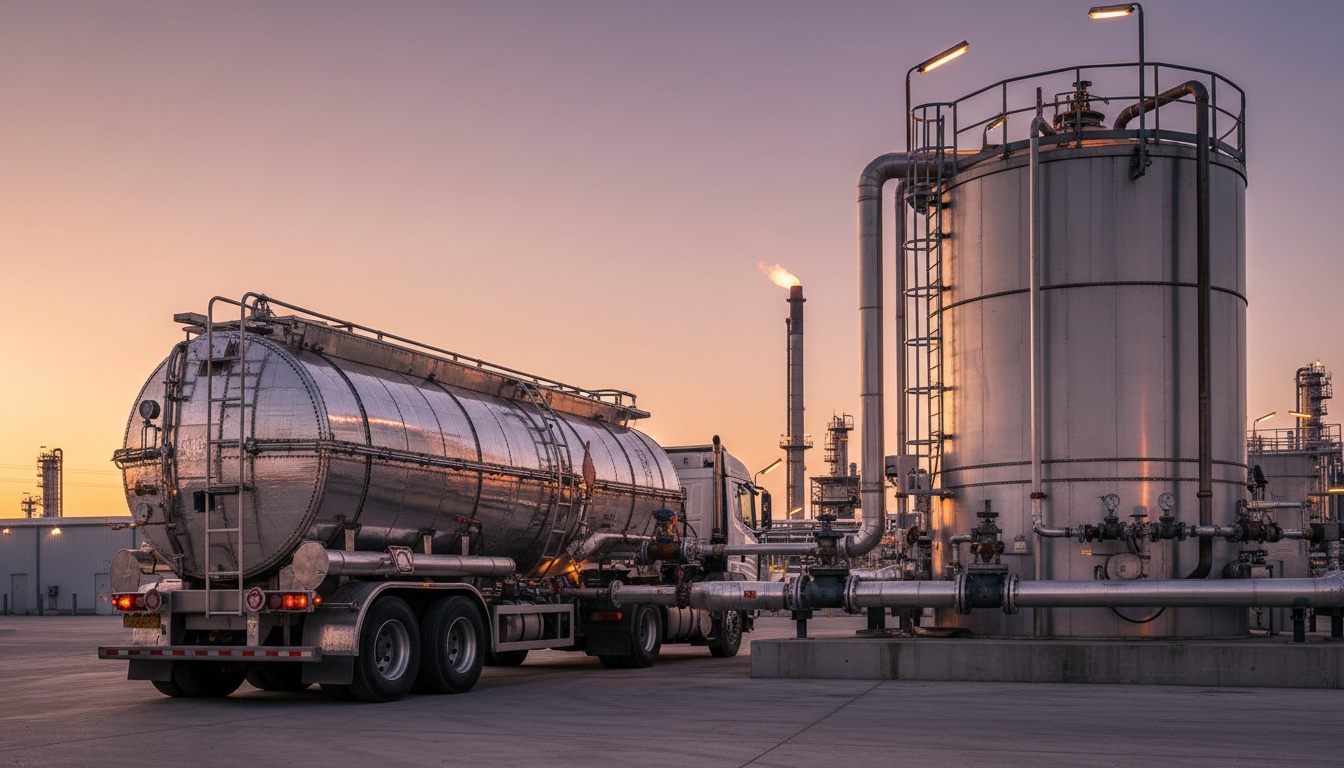
Liquid sulphur is the same recovered elemental sulphur, simply never allowed to solidify. It leaves the Claus unit molten and is kept at 135–145°C — the viscosity window between the freezing point around 115°C and the sharp viscosity rise above roughly 160°C where polymerisation makes it unpumpable — in steam- or electrically-traced insulated tanks. Purity is typically 99.9% or better, moisture is negligible, ash ≤ 0.02% and acidity ≤ 0.01%, and because the material never enters a forming plant or a stockpile it picks up none of the ash, dust and contamination that solid handling introduces. Residual hydrogen sulphide dissolved in the melt is the parameter that genuinely matters here rather than in any solid form: it is degassed at source to under 10 ppm, and that number is a safety specification, not a quality preference, because H₂S evolving in a closed tank is toxic and flammable.
The case for molten is that both ends of the forming cycle disappear. The producer skips granulation and the consumer skips the melter, the melt pit, the associated steam load and the dust and housekeeping burden entirely — so where the geography works, molten is the cheapest and cleanest way to move sulphur into a sulphuric acid plant, a phosphate complex, a carbon-disulphide unit or a pulp mill. The constraint is equally blunt: it only works within economic trucking, rail or short-sea range of the source, because every kilometre is a heated, insulated, dedicated tank movement, and the receiving plant must already have heated storage. Beyond that radius the economics invert and granular wins, which is exactly why the deep-sea trade is solid and the molten trade is regional. CBIL arranges molten sulphur in heated ISO tanks, rail tank cars and road tankers from Middle East and regional sources against COA and independent verification of purity, ash, acidity and H₂S content at loading, with temperature and degassing confirmed at both ends. Send us your location, offtake rate and storage temperature and we will tell you honestly whether molten or granular lands cheaper at your gate.
Need the ship as well? Our chartering desk prices Oman and Red Sea to India sulphur and fertilizer freight on LaycanDesk.
Excluded origins are not offered, including product re-exported, blended or re-processed through a third country. Every lot moves with a certificate of origin naming the producing plant, mine or grower country, and nothing is quoted before the seller and loading point are known.
Indicative reference
$130–200 USD / MT
as at September 2026
Reference level only — not an offer, and reviewed quarterly. Levels shown are as at September 2026. Firm pricing is quoted per RFQ, subject to volume, terms and inspection.
Typical Specification
Specifications are indicative and adjusted to the agreed contract and destination requirements. Final spec confirmed on COA / SGS.
Available Grades
Applications
- Sulphuric acid plants
- Phosphate fertilizer complexes
- Carbon disulphide production
- Pulp & paper
- Chemical & specialty manufacturing
Category
Petroleum & Energy
Incoterms
FOB · CFR · DAP
Pricing basis
USD / MT
Inspection
SGS / Intertek at load port
Liquid Sulphur (Molten) — buyer questions
When does molten beat granular on cost?
When you are close enough to the source and you already have heated storage. Molten removes the forming step at the producer's end and the melter, melt pit and steam load at yours, which is a real saving — but it is spent again on heated, insulated, dedicated tank movements that get more expensive with every kilometre. Inside economic trucking or rail range it usually wins clearly; beyond it, granular does. Give us your location and offtake rate and we will run both.
Why does H₂S content matter so much?
Because dissolved hydrogen sulphide comes out of the melt in the vapour space of a closed tank, where it is both acutely toxic and flammable. It is a safety specification rather than a quality one, which is why sulphur is degassed at source to under 10 ppm before loading and why the figure is verified at both ends. Do not accept a molten delivery without a degassing certificate.
What temperature must be maintained in transit?
135–145°C. Below about 115°C it freezes solid in the tank, which is an expensive recovery job. Above roughly 160°C viscosity rises steeply as the sulphur polymerises and it becomes very difficult to pump. Tanks are steam- or electrically-traced and insulated, and temperature is logged and confirmed on discharge. Your receiving storage has to hold the same window.
Can you supply molten if my plant has no heated storage?
No — and we will say so rather than sell you a problem. Molten sulphur needs heated, insulated storage with the right pumps, tracing and vapour handling at the receiving end. If you do not have that, granular or lump into a melter is the correct answer, and the capital case for molten storage only closes at fairly high sustained offtake. We will help you compare it honestly.
Which buyers lost Gulf sulphur in 2026?
Phosphate producers in Morocco, India, Brazil and Jordan, phosphoric acid makers in South Africa, copper-cobalt leach plants in the DR Congo and the Ambatovy nickel plant in Madagascar all drew most of their sulphur from inside the Gulf. The Strait of Hormuz has been severely restricted since 28 February 2026. CBIL quotes sulphur from origins outside the strait into those markets; the granular sulphur page sets out who buys in each.
Ready to source Liquid Sulphur?
Send your quantity, specification, preferred Incoterms and destination port. Qualified requirements receive a workable offer against verified supply.
Have Liquid Sulphur to sell? Submit an offer — we'll match it against live buyer demand.
More in Sulphur (Granular & Lump)
Lump Sulphur (Crushed)
Crushed block sulphur, 99.8% min, bulk & jumbo bags
Granular Sulphur
Formed 2–6 mm granules, low friability, deep-sea grade
Prilled Sulphur
Uniform 1–4 mm prills for bagged & blended use
Sulphur Powder (Micronized)
Micronized 200–325 mesh for agriculture & rubber
Sulphur Bentonite 90%
90% S pastilles that disperse on contact with moisture
Insoluble Sulphur (IS 60 / IS 90 / HD Grades)
Polymeric sulphur for tyre vulcanisation, bought on insoluble content and thermal stability