
Stockfish, Salted & Dried Cod (Klipfish) and Dried Anchovies
Norwegian stockfish and heads, salted and dried cod and saithe, and dried anchovies for Nigerian, West and Central African and Southern European importers
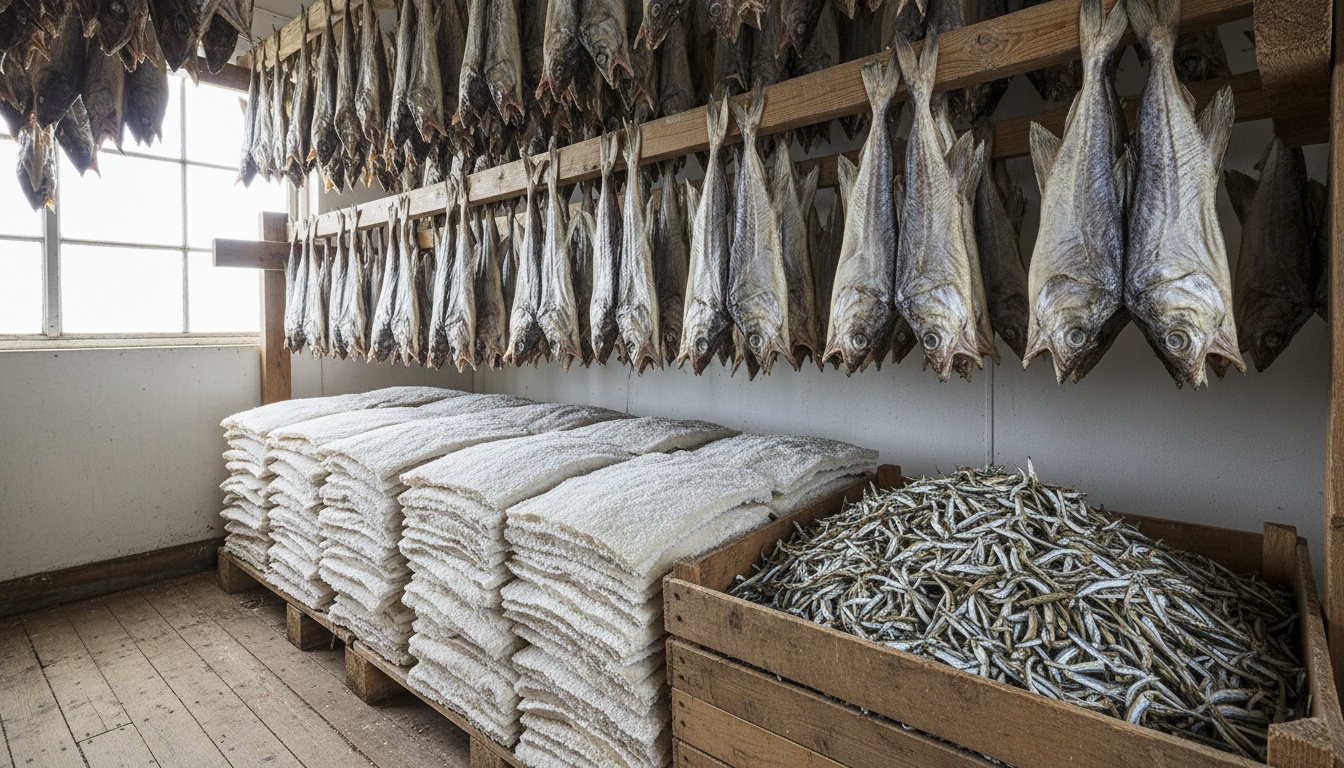
Stockfish is cod (and saithe, ling and tusk) hung unsalted on wooden racks in Lofoten and Troms in late winter and air-dried for about three months, then sorted fish by fish on quality, weight, length, colour, aroma and appearance into Prima, Sekunda and Africa grades, of which Lofoten Prima alone has at least twelve sub-grades, and packed in hessian bales. Italy takes the top grades and Nigeria the Africa grades and the heads, which are the largest single product category shipped there. Klipfish, or clipfish, is a different cure: the fish is split, most of the backbone removed, salt-matured for two to three weeks and then dried and pressed; Portugal's trade guide grades semi-dry salted cod at 16% salt or more with 47-51% moisture and well-dried yellow cure at 12-16% salt and 45% moisture or less. Wet-salted cod that has not been dried is a third product on its own customs line. Boiled dried salted anchovies from Indonesia and Thailand, the "ikan teri" and "ikan bilis" of South-East Asian kitchens, are covered by Codex CXS 236-2003 and graded by size, headless or whole, colour and breakage, with buyer sheets set on moisture and salt. This spoke is fish only: no crab, lobster, oysters, other shellfish or molluscs.
The numbers show who ships and who buys. The Norwegian Seafood Council reports 3,531 MT of stockfish worth NOK 897 million exported in 2024 and 2,893 MT worth NOK 899 million in 2025, with Italy, Croatia and Nigeria the largest markets, and 74,154 MT of clipfish worth NOK 6.7 billion in 2025 to Portugal, Brazil and the Dominican Republic; it directs its clipfish work at Congo and its stockfish work at Nigeria. UN Comtrade 2024 export declarations under HS 0305.51 (dried cod) total 43,400 MT: Norway 28,200 MT worth USD 385 million, Sweden 4,900 MT, Portugal 3,600 MT, Canada 1,400 MT, Spain 1,300 MT and Iceland 1,100 MT, while Portugal imported 21,900 MT, the Dominican Republic 16,900 MT, Germany 5,400 MT, Brazil 2,800 MT and Italy 2,300 MT worth USD 55 million. Under HS 0305.62 (salted cod, not dried) Norway exported 17,700 MT, Iceland 15,500 MT and Sweden 8,300 MT, and Portugal imported 28,300 MT, Spain 11,200 MT, Italy 4,400 MT, Brazil 2,000 MT and Angola 475 MT. Under HS 0305.59 (other dried fish) China exported 10,600 MT worth USD 94 million, India 14,800 MT, Thailand 7,700 MT, Indonesia 3,500 MT, Kenya 3,600 MT and Uganda 2,300 MT, and the Democratic Republic of the Congo declared 3,300 MT of imports worth USD 12 million; salted anchovies (HS 0305.63) came from Spain at 6,700 MT, Morocco 5,900 MT, Italy 4,100 MT, Croatia 3,200 MT and Peru 900 MT. Nigeria does not report to Comtrade. Its import regime matters more than its statistics: the Central Bank of Nigeria lifted the foreign-exchange restriction on stockfish and 42 other items in October 2023, and the import duty on stockfish was raised from 10% to 20% in July 2025, so a Lagos importer's landed cost moved with the tariff line as much as with the Lofoten season. Dried fish ships in hessian bales and cartons in ventilated dry containers, salted fish in cartons or bulk bins, wet-salted cod in reefers. CBIL is a commodity brokerage company and brokers stockfish, heads, klipfish, salted cod and saithe and dried anchovies from Norwegian, Icelandic, Portuguese, Indonesian and Thai packers on FOB, CFR and CIF terms, against the competent-authority health certificate, a certificate of origin, the packer's grade and count declaration and an independent inspection of moisture, salt and condition at stuffing where the buyer wants it; every lot is species-declared. The buyer is an importer-distributor in Lagos, Onitsha, Douala, Pointe-Noire, Kinshasa or Luanda, a Portuguese, Spanish, Italian or Brazilian salted-fish house, or an Asian dried-anchovy packer. Send the product, grade, size, salt and moisture limits, volume and the destination port.
Excluded origins are not offered, including product re-exported, blended or re-processed through a third country. Every lot moves with a certificate of origin naming the producing plant, mine or grower country, and nothing is quoted before the seller and loading point are known.
Indicative reference
Per bale or carton, on grade and size USD / kg
as at September 2026
Reference level only — not an offer, and reviewed quarterly. Levels shown are as at September 2026. Firm pricing is quoted per RFQ, subject to volume, terms and inspection.
Typical Specification
Specifications are indicative and adjusted to the agreed contract and destination requirements. Final spec confirmed on COA / SGS.
Available Grades
Applications
- Nigerian and West African soups and stews (stockfish, heads)
- Central African markets (klipfish saithe, dried fish)
- Portuguese, Spanish, Italian and Brazilian salted-cod trade
- South-East Asian and East African dried-anchovy kitchens
- Repacking and retail portioning
Category
Agri-Foods, Spices & Nuts
Incoterms
FOB · CFR · CIF
Pricing basis
USD / kg
Inspection
SGS / Intertek at load port
Stockfish, Salted & Dried Cod (Klipfish) and Dried Anchovies — buyer questions
What is the difference between stockfish and klipfish?
Salt. Stockfish is cod or saithe hung unsalted on racks in Lofoten and Troms and air-dried for about three months, then sorted into Prima, Sekunda and Africa grades. Klipfish is split, salted for two to three weeks, then dried and pressed. Stockfish goes mainly to Italy, Croatia and Nigeria; klipfish to Portugal, Brazil, the Dominican Republic and Central Africa.
Which stockfish grades go to Nigeria?
The Africa grades and the heads. The Norwegian Seafood Council names Nigeria among its three largest stockfish markets and says heads are the largest product category shipped there, followed by whole dried fish and other cuts. The Italian trade takes the Lofoten Prima grades, of which there are at least twelve sub-grades sorted by size and appearance.
What does a Nigerian importer need to know about duty?
The import duty on stockfish was raised from 10% to 20% in July 2025, and the Central Bank of Nigeria lifted its foreign-exchange restriction on stockfish and 42 other items in October 2023. Landed cost therefore moves with the tariff line and the naira as well as with the Lofoten catch, and offers are compared CFR Lagos on the same grade and count.
How are dried anchovies specified?
Codex CXS 236-2003 covers boiled dried salted anchovies. Buyers set the size band, whether the fish are whole or headless, the colour, the tolerance for broken pieces and the moisture and salt limits, and the Indonesian and Thai packers grade to those sheets. The fish ship in lined cartons in dry containers.
Ready to source Stockfish & Dried Fish?
Send your quantity, specification, preferred Incoterms and destination port. Qualified requirements receive a workable offer against verified supply.
Have Stockfish & Dried Fish to sell? Submit an offer — we'll match it against live buyer demand.
More in Fish & Shrimp: Frozen, Chilled & Salmon
Frozen Sardine, Mackerel & Horse Mackerel
Whole round frozen pelagics by size grade, glaze and histamine
Frozen Tuna (Skipjack, Yellowfin & Loins)
Whole round skipjack and yellowfin for canneries, pre-cooked loins for packers
Frozen Tilapia & Pangasius (Whole and Fillets)
Farmed whitefish whole round, gutted and as IQF fillets by size and glaze
Frozen Shrimp (Vannamei & Black Tiger)
Vannamei and black tiger by presentation, count, glaze and residue test
Fresh, Chilled & Frozen Atlantic Salmon
Farmed Atlantic salmon HOG by weight class, fillets by trim, frozen HOG and portions