
Frozen Tuna (Skipjack, Yellowfin & Loins)
Whole round skipjack and yellowfin for canneries, pre-cooked loins for packers
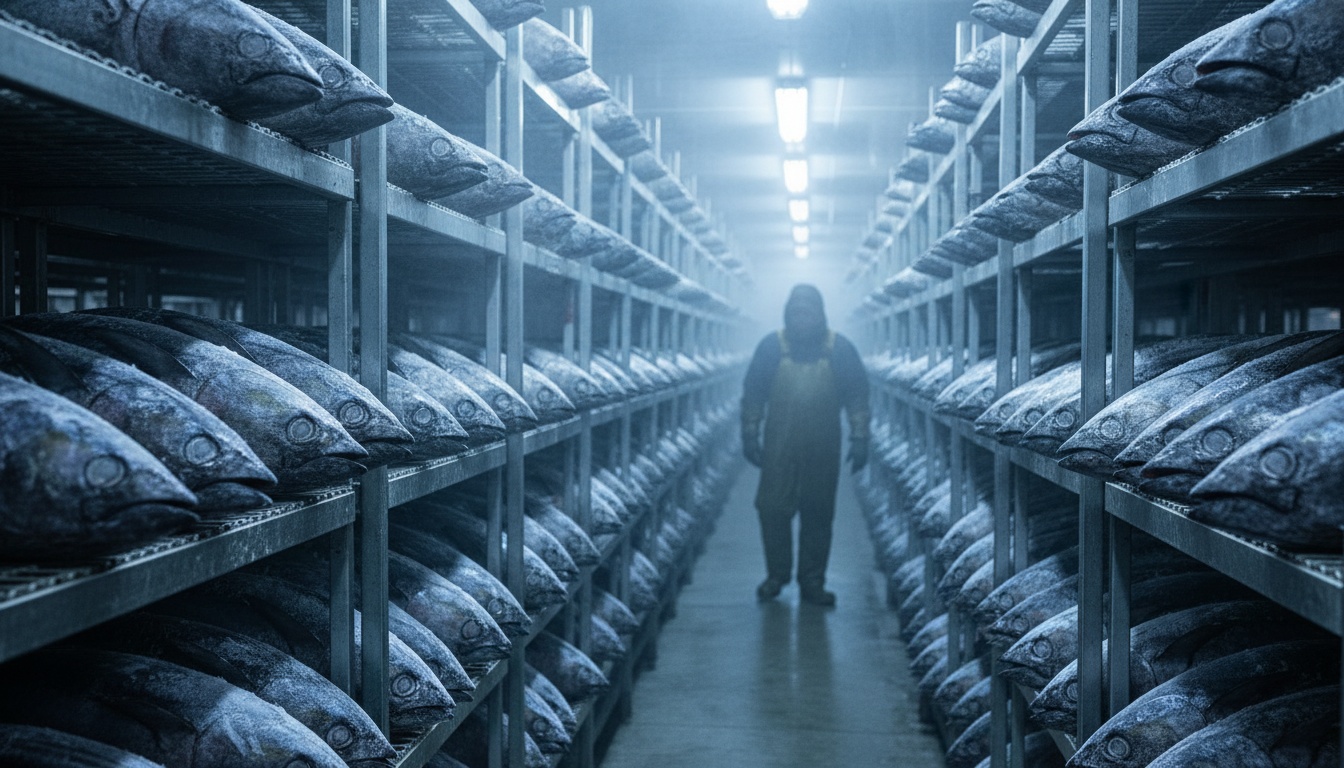
Cannery tuna is bought whole round by size band, and the band decides both the price and the yield. Skipjack (Katsuwonus pelamis, HS 0303.43) trades in the 1.4-1.8 kg, 1.8-3.4 kg and 3.4 kg-up bands, yellowfin (Thunnus albacares, HS 0303.42) in 3-10 kg, 10-20 kg and 20 kg-up, and the larger fish yield more loin per kilo of whole fish - a cannery works on a 40-45% loin recovery for skipjack and higher for large yellowfin. Purse-seine fish is brine frozen on board to -18°C or, on the better vessels and longliners, blast or ultra-low frozen; the salt uptake from brine freezing is a specification (typically under 1.5% in the flesh) because it carries into the can. Histamine is tested on every lot, with the usual ceiling of 100 ppm mean and 200 ppm maximum under EU and Codex practice, and canneries also grade on the proportion of fish with belly burst or pale flesh. Pre-cooked frozen loins (HS 1604 once cooked, but bought under the same book) let a packer skip the cooking and cleaning line and are sold vacuum packed, 6-12 kg per bag, from loining plants in Southeast Asia, Ecuador and the Indian Ocean. UN Comtrade 2025 export declarations under HS 0303, which cover all frozen fish, give the shape of the supply side: Indonesia 341k MT at an average USD 2,113/MT, India 345k MT at USD 1,754, Thailand 77.7k MT at USD 1,900 and the USA 546k MT at USD 4,041, the US and Indonesian averages being lifted by higher-value species. Oman's 2025 destination list shows 53.4k MT going to Thailand at USD 1,414/MT - raw material for the Bangkok and Samut Sakhon canneries - and 48.9k MT to China.
The buyer is a cannery in Thailand, the Philippines, Ecuador, Spain, Ghana, Mauritius, Seychelles or the Gulf, or a packer that buys loins for retail cans and pouches, and it contracts against the Bangkok skipjack landed price by size band with adjustments for salt, histamine and defects on inspection. CBIL is a commodity brokerage company and brokers whole round frozen skipjack and yellowfin and pre-cooked frozen loins from Indonesian, Indian, Omani, Thai and Ecuadorian packers, trader positions and carrier transhipments against a plant health certificate, a catch certificate or IUU documentation where the destination requires it, and a surveyor's report on size band, core temperature, salt and histamine. Every lot is finfish, species-declared and certifiable as halal by the destination's accepted certifier; CBIL does not broker shrimp, prawn, crab, lobster, squid, octopus, cuttlefish or clams, and the tuna book carries no bycatch of any of them. Whole fish moves in 40-ft high-cube reefer containers of about 25-27 MT, loose or in 20 kg cartons, or in reefer carrier holds for cannery-scale lots; reefer freight is quoted through the lines and forwarders, and LaycanDesk, our chartering desk, is only relevant on the rare occasion a full reefer carrier is fixed. Send the species, size band, freezing method, salt ceiling and discharge port and we will work the offer against the current landed price.
Indicative reference
$1,400-3,500 USD / MT
as at September 2026
Reference level only — not an offer, and reviewed quarterly. Levels shown are as at September 2026. Firm pricing is quoted per RFQ, subject to volume, terms and inspection.
Typical Specification
Specifications are indicative and adjusted to the agreed contract and destination requirements. Final spec confirmed on COA / SGS.
Available Grades
Applications
- Tuna canneries (chunks, flakes, solid pack)
- Retail pouch and loin packers
- Foodservice loins and steaks
- Katsuobushi and smoked tuna
- Pet-food grade offcuts
Category
Agri-Foods, Spices & Nuts
Incoterms
FOB · CFR · CIF
Pricing basis
USD / MT
Inspection
SGS / Intertek at load port
Frozen Tuna (Skipjack, Yellowfin & Loins) — buyer questions
How is cannery tuna priced?
Off the Bangkok landed price for skipjack in the 1.8 kg-up band, published weekly, with yellowfin at a premium and the smaller skipjack bands at a discount. The contract then adjusts on inspection for salt content, histamine, belly burst and the proportion of fish outside the declared band. Because the base price moves every week, an offer is normally quoted as the current landed price plus or minus a differential for the origin and the freight leg, rather than as a fixed number weeks ahead.
Is the tuna halal certifiable, and is there any shellfish bycatch in the lot?
Yes to the first and no to the second. Tuna is finfish, and every lot is species-declared on the plant health certificate and packing list so the destination's accepted certifier can issue against it. CBIL brokers finfish only - no shrimp, prawn, crab, lobster, squid, octopus, cuttlefish or clams - and does not offer mixed lots, so a tuna container holds tuna and nothing else.
What documents does a cannery need with the shipment?
A plant health certificate from the exporting country's competent authority, a catch certificate or IUU documentation for fish going to the EU and to markets that mirror it, a certificate of origin, the packer's certificate of analysis for salt and histamine, and the surveyor's report on size band and core temperature at stuffing. Loins going into retail cans usually carry the loining plant's EU or FDA approval number as well.
What is the difference between brine-frozen and blast-frozen tuna?
Purse-seine vessels freeze the catch in refrigerated seawater brine tanks, which is fast and cheap but leaves salt in the flesh - typically 1-1.5%, sometimes more on small fish - and the cannery adjusts its recipe for it. Blast or ultra-low freezing on longliners and shore plants keeps the salt near zero and the flesh colour better, and that fish commands a premium, especially yellowfin for loins and steaks. State which you need; a cannery buying for solid-pack usually takes brine-frozen at the lower price.
Ready to source Frozen Tuna?
Send your quantity, specification, preferred Incoterms and destination port. We'll verify supply and respond with a workable offer — usually within one business day.
Have Frozen Tuna to sell? Submit an offer — we'll match it against live buyer demand.