
Frozen Tilapia & Pangasius (Whole and Fillets)
Farmed whitefish whole round, gutted and as IQF fillets by size and glaze
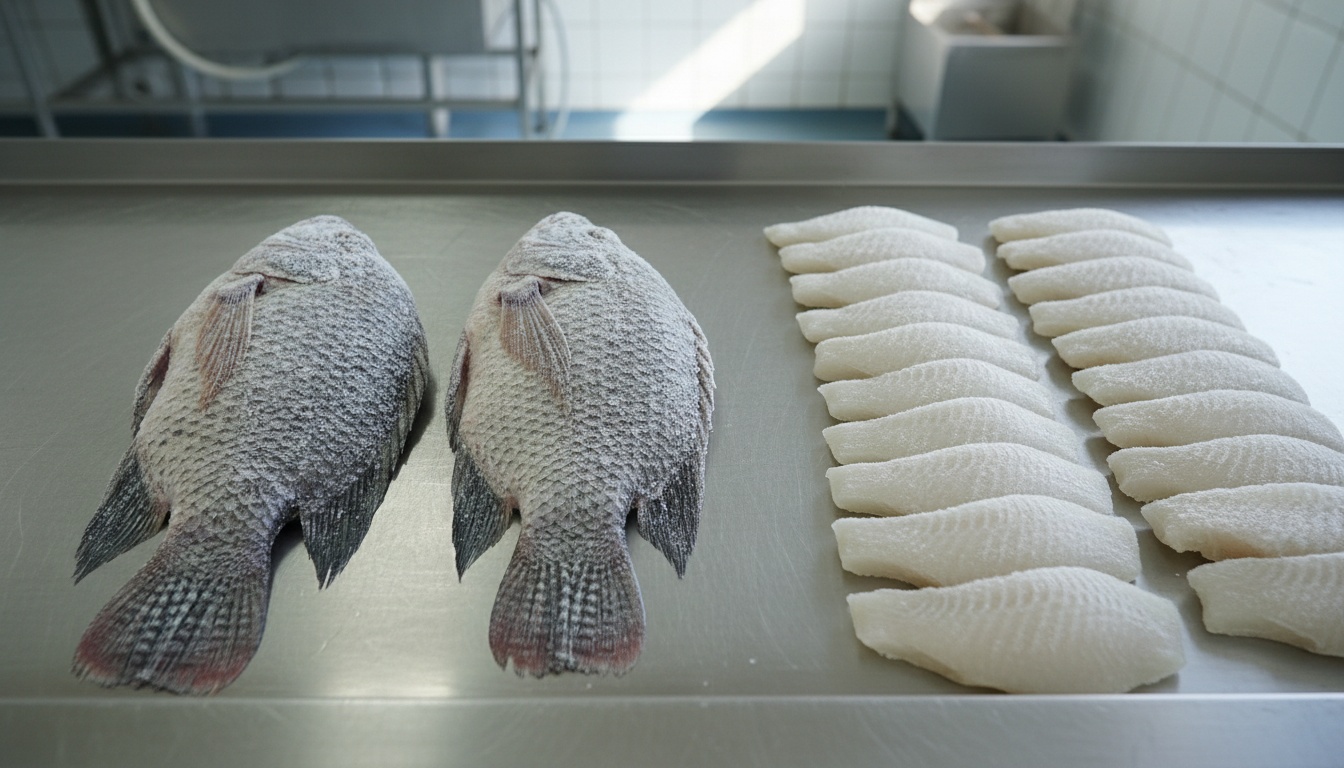
Tilapia and pangasius are the two farmed whitefish that fill the frozen retail cabinet from Riyadh to Lagos, and they are bought in three presentations. Whole round and gutted tilapia (Oreochromis niloticus, HS 0303.23) is graded by piece weight - 200-300 g, 300-500 g, 500-800 g and 800 g-up - and IQF (individually quick frozen) so each fish comes free of the carton; pangasius (Pangasius hypophthalmus, HS 0303.24), farmed in the Mekong delta, is mostly sold as skinless, boneless fillets (HS 0304.62) in 120-170 g, 170-220 g and 220 g-up sizes, well trimmed or untrimmed, and colour graded white, light pink or yellow with white at the top of the range. Tilapia fillets (HS 0304.61) follow the same pattern in 3-5 oz, 5-7 oz and 7-9 oz. Glaze is the specification that decides the real price: pangasius fillets are sold at anything from 10% to 40% glaze, and moisture retention treatment with phosphates (STPP) is declared as a percentage, so an offer at 80% net weight and one at 90% net weight are not the same product per kilo of fish. Core temperature is -18°C or colder, and the packing is 10 kg cartons (1 kg or 5 kg inner bags for retail) or 5 x 2 kg for foodservice. UN Comtrade 2025 export declarations under HS 0303 put India at 345k MT at an average USD 1,754/MT and Indonesia at 341k MT at USD 2,113 across all frozen fish; the pangasius trade sits mostly under HS 0304 fillets and is read in Vietnamese customs data rather than the frozen whole-fish line.
The buyer is a retail chain, a foodservice distributor or a wholesale importer in the Gulf, Egypt, East and West Africa or Pakistan, and it specifies the presentation, the size, the glaze and net weight, and increasingly the farm certification - ASC, BAP or GlobalG.A.P. - alongside the halal certificate. CBIL is a commodity brokerage company and brokers frozen tilapia and pangasius from Vietnamese, Chinese, Indonesian, Egyptian and Indian farms and processing plants against the plant's competent-authority health certificate, a certificate of analysis for moisture, phosphate and net weight, and a surveyor's check of size grade, glaze and core temperature at stuffing. Every lot is finfish, species-declared and certifiable as halal by the destination's accepted certifier; CBIL does not broker shrimp, prawn, crab, lobster, squid, octopus, cuttlefish or clams, so the plants we work with pack finfish lines for these lots and the container holds no other species. Cargo moves in 40-ft high-cube reefer containers of about 25-27 MT at -18°C or colder on FOB, CFR and CIF terms, with reefer freight quoted through the lines and forwarders; this is not a chartering trade and LaycanDesk, our chartering desk, does not come into it. Send the presentation, size grade, net weight basis, treatment declaration and discharge port and we will work an offer per net kilo to it.
Indicative reference
$1,300-2,800 USD / MT
as at September 2026
Reference level only — not an offer, and reviewed quarterly. Levels shown are as at September 2026. Firm pricing is quoted per RFQ, subject to volume, terms and inspection.
Typical Specification
Specifications are indicative and adjusted to the agreed contract and destination requirements. Final spec confirmed on COA / SGS.
Available Grades
Applications
- Supermarket frozen fish cabinets
- Foodservice and catering (fillets, portions)
- Wholesale and wet-market whole fish
- Further processing (breaded, battered portions)
- Institutional and camp catering
Category
Agri-Foods, Spices & Nuts
Incoterms
FOB · CFR · CIF
Pricing basis
USD / MT
Inspection
SGS / Intertek at load port
Frozen Tilapia & Pangasius (Whole and Fillets) — buyer questions
Why do two pangasius fillet offers differ so much in price?
Almost always glaze and treatment. A fillet sold at 80% net weight carries 20% ice, and one at 60% net weight carries 40%, so the cheaper offer per carton can be the dearer one per kilo of fish. Phosphate treatment adds retained water as well. Ask for the net weight after deglazing, the treatment declaration and the colour grade - white commands the premium over light pink and yellow - and compare on net fish, not on carton price.
Is the fish halal certifiable, and do the plants handle shellfish?
Tilapia and pangasius are finfish, and every lot is species-declared so the destination's accepted certifier can issue against it. CBIL brokers finfish only - no shrimp, prawn, crab, lobster, squid, octopus, cuttlefish or clams - and offers no mixed lots. Where a plant also runs other species, the finfish lines are separately declared and certified; if your certifier requires a dedicated finfish plant, say so and we filter the origins to it.
What is the difference between IQF and block frozen?
IQF freezes each fish or fillet separately so it can be taken from the carton one at a time, which is what retail and foodservice need; block frozen (BQF) freezes the fish together in a slab, which is cheaper and is standard for the pelagic trade and for further processors who thaw the whole block. Tilapia and pangasius for retail are IQF and glazed; whole tilapia for the wet market is sometimes block frozen at a lower price.
Which certifications should I ask for?
The exporting country's competent-authority health certificate is mandatory everywhere; most Gulf importers also require a halal certificate from a body their authority recognises. On farm practice, ASC, BAP and GlobalG.A.P. are the three that retail chains ask for, and HACCP or BRC at plant level. For pangasius the plant's EU approval code is the usual shorthand for a well-run line even when the container is going to Jeddah or Tema.
Ready to source Frozen Tilapia & Pangasius?
Send your quantity, specification, preferred Incoterms and destination port. We'll verify supply and respond with a workable offer — usually within one business day.
Have Frozen Tilapia & Pangasius to sell? Submit an offer — we'll match it against live buyer demand.