
Kangra Tea
Himachal orthodox & green — GI-protected in India and the EU
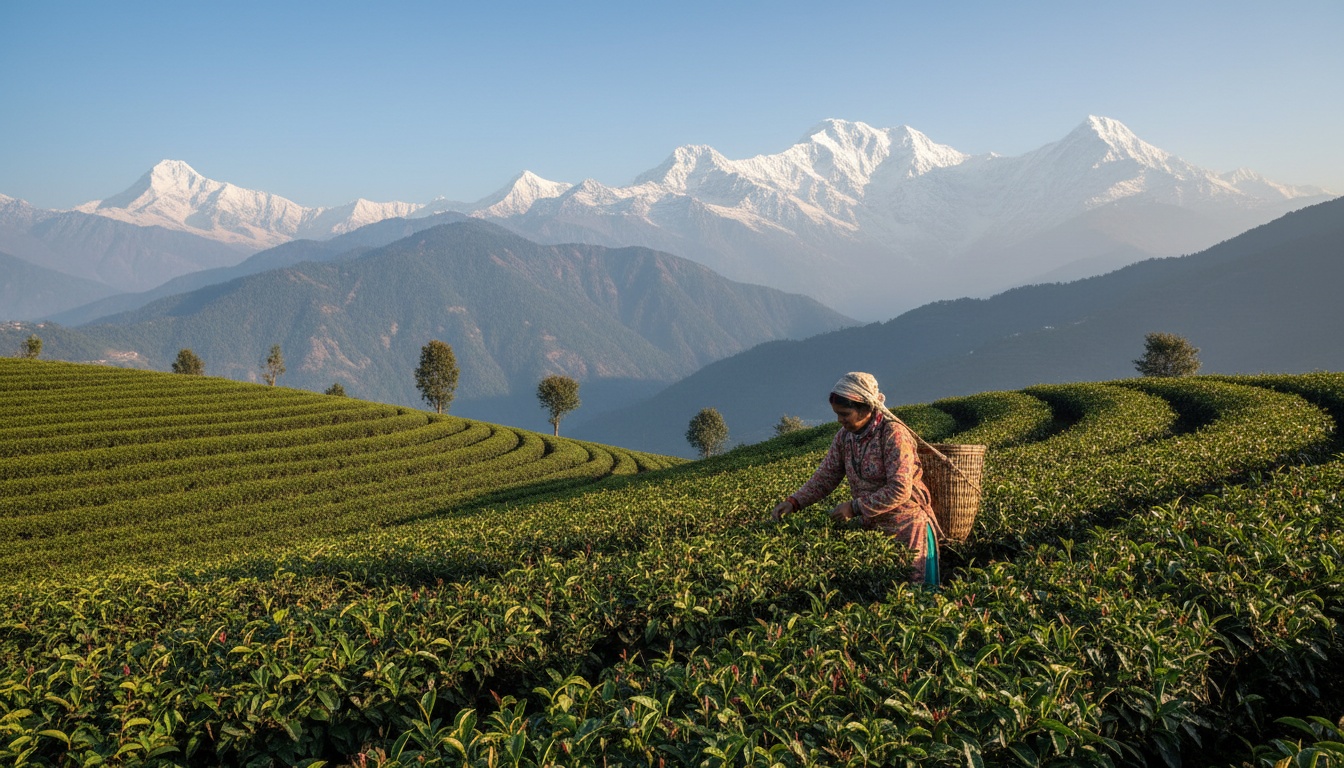
Kangra is India's smallest classic tea origin and its most northerly, grown at roughly 1,250 to 1,525 metres below the Dhauladhar range around Palampur and Dharamshala from China-variety bushes first planted in the 1850s. The cup sits between Darjeeling and a Chinese green: the orthodox black is light-bodied, floral and fruity with a sweet lingering finish and low astringency; the green has a delicate woody aroma. The valley won gold and silver medals in London and Amsterdam in 1886 and 1895, the 1905 earthquake destroyed the factories, and for most of a century Kangra green tea went north by road through Amritsar to Kabul, Central Asia and the wider region rather than to the auction rooms. That trade is gone; today about 90 per cent of output is orthodox black, the remainder green, oolong and white, and the origin is protected by a Geographical Indication registered in India in 2005 and recognised by the European Union in 2023. The year has three flushes — the April flush from March to mid-June, the rainy or monsoon flush, and the autumn flush — and they price as three different products: first flush whole leaf commands several times the rainy-season figure.
The commercial fact that governs everything is scale. The whole valley produces about 900,000 to 1,100,000 kilograms a year against a potential of two million, from around 2,300 hectares, fifteen estates, one surviving cooperative factory, some 1,500 small growers and eleven bought-leaf factories. A single estate's export lot is typically 200 kg to a few tonnes, not a container, which makes Kangra a specialty, private-label and boutique-importer origin moved by air freight or LCL groupage rather than a bulk tea. Most of it has historically been trucked 2,000 kilometres to the Kolkata auction; the estates that export directly sell into Germany, the Netherlands, France, the United Kingdom and the United States. Buy Kangra for a single-origin loose-leaf line, a Himalayan or Indian-origins range beside Darjeeling and Nilgiri, or an organic programme — several estates hold NPOP certification, which the EU and Switzerland treat as equivalent for processed plant products. Do not buy it for blending or milk tea, where its delicacy is wasted. CBIL brokers Kangra direct from estate factories against Tea Board of India registration, GI authorised-user certificate, grade, flush, moisture and a taster's assessment, with samples going from the estate to the buyer, on FOB, CFR and CIF terms and air or LCL routing.
Excluded origins are not offered, including product re-exported, blended or re-processed through a third country. Every lot moves with a certificate of origin naming the producing plant, mine or grower country, and nothing is quoted before the seller and loading point are known.
Indicative reference
$3,000–30,000 USD / MT
as at September 2026
Reference level only — not an offer, and reviewed quarterly. Levels shown are as at September 2026. Firm pricing is quoted per RFQ, subject to volume, terms and inspection.
Typical Specification
Specifications are indicative and adjusted to the agreed contract and destination requirements. Final spec confirmed on COA / SGS.
Available Grades
Applications
- Single-origin loose-leaf retail
- Himalayan & Indian-origins ranges
- Organic (NPOP / EU-equivalent) programmes
- Speciality tea rooms & hotels
- Private label & gifting
Category
Agri-Foods, Spices & Nuts
Incoterms
FOB · CFR · CIF
Pricing basis
USD / MT
Inspection
SGS / Intertek at load port
Kangra Tea — buyer questions
How is Kangra different from Darjeeling?
Same bush family, a different mountain and a lighter hand. Both are China-variety orthodox teas from the Himalaya, but Kangra is grown lower and further north-west, and the cup is softer — floral and fruity with a sweet finish and noticeably less astringency than a Darjeeling. It is also far smaller: the whole valley makes about a million kilograms a year, an eighth of Darjeeling. Buyers use it beside Darjeeling in an Indian-origins range rather than instead of it.
Which flush should I buy?
First flush, from March to mid-June, is the premium tea and the one the specialty market wants; whole-leaf first flush can cost three times the rainy-season figure from the same estate. Autumn flush is close behind and often better value. Rainy-season tea is plainer and cheaper and suits a value line or a green-tea programme. Ask for the flush by name and buy against a sample of that flush, not a standing spec.
What lot sizes are realistic?
Small. A Kangra estate offers first-flush whole leaf in hundreds of kilograms to a few tonnes, and rainy-season grades in single-digit tonnes. That is a specialty, private-label and boutique-importer origin moved by air or LCL groupage, not a container trade. If you need full containers of an Indian orthodox, that is Assam or Nilgiri; Kangra is bought for the origin, not the volume.
How do I know a lot is genuine Kangra?
Two documents. Kangra Tea holds a Geographical Indication in India (No. 25, registered 2005) and in the European Union (2023), and genuine estates are registered authorised users with a certificate number. Every Indian tea exporter also holds a Tea Board of India registration and a Form-F exporter licence. Ask for both by number before samples; an estate has them to hand, a reseller does not.
Is Kangra organic tea accepted in Europe?
Yes, on the right certificate. Several Kangra estates are certified under India's NPOP, which the EU and Switzerland recognise as equivalent for processed plant products, so NPOP tea can be sold as organic there with a transaction certificate for each consignment. NPOP is not USDA NOP — an American organic buyer needs a separate NOP certificate, so check which one the estate actually holds.
Ready to source Kangra?
Send your quantity, specification, preferred Incoterms and destination port. Qualified requirements receive a workable offer against verified supply.
Have Kangra to sell? Submit an offer — we'll match it against live buyer demand.
More in Tea
Assam CTC Tea
BP1, PF1, PD & D1 — malty, strong, milk-tea grade
Assam Orthodox Tea
TGFOP & FTGFOP whole leaf — tippy, malty, loose-leaf grade
Darjeeling Tea
First & second flush — muscatel, GI-protected
Nilgiri Tea
Fragrant South Indian — clear liquor, iced-tea grade
Ceylon Tea (Sri Lanka)
High, mid & low grown — OP, BOP & BOPF orthodox
Kenya CTC Tea
Bright coppery BP1 & PF1 from the Mombasa auction
Green Tea
Chunmee, gunpowder & sencha — pan-fired and steamed