
Pectin (HM / LM, E440) and Carrageenan (Kappa / Iota, E407 and E407a)
Citrus and apple pectin and refined or semi-refined carrageenan from the plants that make them
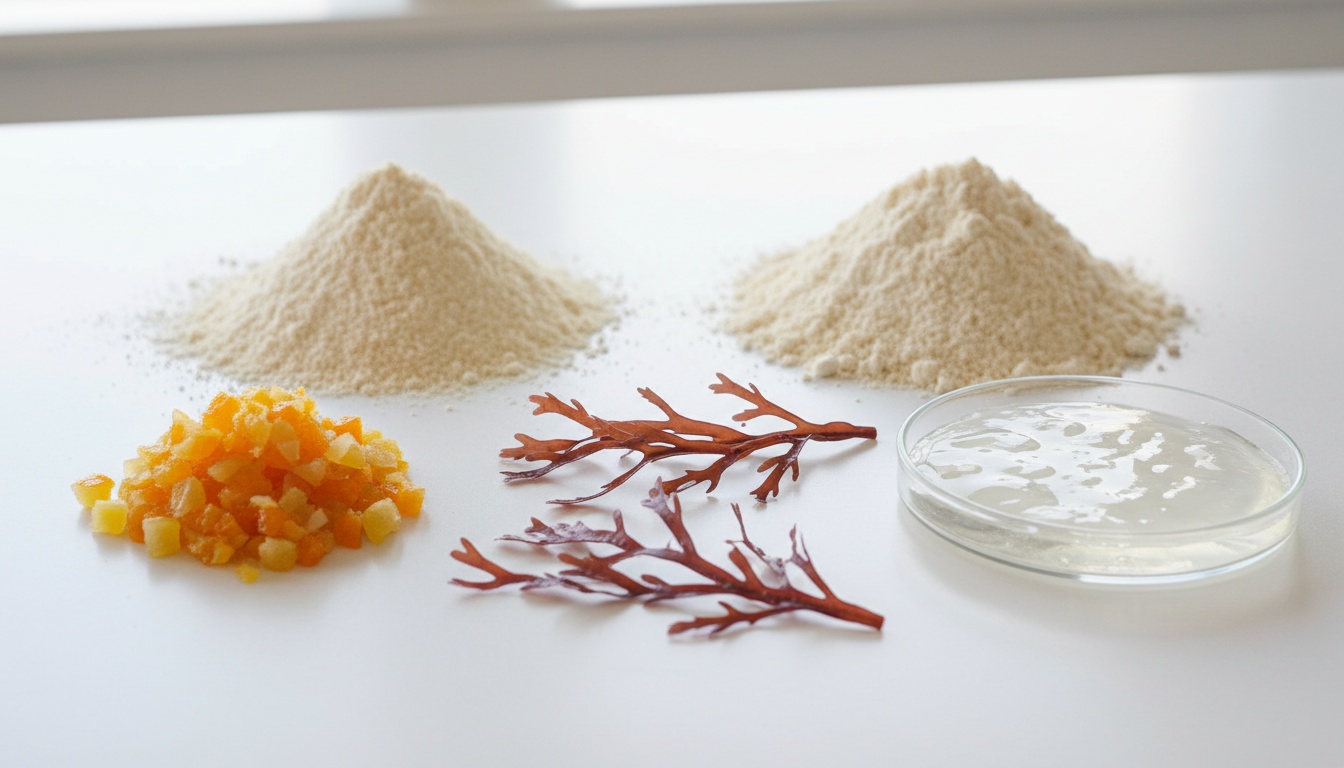
Pectin and carrageenan are the two gelling hydrocolloids, one from fruit peel and one from red seaweed, and both are bought by function rather than by chemistry. Pectin (E440, HS 1302.20) is extracted from citrus peel (the larger share) and apple pomace; the degree of esterification sorts it: above 50% it is high-methoxyl (HM) pectin, which gels with sugar and acid and is the jam, confectionery and acidified-milk-drink pectin, graded by set time (rapid, medium, slow set) and standardised to 150 °USA-SAG; below 50% it is low-methoxyl (LM) pectin, conventional or amidated (E440(ii)), which gels with calcium and serves low-sugar jams, dairy desserts and fruit preparations. EU purity criteria in Regulation (EU) No 231/2012 require not less than 65% galacturonic acid on the ash- and moisture-free basis. Production sits where peel and technology meet: one 2024 estimate puts world pectin output at about 73,500 MT, more than two-thirds from citrus peel and about a fifth from apple pomace. UN Comtrade 2023 export declarations under HS 1302.20 show Germany at USD 205 million and 11,600 MT, Brazil USD 93 million and 9,100 MT, China USD 79 million and 7,000 MT, France USD 61 million, Czechia USD 61 million, the Netherlands USD 28 million, Switzerland USD 22 million and the USA USD 19 million; the plants are the world's largest at Lille Skensved in Denmark, at Limeira and Bebedouro in Brazil (the second opened in 2021 on orange peel), at Tecomán in Mexico on lime peel, and the apple-pectin works in Germany. Carrageenan (HS 1302.39) is extracted from Eucheuma cottonii (kappa, a firm brittle gel with potassium) and Eucheuma spinosum (iota, a soft elastic gel with calcium). Refined carrageenan (E407) is the alcohol- or gel-pressed product; semi-refined carrageenan or processed Eucheuma seaweed (E407a) is the alkali-treated, washed and milled seaweed, which may hold up to 15% algal cellulose as insoluble matter and prices well below refined. Both must meet the E407 purity criteria: sulphate 15–40% on the dry basis, viscosity not less than 5 mPa·s at 1.5% and 75 °C, loss on drying not more than 12%, arsenic 3, lead 5, mercury 1 and cadmium 2 mg/kg, residual solvents not more than 0.1%, and a low-molecular-weight fraction (below 50 kDa) of not more than 5%. Comtrade 2023 declarations under HS 1302.39 (which also holds agar and other seaweed extracts) show China at USD 571 million and 55,400 MT, the Philippines USD 282 million and 29,700 MT, Spain USD 155 million and 12,800 MT, Indonesia USD 141 million and 14,200 MT, Chile USD 111 million and France USD 101 million. Philippine industry data count at least 16 carrageenan plants in 2020, mostly in Cebu, with about 65% of dried seaweed going to semi-refined and 22% to refined carrageenan. Those are declared values and industry counts, not offers.
The buyer is a jam, fruit-preparation or confectionery plant, a dairy or plant-based dairy manufacturer, a meat or pet-food processor (carrageenan as a water binder), a beverage plant, a toothpaste or personal-care formulator, a pharmaceutical excipient buyer or a hydrocolloid distributor. Documents are the producer's certificate of analysis (COA) for degree of esterification and SAG grade (pectin) or gel strength, viscosity and sulphate (carrageenan), the safety data sheet (SDS), a certificate of origin naming the plant, and halal and kosher certificates from bodies the buyer accepts; neither product is classed as dangerous goods for sea carriage. CBIL is a commodity brokerage company and brokers HM and LM pectin from German, Danish, Brazilian, Mexican and Spanish plants and kappa and iota carrageenan, refined and semi-refined, from Philippine and Indonesian processors and trader positions, in 25 kg multiwall bags palletised in 20-ft dry containers or groupage, on FCA, FOB, CFR and CIF terms. Price is per MT on grade and standardisation; minimum quantities are confirmed per product and pack. Send the application, the grade or gel test you buy against, certification, volume and destination, and the enquiry is screened and worked against it.
Excluded origins are not offered, including product re-exported, blended or re-processed through a third country. Every lot moves with a certificate of origin naming the producing plant, mine or grower country, and nothing is quoted before the seller and loading point are known.
Indicative reference
Per MT, on grade and standardisation USD / MT
as at September 2026
Reference level only — not an offer, and reviewed quarterly. Levels shown are as at September 2026. Firm pricing is quoted per RFQ, subject to volume, terms and inspection.
Typical Specification
Specifications are indicative and adjusted to the agreed contract and destination requirements. Final spec confirmed on COA / SGS.
Available Grades
Applications
- Jams, jellies and fruit preparations (HM pectin)
- Low-sugar and dairy gels (LM pectin)
- Acidified milk drinks and confectionery
- Dairy desserts, chocolate milk and plant-based dairy (carrageenan)
- Meat and pet-food water binding (SRC)
- Toothpaste, personal care and pharmaceutical excipients
Category
Agri-Foods, Spices & Nuts
Incoterms
FCA · FOB · CFR · CIF
Pricing basis
USD / MT
Inspection
SGS / Intertek at load port
Pectin (HM / LM, E440) and Carrageenan (Kappa / Iota, E407 and E407a) — buyer questions
HM or LM pectin?
HM pectin (degree of esterification above 50%) gels with sugar above about 55% soluble solids and acid, so it is the pectin for conventional jams, confectionery jellies and acidified milk drinks, chosen by set time. LM pectin (below 50%), conventional or amidated, gels with calcium and works at low sugar, so it serves reduced-sugar jams, dairy desserts and fruit preparations for yoghurt. The buyer names the application and the producer standardises the grade to it.
What is the difference between refined carrageenan and E407a?
Refined carrageenan (E407) is extracted from the seaweed and recovered by alcohol precipitation or gel pressing, leaving a clean, near-colourless gum. Semi-refined carrageenan or processed Eucheuma seaweed (E407a) is the whole seaweed cooked in alkali, washed, dried and milled; it may hold up to 15% algal cellulose as insoluble matter, gives a slightly cloudy gel and costs much less. Both must meet the same EU limits for sulphate, heavy metals, solvents and low-molecular-weight fraction. Meat, pet food and many dairy uses take E407a; clear gels and pharmaceuticals take E407.
Kappa or iota?
Kappa, from Eucheuma cottonii, gels firm and brittle with potassium and is the dairy, dessert and meat carrageenan. Iota, from Eucheuma spinosum, gels soft and elastic with calcium, is freeze-thaw stable and goes into creamy desserts, toothpaste and personal care. Lambda does not gel and thickens cold; most commercial products are blends standardised to a gel-strength test the buyer specifies.
Where are pectin and carrageenan made?
Pectin at the world's largest plant at Lille Skensved in Denmark, at Limeira and Bebedouro in Brazil on orange peel, at Tecomán in Mexico on lime peel, and at German apple-pectin works; Comtrade 2023 declarations put Germany at USD 205 million, Brazil USD 93 million and China USD 79 million. Carrageenan in Cebu in the Philippines (at least 16 plants in 2020), in Indonesia and in China; Comtrade 2023 declarations under HS 1302.39 put China at USD 571 million, the Philippines USD 282 million and Indonesia USD 141 million, though that subheading also holds agar.
Ready to source Pectin & Carrageenan?
Send your quantity, specification, preferred Incoterms and destination port. Qualified requirements receive a workable offer against verified supply.
Have Pectin & Carrageenan to sell? Submit an offer — we'll match it against live buyer demand.
More in Guar Gum & Gum Arabic
Guar Gum Powder, Food Grade (E412, 200 Mesh, 3,500-8,000 cps)
E412 guar gum powder at 200 mesh, bought on viscosity, moisture and the EU purity criteria
Guar Gum, Oilfield and Industrial Grades (Fast Hydrating Guar, HPG, CMHPG)
Fast hydrating guar and HPG and CMHPG derivatives for fracturing fluids, paper, textiles and explosives
Guar Splits and Guar Meal (Refined Splits, Guar Korma, Guar Churi)
Refined guar splits for gum milling and guar korma and churi protein meal for cattle feed
Gum Arabic (Acacia Senegal / Hashab and Acacia Seyal / Talha, Kibbled and Spray-Dried, E414)
Hashab and talha gum arabic in HPS, cleaned and siftings grades and spray-dried powder, with the origin traced
Locust Bean Gum (Carob Bean Gum, E410)
Carob seed endosperm gum from Mediterranean processors, bought on galactomannan and viscosity
Xanthan Gum, Food Grade (E415, 80 / 200 Mesh) and Oilfield Grade (API 13A)
Fermentation gum bought on viscosity in 1% KCl, mesh and pyruvate; API 13A grade on rheometer readings
Dried Raw Seaweed: Eucheuma Cottonii, Spinosum and Gracilaria for Extraction
Farm-dried Kappaphycus and Eucheuma for carrageenan plants and Gracilaria for agar, bought on moisture, impurities and clean anhydrous weed