
Dried Raw Seaweed: Eucheuma Cottonii, Spinosum and Gracilaria for Extraction
Farm-dried Kappaphycus and Eucheuma for carrageenan plants and Gracilaria for agar, bought on moisture, impurities and clean anhydrous weed
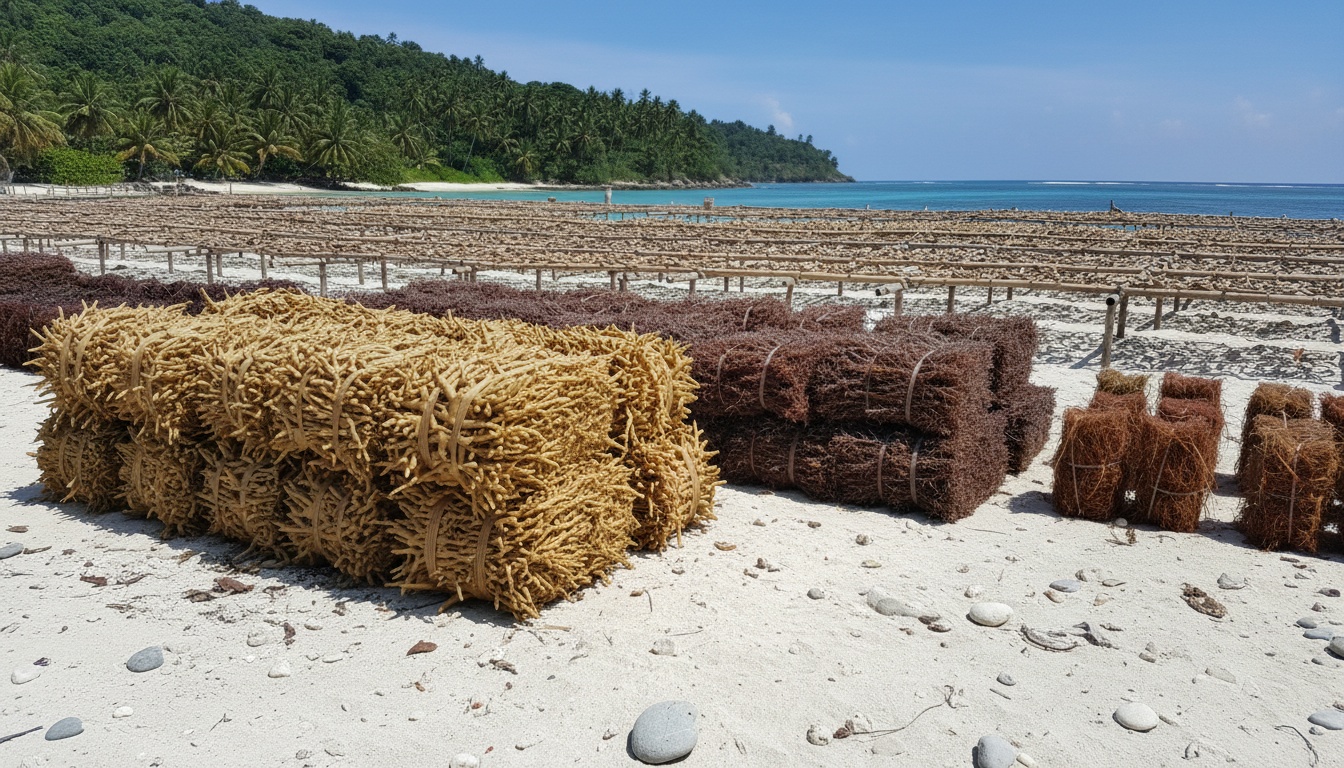
Raw seaweed for extraction is a farmed crop sold dry by the pressed bale, and the buyer is a carrageenan or agar plant, not a food company. Eucheuma cottonii (the trade name for Kappaphycus alvarezii) gives kappa carrageenan; Eucheuma spinosum (Eucheuma denticulatum) gives iota carrageenan; Gracilaria gives agar. All three declare under HS 1212.21 (seaweeds fit for human consumption) or 1212.29, depending on the customs authority's reading, and are farmed on lines in shallow tropical and temperate water, harvested at 45 days or more, and sun-dried on racks to about a third of their wet weight. The lot is bought on three numbers: moisture (Indonesia's national standard SNI 2690:2018 sets not more than 30%, and export contracts commonly accept up to 35%), impurities (sand, salt, tie-ties and foreign weed, SNI limit 3%) and clean anhydrous weed, the carrageenan-bearing fraction after moisture and impurities are removed (SNI minimum 50%). A plant that buys 35% moisture material and gets 40% has paid for water and lost carrageenan yield, so the loading survey and the moisture claim clause matter more than the headline price. Supply is Indonesian and Philippine. Government statistics put Indonesia's Kappaphycus and Eucheuma harvest in the millions of tonnes wet a year (industry estimates are lower, 1.3–1.5 million MT wet in 2021) and the Philippines at about 1.3 million MT wet in 2021 against a 2011 peak of 1.8 million; Indonesia's statistics office recorded about 250,000 MT of dried seaweed exports in 2023, roughly 88% to China, at an average export price around USD 1.8 per kilogram, with a lower preliminary figure for 2024. Zanzibar farms both species, largely spinosum, with about 30,000 Tanzanian farmers, 80% of them women, and the Zanzibar government raised the farm-gate price in 2024–25 to TZS 1,000 per kilogram for spinosum and TZS 2,100 for cottonii; cottonii there is constrained by ice-ice disease and warming water. Chile's farmed Gracilaria (pelillo) harvest was 11,267 MT wet in 2024 by the national fisheries yearbook, concentrated in Los Lagos, with about a fifth exported raw. The Philippines prohibits the export of fresh (undried) Eucheuma under a 1990 fisheries order; dried seaweed ships freely with the fisheries bureau's export commodity clearance. Those are government and industry figures, not offers.
The buyer is a carrageenan plant in Cebu, Indonesia, China or Europe, an agar plant, a semi-refined carrageenan processor serving pet food and meat, or a trader consolidating for one of them. Documents are the exporter's certificate of analysis for moisture, impurities and clean anhydrous weed, a phytosanitary certificate, a certificate of origin, the fisheries export clearance the origin requires and, for buyers with a food end-use, heavy-metals results and halal certification where the market asks for it. CBIL is a commodity brokerage company and brokers dried cottonii, spinosum and Gracilaria from Indonesian, Philippine, Tanzanian and Chilean exporters and consolidators, in pressed bales of about 50–100 kg wrapped in PP, loaded loose or palletised in 40-ft high-cube containers (a container carries roughly 14–20 MT depending on press density), on FOB, CFR and CIF terms, with a loading survey for moisture and impurities where the buyer wants it. Price is per MT on species, moisture and clean anhydrous weed; minimum quantities are confirmed per product and pack. Send the species, the moisture and impurity limits you buy against, monthly volume and discharge port, and the enquiry is screened and worked against it.
Excluded origins are not offered, including product re-exported, blended or re-processed through a third country. Every lot moves with a certificate of origin naming the producing plant, mine or grower country, and nothing is quoted before the seller and loading point are known.
Indicative reference
Per MT, on species, moisture and CAW USD / MT
as at September 2026
Reference level only — not an offer, and reviewed quarterly. Levels shown are as at September 2026. Firm pricing is quoted per RFQ, subject to volume, terms and inspection.
Typical Specification
Specifications are indicative and adjusted to the agreed contract and destination requirements. Final spec confirmed on COA / SGS.
Available Grades
Applications
- Refined carrageenan extraction (E407)
- Semi-refined carrageenan / processed Eucheuma seaweed (E407a)
- Agar extraction (Gracilaria)
- Pet-food and meat-binder SRC plants
- Seaweed fertiliser and biostimulant extraction
Category
Agri-Foods, Spices & Nuts
Incoterms
FOB · CFR · CIF
Pricing basis
USD / MT
Inspection
SGS / Intertek at load port
Dried Raw Seaweed: Eucheuma Cottonii, Spinosum and Gracilaria for Extraction — buyer questions
What decides the price of dried cottonii?
Moisture, impurities and clean anhydrous weed, in that order, then species. Indonesia's SNI 2690:2018 sets moisture at not more than 30%, impurities at not more than 3% and CAW at not less than 50%; many contracts accept 35% moisture with a price claim above it. A loading survey on moisture and impurities is the cheapest insurance a plant can buy.
Cottonii or spinosum?
Cottonii (Kappaphycus alvarezii) is the kappa-carrageenan weed and commands roughly twice the farm-gate price of spinosum: Zanzibar's 2024–25 prices were TZS 2,100 per kilogram for cottonii against TZS 1,000 for spinosum. Spinosum (Eucheuma denticulatum) is the iota weed, hardier in warm water, and East Africa grows mostly spinosum because cottonii there suffers from ice-ice disease. A plant buys the species its product line needs and blends.
Are there export restrictions on raw seaweed?
The Philippines has prohibited the export of fresh, undried Eucheuma since a 1990 fisheries order; dried seaweed exports need the fisheries bureau's export commodity clearance. Indonesia has debated keeping more raw weed at home for its own carrageenan and agar plants and has a national quality standard, SNI 2690:2018, that export lots are graded against. Origin documents are checked lot by lot.
How much does Indonesia export?
Indonesia's statistics office recorded about 250,000 MT of dried seaweed exports in 2023, roughly 88% to China, at an average export price around USD 1.8 per kilogram, with a lower preliminary figure for 2024. Government production statistics run in the millions of tonnes wet a year; industry estimates put the Kappaphycus and Eucheuma crop at 1.3–1.5 million MT wet in 2021, against about 1.3 million MT in the Philippines.
Ready to source Raw Seaweed?
Send your quantity, specification, preferred Incoterms and destination port. Qualified requirements receive a workable offer against verified supply.
Have Raw Seaweed to sell? Submit an offer — we'll match it against live buyer demand.
More in Guar Gum & Gum Arabic
Guar Gum Powder, Food Grade (E412, 200 Mesh, 3,500-8,000 cps)
E412 guar gum powder at 200 mesh, bought on viscosity, moisture and the EU purity criteria
Guar Gum, Oilfield and Industrial Grades (Fast Hydrating Guar, HPG, CMHPG)
Fast hydrating guar and HPG and CMHPG derivatives for fracturing fluids, paper, textiles and explosives
Guar Splits and Guar Meal (Refined Splits, Guar Korma, Guar Churi)
Refined guar splits for gum milling and guar korma and churi protein meal for cattle feed
Gum Arabic (Acacia Senegal / Hashab and Acacia Seyal / Talha, Kibbled and Spray-Dried, E414)
Hashab and talha gum arabic in HPS, cleaned and siftings grades and spray-dried powder, with the origin traced
Locust Bean Gum (Carob Bean Gum, E410)
Carob seed endosperm gum from Mediterranean processors, bought on galactomannan and viscosity
Xanthan Gum, Food Grade (E415, 80 / 200 Mesh) and Oilfield Grade (API 13A)
Fermentation gum bought on viscosity in 1% KCl, mesh and pyruvate; API 13A grade on rheometer readings
Pectin (HM / LM, E440) and Carrageenan (Kappa / Iota, E407 and E407a)
Citrus and apple pectin and refined or semi-refined carrageenan from the plants that make them