
Mango Puree & Concentrate (Totapuri, Alphonso & Kesar)
Aseptic 14 °Brix single-strength puree and 28-30 °Brix concentrate in drums, bought on Brix, Bostwick and acidity
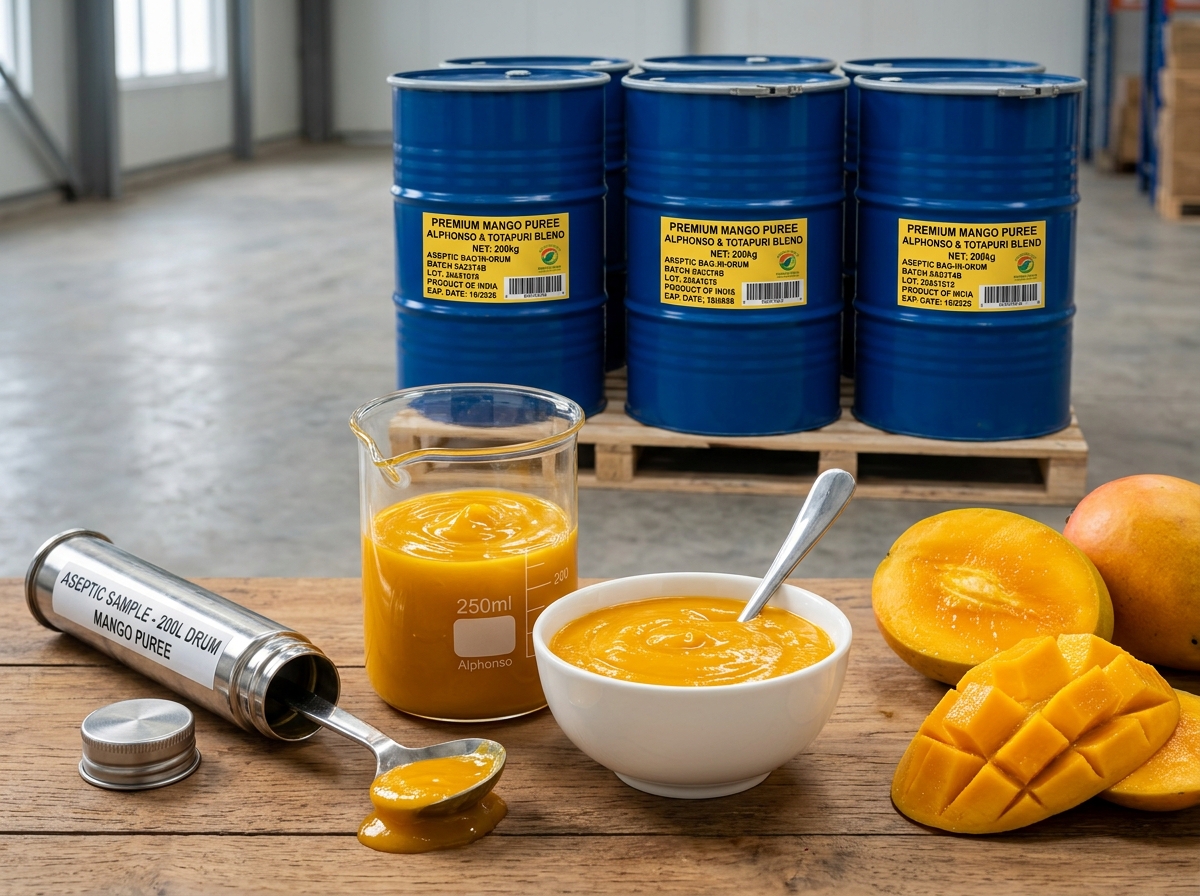
Mango puree and mango puree concentrate are the tropical fruit foundation of the beverage, dairy and baby food sectors: ripe sound mangoes washed, sorted, peeled, de-stoned, thermalised and refined through fine sieves to extract a smooth, aromatic fruit pulp, which is either aseptically sterilised at single strength or concentrated under vacuum and aseptically filled. The trade is divided into two formats: single-strength puree at the natural fruit soluble solids (Totapuri at 14 °Brix minimum, Alphonso and Kesar at 16-17 °Brix, and Kent or Tommy Atkins at 14-16 °Brix) and concentrated mango puree (chiefly Totapuri evaporated to 28-30 °Brix), which cuts shipping weight and storage by more than half for high-volume beverage blenders and remanufacturers. Buyers specify the Brix (acid-corrected refractometric Brix), titratable acidity as anhydrous citric acid (typically 0.40–0.70% for Totapuri and 0.50–0.80% for Alphonso at pH 3.6–4.2), Bostwick consistency (commonly 6.0–12.0 cm / 30 sec at 20 °C), colour score (deep golden-yellow to rich orange), and strict defect limits: Howard Mould Count (HMC ≤ 20% or ≤ 15% positive fields) and specks per 10 grams (black specks ≤ 5, brown specks ≤ 10 for Grade A export / baby food).
India is the world leader in processed mango, centred in the primary processing belts of Chittoor and Tirupati in Andhra Pradesh, Krishnagiri and Dharmapuri in Tamil Nadu, and Gujarat/Maharashtra for Alphonso and Kesar; Latin American processors in Peru (Piura, Lambayeque), Mexico (Sinaloa, Nayarit) and Ecuador provide counter-seasonal and transatlantic supply of Kent, Tommy Atkins and Edward purees. Industrial off-takers include ambient juice and nectar packers (reconstituted mango nectar requires ≥ 13.5–15.0 °Brix under national food codes), fruit yoghurt, milkshake and dairy dessert producers, baby food manufacturers requiring ultra-low pesticide residues and speck-free texture, and bakery/glaze preparers. CBIL is a commodity brokerage company and brokers aseptic and frozen mango puree and concentrate from FSSC 22000, BRCGS and ISO 22000 certified processors in India, Peru, Mexico, Ecuador and Thailand on FCA, FOB, CFR and CIF terms. Cargo moves primarily in aseptic barrier bags inside 215 kg or 228 kg net steel drums (80 drums per 20-ft dry container, ~17.2–18.2 MT net) with 24-month ambient shelf life (optimally cool stored at 4–10 °C to preserve color), or frozen in polyethylene bags in drums at -18 °C in 20-ft reefers. Shipments carry the manufacturer's Certificate of Analysis, pesticide residue screening reports compliant with EU/US MRLs, Certificate of Origin, Phytosanitary/Health Certificate, accredited Halal certification, and authenticity verification against the AIJN Code of Practice. Send the variety, format (puree vs concentrate), Brix, packaging, volume and discharge port, and the enquiry is screened and worked against it.
Excluded origins are not offered, including product re-exported, blended or re-processed through a third country. Every lot moves with a certificate of origin naming the producing plant, mine or grower country, and nothing is quoted before the seller and loading point are known.
Indicative reference
Per lot, on variety, Brix and packing USD / MT
as at September 2026
Reference level only — not an offer, and reviewed quarterly. Levels shown are as at September 2026. Firm pricing is quoted per RFQ, subject to volume, terms and inspection.
Typical Specification
Specifications are indicative and adjusted to the agreed contract and destination requirements. Final spec confirmed on COA / SGS.
Available Grades
Applications
- Fruit juice, nectar and beverage bottling (ambient and chilled)
- Dairy, yoghurt, milkshake and ice cream preparations
- Infant nutrition and baby food purees
- Bakery fillings, glazes, jams and fruit toppings
- Foodservice smoothies, confectionery and dessert formulation
Category
Agri-Foods, Spices & Nuts
Incoterms
FCA · FOB · CFR · CIF
Pricing basis
USD / MT
Inspection
SGS / Intertek at load port
Mango Puree & Concentrate (Totapuri, Alphonso & Kesar) — buyer questions
What is the difference between single-strength mango puree and mango puree concentrate?
Single-strength mango puree is produced by refining whole ripe mangoes without water removal, preserving the natural juice Brix (14 °Brix for Totapuri, 16-17 °Brix for Alphonso) and fresh fruit aromatic volatiles. Mango puree concentrate (typically 28-30 °Brix) is produced by concentrating single-strength puree in falling-film or forced-circulation vacuum evaporators at low temperatures. Concentrate roughly doubles the soluble solids per drum, cutting container freight, handling, and cold-storage costs by ~50% for juice re-packers who reconstitute with water at the bottling plant.
Why is Totapuri the dominant industrial processing mango variety?
Totapuri mangoes yield a heavy, uniform pulp with robust body (Bostwick 6-12 cm), bright golden-yellow colour, and a balanced sweet-tart profile (acidity 0.40–0.70%) that blends harmoniously into multi-fruit juices, nectars, and fruit preparations. Alphonso, by contrast, commands a substantial price premium and is prized for its intense aroma, saffron-orange colour, and rich dessert flavour, making it the choice for premium retail nectars, gourmet ice creams, and baby food.
How should aseptic mango puree drums be stored to prevent darkening?
While aseptic drums are commercially sterile and shelf-stable at ambient temperatures (up to 25 °C) for up to 18–24 months, prolonged ambient exposure in hot transit or storage climates accelerates non-enzymatic browning (Maillard reaction) and caramelisation, degrading the bright yellow-orange colour. For premium applications, blenders and importers store drums in cold-storage warehouses at 4–10 °C (cool chain) or freeze at -18 °C to preserve factory-fresh hue and volatile aromatics.
What documentation accompanies export shipments of mango puree?
Every export lot is dispatched with the manufacturer's Certificate of Analysis (verifying Brix, acidity, pH, Bostwick viscosity, Howard mould count, black/brown specks, and aerobic plate count), multi-residue pesticide screening compliant with destination EU or US FDA MRLs, Certificate of Origin (Chamber of Commerce / GSP / CoO), Phytosanitary or Export Health Certificate issued by agricultural authorities (e.g. APEDA / NPPO), and an accredited Halal certificate.
Ready to source Mango Puree & Concentrate?
Send your quantity, specification, preferred Incoterms and destination port. Qualified requirements receive a workable offer against verified supply.
Have Mango Puree & Concentrate to sell? Submit an offer — we'll match it against live buyer demand.
More in Fruit Juice Concentrates
Frozen Concentrated Orange Juice (FCOJ 65-66 °Brix)
65-66 °Brix FCOJ in frozen drums at -18 °C or bulk from processor terminals, bought on ratio, acidity and pulp
Apple Juice Concentrate (Clear 70-72 °Brix)
Clear 70-72 °Brix concentrate bought on colour at 440 nm, clarity, acidity and patulin
Pineapple Juice Concentrate (60 °Brix Aseptic)
60 °Brix aseptic concentrate from Thailand, the Philippines, Costa Rica, Kenya and Indonesia
Grape Juice Concentrate (Red & White 65-68 °Brix, RCGM)
Non-alcoholic red and white grape juice concentrate and rectified grape sugar for beverages, food and sweetening
Lemon Juice Concentrate (Cloudy & Clarified 400–500 GPL, 45–55 °Brix)
400 GPL and 45-55 °Brix cloudy and clarified lemon concentrate, bought on acidity, ratio, essential oil and pulp