
FIBC Jumbo Bags & PP Woven Sacks
Bulk bags to ISO 21898 and UN 13H, and 50 kg PP woven, laminated and BOPP sacks for fertilizer, cement, rice and sugar packers
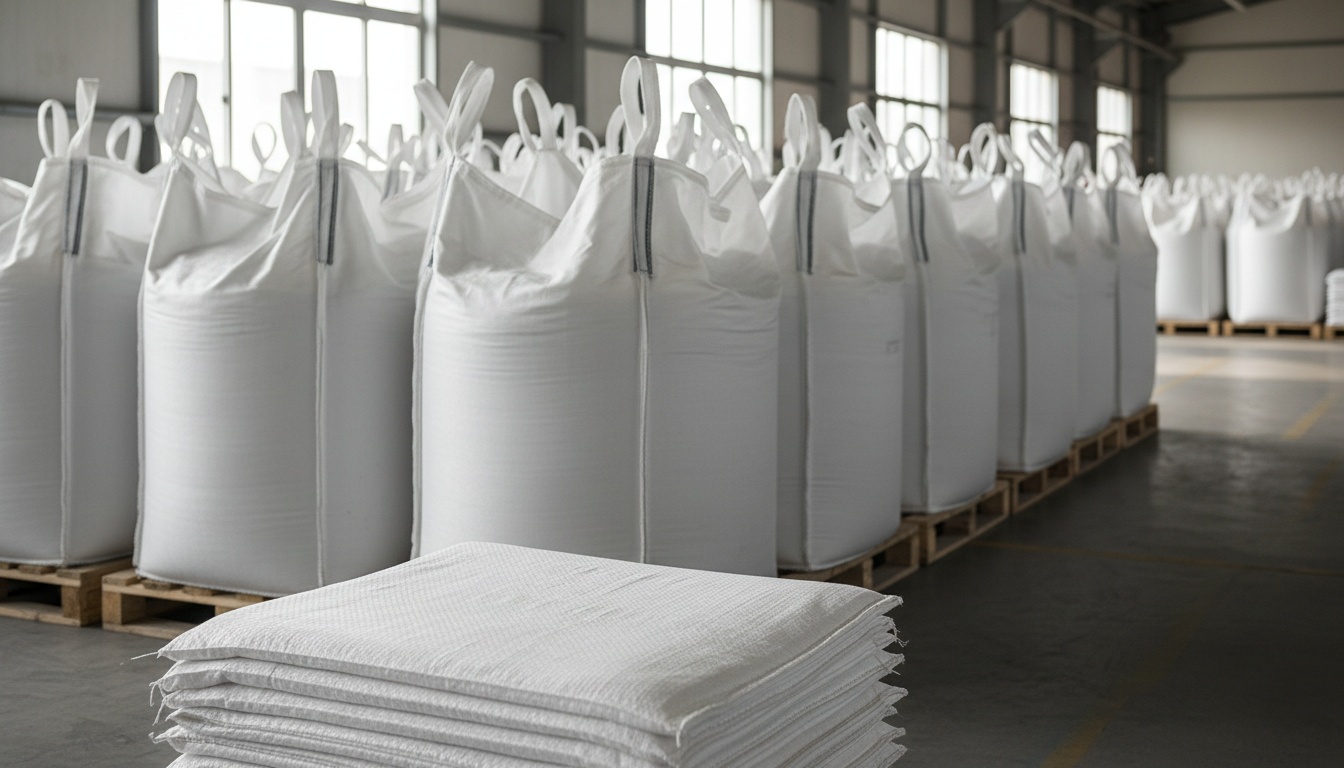
Both products are woven from polypropylene tape, and the buyer specifies them by the load and the product inside. An FIBC is bought on safe working load (500 to 2,000 kg), safety factor (5:1 for single-trip bags, 6:1 for bags that pass cyclic top-lift testing for multiple trips), fabric weight and coating, loop design (cross-corner or four-panel), top and bottom fittings (open top, filling spout, duffle, discharge spout, flat bottom), and liner (form-fit or tubular PE, or a coated inner face). ISO 21898 sets the safety requirements and the label: manufacturer, safe working load, safety factor and date of manufacture. Bags filled near flammable vapours or combustible dust are marked Type A (no static protection), Type B (breakdown voltage limited), Type C (conductive, must be earthed) or Type D (static dissipative fabric) under IEC 61340-4-4. Bags for dangerous goods carry a UN mark, 13H1 plain woven, 13H2 coated, 13H3 with liner and 13H4 coated with liner, tested to the packing group. Small sacks are bought by capacity (25 or 50 kg), fabric weight in g/m², lamination (a PP film for moisture and sift-proofing), BOPP film for printed retail sacks, valve or open mouth, and gusset and hemming. The HS lines are 6305.32 for FIBCs and 6305.33 for other polyethylene or polypropylene strip sacks. UN Comtrade 2024 export declarations under HS 6305.32 total USD 2.13 billion and about 803,000 MT across 93 reporters: India USD 872 million and 416,000 MT, China USD 388 million and 161,000 MT, Türkiye USD 196 million and 50,000 MT, Germany USD 84 million, the Netherlands USD 59 million, Mexico USD 55 million, Romania USD 37 million, Belgium USD 36 million, Czechia USD 36 million, Indonesia USD 26 million, Serbia USD 25 million and Poland USD 25 million. Under HS 6305.33 declarations total USD 1.81 billion and about 691,000 MT across 112 reporters: China USD 955 million and 418,000 MT, Türkiye USD 129 million and 38,000 MT, Thailand USD 105 million and 37,000 MT, Egypt USD 43 million, Guatemala USD 32 million, Côte d'Ivoire USD 29 million, the Philippines USD 29 million, the USA USD 27 million, Morocco USD 23 million, Canada USD 23 million, Indonesia USD 22 million and India USD 21 million. Those are declared export values, not offers; Bangladesh and Vietnam do not appear in the 2024 pull.
The buyer is a fertilizer blender, cement or lime plant, rice or sugar mill, seed or feed packer, chemical or mineral producer, or a packaging distributor, and the offer is a price per bag or per thousand for a drawn specification. The USA applies anti-dumping and countervailing duties to laminated woven sacks from China (orders of August 2008) and Vietnam (orders of June 2019, continued after a 2024 sunset review), so US buyers of printed laminated sacks source from other origins or price the duty. CBIL is a commodity brokerage company and brokers FIBCs and PP sacks from manufacturers in India, Türkiye, Vietnam, China and Bangladesh against a drawn specification and approved pre-production sample, the manufacturer's test certificate (top-lift, and UN test report for 13H bags), food-contact declarations where the bag holds food, and a certificate of origin, on FOB, CFR and CIF terms. Bales of FIBCs or sacks ship in 40-ft high-cube containers; minimum orders follow the manufacturer's own published terms and are otherwise confirmed per product and pack. Send the drawing or the product, weight, fittings, liner, print, quantity and discharge port.
Excluded origins are not offered, including product re-exported, blended or re-processed through a third country. Every lot moves with a certificate of origin naming the producing plant, mine or grower country, and nothing is quoted before the seller and loading point are known.
Indicative reference
Per piece, on specification and quantity USD / piece
as at September 2026
Reference level only — not an offer, and reviewed quarterly. Levels shown are as at September 2026. Firm pricing is quoted per RFQ, subject to volume, terms and inspection.
Typical Specification
Specifications are indicative and adjusted to the agreed contract and destination requirements. Final spec confirmed on COA / SGS.
Available Grades
Applications
- Fertilizer, urea and NPK blending plants
- Cement, lime and gypsum packing
- Rice, sugar, flour and feed mills
- Chemical, mineral and resin producers
- Seed and agricultural cooperatives
Category
Industrial Minerals & Construction
Incoterms
FOB · CFR · CIF
Pricing basis
USD / piece
Inspection
SGS / Intertek at load port
FIBC Jumbo Bags & PP Woven Sacks — buyer questions
What do Type A, B, C and D mean on a bulk bag?
The electrostatic class under IEC 61340-4-4. Type A has no static protection; Type B limits breakdown voltage; Type C is conductive and must be earthed during filling and emptying; Type D is made of static-dissipative fabric and needs no earthing. The class is chosen from the product's dust and the atmosphere at the filling point.
5:1 or 6:1 safety factor?
A 5:1 bag is for a single fill and empty cycle. A 6:1 bag has passed cyclic top-lift testing under ISO 21898 and may be reused. The label must carry the manufacturer, safe working load, safety factor and date of manufacture.
When does an FIBC need a UN mark?
When it carries dangerous goods. The mark reads 13H1 for plain woven, 13H2 coated, 13H3 with liner and 13H4 coated with liner, followed by the packing group letter and the manufacturer's test details. The UN test report travels with the offer.
Who exports FIBCs and PP sacks?
UN Comtrade 2024 export declarations put India first in FIBCs (HS 6305.32) at USD 872 million and 416,000 MT, then China and Türkiye; China leads other PP sacks (HS 6305.33) at USD 955 million and 418,000 MT, then Türkiye and Thailand. The USA applies anti-dumping duties to laminated woven sacks from China and Vietnam.
Ready to source FIBC & PP Sacks?
Send your quantity, specification, preferred Incoterms and destination port. Qualified requirements receive a workable offer against verified supply.
Have FIBC & PP Sacks to sell? Submit an offer — we'll match it against live buyer demand.
More in Kraft Paper & Packaging Board
Kraftliner (Unbleached Brown & White-Top, Virgin Fibre)
Virgin-fibre brown and white-top kraftliner in reels, bought on grammage, burst, RCT and SCT
Testliner & Fluting (Recycled Containerboard, Semi-Chemical Fluting)
Recycled testliner, recycled fluting and semi-chemical fluting in reels for corrugated board
Sack Kraft Paper (Extensible & Standard, for Cement and Fertilizer Bags)
Extensible and standard sack kraft in reels for multiwall cement, fertilizer and flour bags
Folding Boxboard, Coated Duplex Board & SBS (GC1, GC2, GD2, GZ)
Coated folding boxboard, grey-back duplex and solid bleached board in reels and sheets for folding cartons
Jute Bags & Hessian Cloth (B-Twill, A-Twill, Food-Grade)
B-Twill and A-Twill sacking, hessian cloth and bags, and hydrocarbon-free food-grade jute to IJO 98/01 for coffee, cocoa, rice, sugar and seed