
POM Polyacetal Resin (Polyoxymethylene)
Acetal copolymer and homopolymer pellets by melt flow, for gears, clips and precision parts
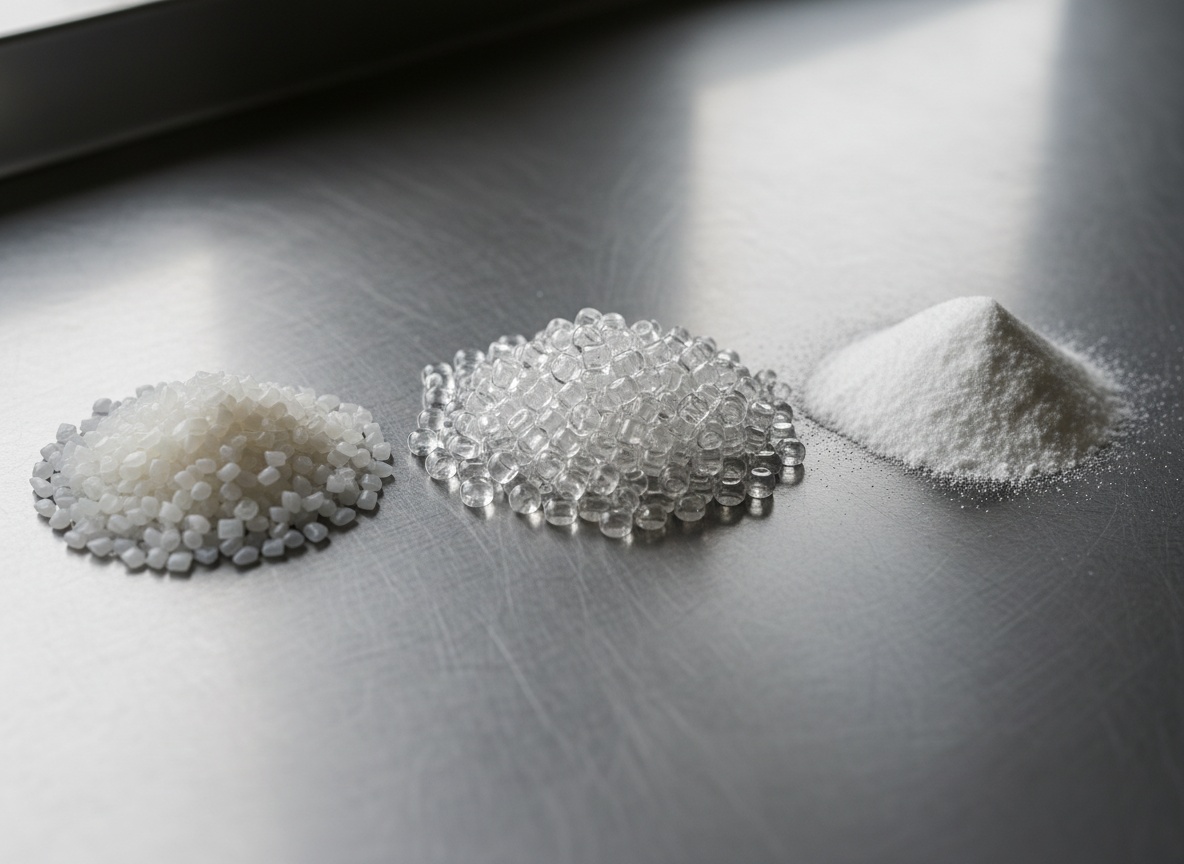
POM, polyoxymethylene or acetal (HS 3907.10), is the engineering plastic of gears, fuel-system parts, zips, clips, bearings and conveyor components: stiff, dimensionally stable, low-friction and resistant to fuels and solvents. It comes in two chemistries. Copolymer POM, made by Celanese (Hostaform), Polyplastics (Duracon), Korea Engineering Plastics (Kepital), Kolon Plastics (Kocetal), Mitsubishi Engineering-Plastics (Iupital) and the Chinese producers led by Yuntianhua, is the volume grade, more stable to hot water and alkali and easier to process. Homopolymer POM, Delrin from Celanese since the DuPont spin-off, is slightly stiffer and stronger. Grades are specified by melt flow at 190 °C under 2.16 kg: about 9 g/10 min for general injection, 27 for thin-wall and fast-cycle parts, and 2.5 for extrusion of rod and sheet; glass-fibre reinforced grades at 10 to 25 per cent and low-friction, UV-stabilised, antistatic and medical grades sit beside them. A buyer states the chemistry, the melt flow, any filler, the colour and whether the lot is prime, because the producers name grades differently and a Kocetal K300 is not interchangeable with a Hostaform C 9021 without a datasheet comparison.
Korea, Japan, China, Germany and the United States are the exporters; Platts has published weekly POM copolymer spot assessments for Europe, Brazil and the United States since October 2024, and Asian producers price against them and the Chinese domestic market. A general-purpose copolymer at melt flow 27 was offered at about USD 1,630 to 1,640 per tonne FOB Busan in the third quarter of 2025, Chinese domestic product sat near USD 1,850 to 1,910 per tonne in early 2026, and US prices were about USD 2,650 per tonne, so a delivered price depends on the origin as much as the grade. POM from the named producers moves through appointed distributors and the producers' own regional offices, and the first document a buyer sees is the distributor's authorisation or the producer's allocation confirmation, with the certificate of analysis for the lot. CBIL brokers POM copolymer and homopolymer from producer distributors against that authorisation, the producer's certificate of analysis and SGS or Intertek inspection at stuffing where the buyer wants it, in 25 kg bags on pallets, about 16 to 18 tonnes in a 20 ft container, on FOB, CFR and CIF terms. Send the grade you run, the melt flow, filler and colour, and the monthly volume.
See also: ABS resin: the other engineering styrenic · Nylon 6
Need the ship as well? Our chartering desk prices part cargo and parcel space on LaycanDesk.
Excluded origins are not offered, including product re-exported, blended or re-processed through a third country. Every lot moves with a certificate of origin naming the producing plant, mine or grower country, and nothing is quoted before the seller and loading point are known.
Indicative reference
$1,600–2,100 USD / MT
as at September 2026
Reference level only — not an offer, and reviewed quarterly. Levels shown are as at September 2026. Firm pricing is quoted per RFQ, subject to volume, terms and inspection.
Typical Specification
Specifications are indicative and adjusted to the agreed contract and destination requirements. Final spec confirmed on COA / SGS.
Available Grades
Applications
- Gears, bushings and bearings
- Automotive fuel-system and interior parts
- Zips, buckles, clips and fasteners
- Conveyor and material-handling components
- Precision electrical and consumer parts
- Rod, sheet and profile extrusion
Category
Petroleum & Energy
Incoterms
FOB · CFR · CIF
Pricing basis
USD / MT
Inspection
SGS / Intertek at load port
POM Polyacetal Resin (Polyoxymethylene) — buyer questions
Copolymer or homopolymer POM?
Copolymer for most parts: it resists hot water and alkali, processes with less odour and is the volume grade from Korea, Japan and China. Homopolymer, which is the Delrin family, is a few per cent stiffer and stronger and is chosen for highly loaded gears and springs. Datasheets are compared grade for grade before switching.
Why does a POM offer come with a distributor letter?
Because the producers sell through appointed distributors and regional offices, and a trader offering a named grade is either one of them or buying from one. The distributor's authorisation, or the producer's allocation confirmation, is what identifies the supply; a datasheet alone can be downloaded by anyone.
What moves the POM price?
Methanol and formaldehyde, the feedstocks, and Chinese capacity, which has grown fastest and sets the Asian floor. In early 2026 Chinese domestic product was about USD 1,850 to 1,910 per tonne, Korean export grades somewhat above, and US product about USD 2,650, so origin and freight decide the landed figure as much as the grade.
Does POM need any special shipping handling?
No. It is a stable pellet in 25 kg bags on pallets, shipped in standard containers. It should be dried before moulding, and reinforced grades are kept away from moisture in storage; otherwise it moves like any other engineering resin.
Ready to source POM / Acetal?
Send your quantity, specification, preferred Incoterms and destination port. Qualified requirements receive a workable offer against verified supply.
Have POM / Acetal to sell? Submit an offer — we'll match it against live buyer demand.
More in Polymers: PE, PP, PVC, PET, PS & Engineering Resins
Polyethylene (HDPE, LLDPE, LDPE)
HDPE, LLDPE and LDPE by density, melt index and end-use grade
Polypropylene (Homopolymer & Copolymer)
PP homopolymer raffia, injection and film grades, impact and random copolymers
PVC Resin (Suspension Grade)
Suspension PVC by K-value for pipe, profile, cable and film
PET Resin (Bottle, Fibre & Film Grade Chips)
Bottle-grade PET chips by intrinsic viscosity for water, CSD and edible-oil preforms
Polystyrene (GPPS, HIPS & EPS)
General-purpose and high-impact polystyrene by melt flow, and EPS beads by size
ABS Resin (General Purpose, High Impact & Extrusion)
Acrylonitrile-butadiene-styrene pellets by melt flow and notched Izod impact
Polycarbonate Resin (General, Optical & Flame-Retardant)
PC pellets by melt flow, light transmission and UL94 flame rating
Nylon 6 Chips & Caprolactam
Polyamide 6 chips by relative viscosity, and caprolactam monomer for polymerisers
MDI, TDI & Polyether Polyols
Polymeric MDI, TDI and polyether polyols for rigid and flexible polyurethane foam
POE Polyolefin Elastomer (Ethylene-Octene)
Metallocene ethylene-octene and ethylene-butene elastomers for PV film, TPO and impact modification
EVA Copolymer Resin (Ethylene-Vinyl Acetate)
Ethylene-vinyl acetate pellets by VA content and melt index, from foam to solar film