
Cashew Pieces & Splits
LWP, SWP, butts & splits — the processing grades
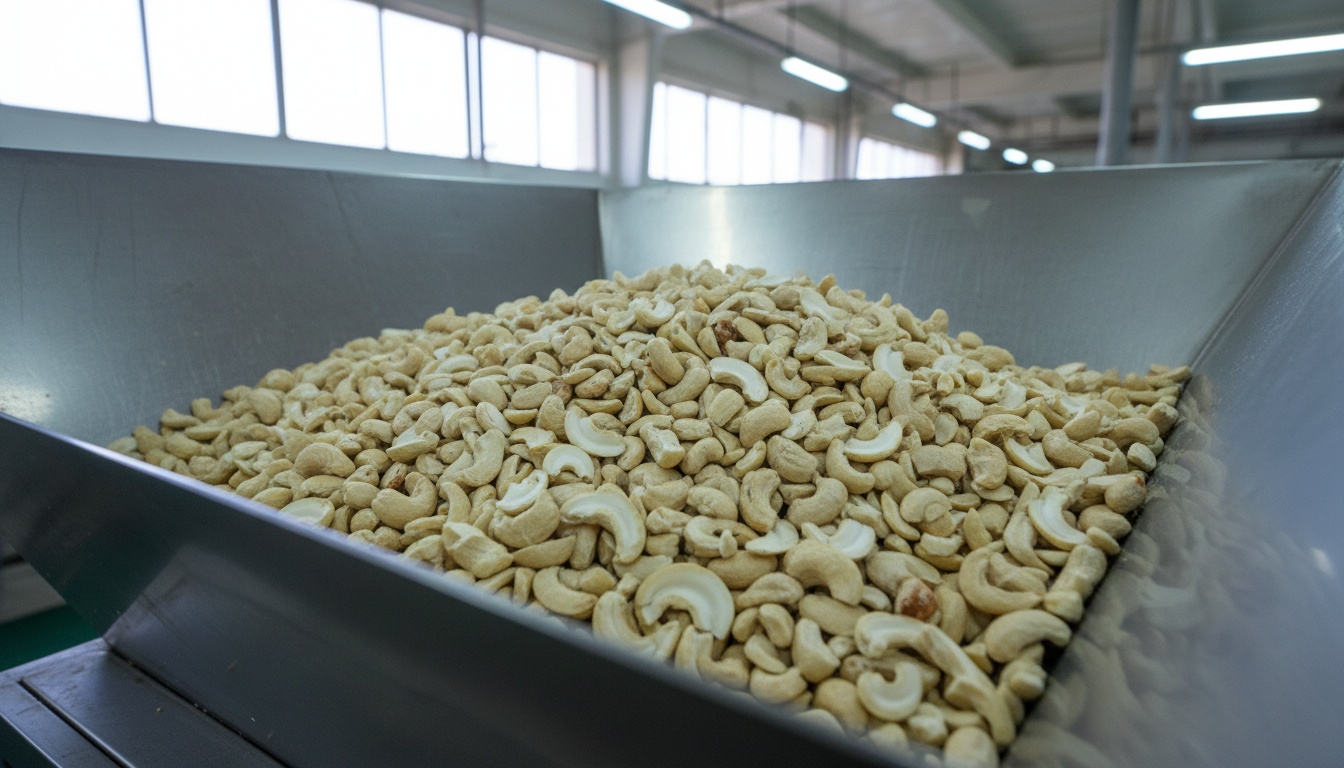
Cashew pieces are whole kernels that broke, and the grading ladder runs by fragment size: butts (B) are kernels split lengthwise with one end broken, splits (S) are cleanly halved, large white pieces (LWP) are coarse fragments, small white pieces (SWP) are finer, and baby bits are the smallest usable grade. Every one of them is the same kernel with the same oil content, flavour and food-safety profile as a W320 whole — moisture ≤ 5%, white to pale ivory colour, vacuum or nitrogen-flushed packing — and every one of them prices well below wholes, because the market pays for intact kernels and breakage is inevitable in processing.
That gap is the entire commercial case. If the kernel is going to be chopped, ground, roasted into a paste, baked into a biscuit, folded into ice cream or pressed into a spread, its shape is destroyed in your first process step and paying whole-kernel money for it is straightforwardly wasteful. Confectionery, bakery, cashew butter and spread manufacture, ice cream and dessert inclusion, and snack seasoning lines all run better economics on pieces. What pieces cannot do is present — they have no place in a gift pack or a clear retail bag where the customer assesses appearance, and no amount of price advantage changes that. Choose the fragment size by your process: LWP where visible pieces are wanted in a baked good or a topping, SWP and baby bits where the material is ground or milled anyway. CBIL supplies against SGS or Intertek certification of grade, moisture, colour and microbiology, on FOB, CFR and CIF terms.
Excluded origins are not offered, including product re-exported, blended or re-processed through a third country. Every lot moves with a certificate of origin naming the producing plant, mine or grower country, and nothing is quoted before the seller and loading point are known.
Indicative reference
$5,200–6,800 USD / MT
as at September 2026
Reference level only — not an offer, and reviewed quarterly. Levels shown are as at September 2026. Firm pricing is quoted per RFQ, subject to volume, terms and inspection.
Typical Specification
Specifications are indicative and adjusted to the agreed contract and destination requirements. Final spec confirmed on COA / SGS.
Available Grades
Applications
- Confectionery & chocolate
- Bakery & biscuits
- Cashew butter & spreads
- Ice cream & dessert inclusion
- Snack seasoning & granola
Category
Agri-Foods, Spices & Nuts
Incoterms
FOB · CFR · CIF
Pricing basis
USD / MT
Inspection
SGS / Intertek at load port
Cashew Pieces & Splits — buyer questions
Are pieces lower quality than wholes?
No — same kernel, same crop, same oil content and flavour, same food-safety specification. The only difference is that they broke during shelling or peeling. The discount reflects appearance and nothing else, which is why pieces are the correct buy for any application where the kernel does not stay whole.
Which fragment grade should I take?
Work back from your process. LWP where you want visible pieces in a cookie, a topping or a granola. SWP and baby bits where the material is ground, milled or blended into a paste and fragment size is irrelevant — those are the cheapest and there is no reason to pay more. Butts and splits sit between and suit applications wanting a recognisable half-kernel.
How much do pieces actually save?
Typically 20–35% against the equivalent whole grade, and it widens when whole-kernel demand is strong. On a manufacturing programme running hundreds of tonnes that is a material line-item, which is why processors that switched from wholes rarely switch back. Ask us to quote both so you can see the spread on the day.
What are scorched pieces?
Fragments that took heat colour during roasting or drying — tan rather than white. They are perfectly sound to eat and cheaper again, and they disappear entirely in a chocolate coating, a dark baked good or a roasted seasoned product. In anything pale where colour shows, take white pieces instead.
Ready to source Cashew Pieces?
Send your quantity, specification, preferred Incoterms and destination port. Qualified requirements receive a workable offer against verified supply.
Have Cashew Pieces to sell? Submit an offer — we'll match it against live buyer demand.
More in Dry Fruits & Nuts
Cashew Nuts
W180 to W450 wholes, plus SW, butts, splits & LWP
Almonds
Nonpareil, Independence & Carmel by count per ounce
Walnuts
Light halves, in-shell & kernel by colour grade
Pistachios
Californian & Turkish, open-shell by count per ounce
Dates
Medjool, Ajwa, Safawi & Zahidi by grade and moisture
Dried Figs
Turkish Lerida & Natural by diameter grade
W320 Cashew Kernels
300–320 kernels/lb — the world benchmark grade
Premium Whole Cashews (W180 / W210 / W240)
170–240 kernels/lb — the gifting & premium retail sizes
Nonpareil Almonds
California's premium variety — clean blanching, uniform kernel
California Type Almonds
Carmel, Monterey & Independence — the volume grades
Walnut Kernels
Colour-graded ELH to Amber — halves, quarters & pieces
In-Shell Walnuts
30 mm, 32 mm & 34 mm+ — Chandler & Hartley
Hazelnuts (Kernels & In-Shell)
Turkish Giresun & Levant kernels, natural or roasted, 11-13 & 13-15 mm
Macadamia Nuts (NIS & Kernel)
Nut-in-shell and kernel styles 0 to 8 from South Africa, Australia, Kenya & China
Pecans (In-Shell & Kernels)
In-shell and halves by count per pound from the USA, Mexico & South Africa
Brazil Nuts
Shelled kernels by count per pound from Bolivia, Peru & Brazil
Raw Cashew Nuts (RCN, In-Shell)
In-shell RCN by outturn (KOR lbs/80 kg), nut count & moisture
Pine Nuts (Kernels & In-Shell)
Chinese Pinus koraiensis kernels and Pakistani chilgoza, species-declared
Dried Apricots
Turkish Malatya, sulphured or natural, sizes 1 to 8
Prunes (Dried Plums)
Chilean, Californian, Agen & Argentine prunes by count per pound
Date Paste (Bulk, for Bars, Bakery & Fillings)
100% pitted, minced dates in vacuum blocks, bought on moisture, pit fragments, mince size and variety