
Walnut Kernels
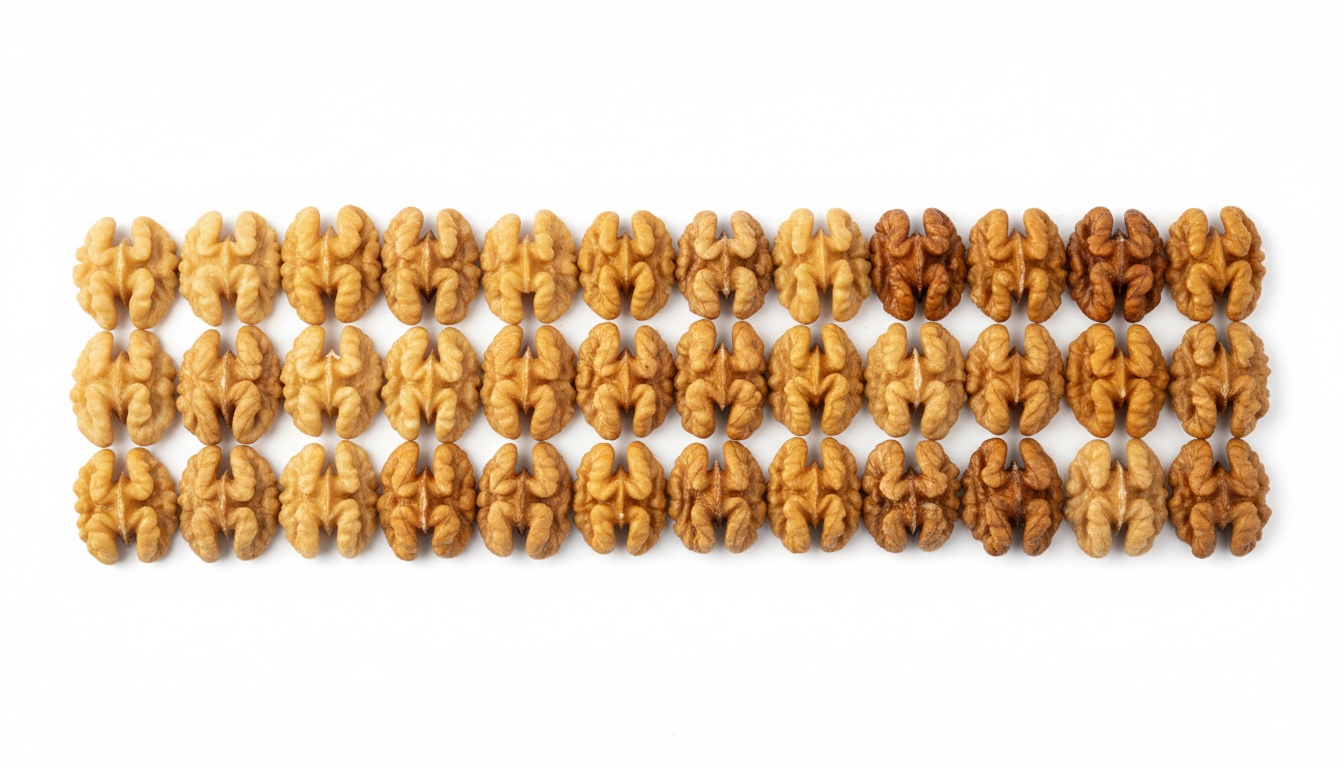
Colour-graded ELH to Amber — halves, quarters & pieces
Shelled walnuts are graded on colour, and colour is very nearly the whole price ladder. The scale runs Extra Light Halves (ELH) at the top, then Light Halves (LH), Light Quarters, Light Amber (LA) and Amber (A), with pieces and meal at the bottom — paler kernels command a large premium because they look better in a visible application and because darkening correlates loosely with age and oxidation. Moisture is contracted at ≤ 5%, which matters more on walnuts than on most nuts: they are the highest in polyunsaturated oil of the common tree nuts, which makes them the quickest to go rancid, and moisture, warmth and air exposure all accelerate it. Halves percentage, foreign matter and shell fragments complete the sheet.
Buy by colour according to whether the kernel is seen. ELH and LH for premium retail in clear packs, cake and dessert decoration, and gifting; Light Amber and Amber for baking, where the kernel is inside the product and cheaper material performs identically; pieces and meal for walnut butter, pastes, granola, cereal and inclusion work where the shape is destroyed anyway. Buy in-shell instead where the customer cracks the nut themselves — festive retail and traditional markets — but understand that you are then paying freight and storage on a shell that is roughly half the gross weight, which is why in-shell prices per tonne look deceptively low. The single most important thing to control on kernels is the cold chain and turnover: walnuts held warm or long simply go rancid, and no specification sheet protects you from that. CBIL supplies against certification of colour grade, moisture, halves percentage, foreign matter and peroxide value, on FOB, CFR and CIF terms.
Excluded origins are not offered, including product re-exported, blended or re-processed through a third country. Every lot moves with a certificate of origin naming the producing plant, mine or grower country, and nothing is quoted before the seller and loading point are known.
Indicative reference
$6,200–8,400 USD / MT
as at September 2026
Reference level only — not an offer, and reviewed quarterly. Levels shown are as at September 2026. Firm pricing is quoted per RFQ, subject to volume, terms and inspection.
Typical Specification
Specifications are indicative and adjusted to the agreed contract and destination requirements. Final spec confirmed on COA / SGS.
Available Grades
Applications
- Premium retail in clear packs
- Cake & dessert decoration
- Bakery & confectionery
- Walnut butter & pastes
- Granola, cereal & inclusion
Category
Agri-Foods, Spices & Nuts
Incoterms
FOB · CFR · CIF
Pricing basis
USD / MT
Inspection
SGS / Intertek at load port
Walnut Kernels — buyer questions
How much does colour grade actually cost me?
A great deal — ELH to Amber can span a third of the price or more. Pale kernels look better and are the correct buy where they are visible: clear packs, decoration, gifting. In a baked good, a butter or a granola the kernel is hidden or destroyed, and Amber pieces perform identically for substantially less. Grading up when nobody sees the nut is the most common overspend on walnuts.
Why do walnuts go rancid faster than other nuts?
Oil chemistry. Walnuts carry the highest polyunsaturated oil content of the common tree nuts, and polyunsaturated fats oxidise fastest. Warmth, air and time all accelerate it. Control moisture at ≤ 5%, keep the cold chain intact, buy against peroxide value, and — most practically — do not hold more stock than you will turn over.
Kernels or in-shell?
Kernels for anything processed, packed or baked. In-shell only where the customer cracks the nut as part of the occasion — festive retail and some traditional markets. Note that in-shell prices per tonne look much cheaper because roughly half the weight is shell you pay freight and storage on and then discard.
Does origin change the product?
Less than colour grade does. California is the largest and most consistently graded supplier; Chile offers a counter-seasonal harvest that helps year-round programmes; Central Asian and Kashmiri walnuts can price attractively with more variable grading. For a given colour grade and moisture spec they are broadly substitutable — compare delivered cost and the seller's grading discipline.
Ready to source Walnut Kernels?
Send your quantity, specification, preferred Incoterms and destination port. Qualified requirements receive a workable offer against verified supply.
Have Walnut Kernels to sell? Submit an offer — we'll match it against live buyer demand.
More in Dry Fruits & Nuts
Cashew Nuts
W180 to W450 wholes, plus SW, butts, splits & LWP
Almonds
Nonpareil, Independence & Carmel by count per ounce
Walnuts
Light halves, in-shell & kernel by colour grade
Pistachios
Californian & Turkish, open-shell by count per ounce
Dates
Medjool, Ajwa, Safawi & Zahidi by grade and moisture
Dried Figs
Turkish Lerida & Natural by diameter grade
W320 Cashew Kernels
300–320 kernels/lb — the world benchmark grade
Premium Whole Cashews (W180 / W210 / W240)
170–240 kernels/lb — the gifting & premium retail sizes
Cashew Pieces & Splits
LWP, SWP, butts & splits — the processing grades
Nonpareil Almonds
California's premium variety — clean blanching, uniform kernel
California Type Almonds
Carmel, Monterey & Independence — the volume grades
In-Shell Walnuts
30 mm, 32 mm & 34 mm+ — Chandler & Hartley
Hazelnuts (Kernels & In-Shell)
Turkish Giresun & Levant kernels, natural or roasted, 11-13 & 13-15 mm
Macadamia Nuts (NIS & Kernel)
Nut-in-shell and kernel styles 0 to 8 from South Africa, Australia, Kenya & China
Pecans (In-Shell & Kernels)
In-shell and halves by count per pound from the USA, Mexico & South Africa
Brazil Nuts
Shelled kernels by count per pound from Bolivia, Peru & Brazil
Raw Cashew Nuts (RCN, In-Shell)
In-shell RCN by outturn (KOR lbs/80 kg), nut count & moisture
Pine Nuts (Kernels & In-Shell)
Chinese Pinus koraiensis kernels and Pakistani chilgoza, species-declared
Dried Apricots
Turkish Malatya, sulphured or natural, sizes 1 to 8
Prunes (Dried Plums)
Chilean, Californian, Agen & Argentine prunes by count per pound
Date Paste (Bulk, for Bars, Bakery & Fillings)
100% pitted, minced dates in vacuum blocks, bought on moisture, pit fragments, mince size and variety