
Dried Figs
Turkish Lerida & Natural by diameter grade
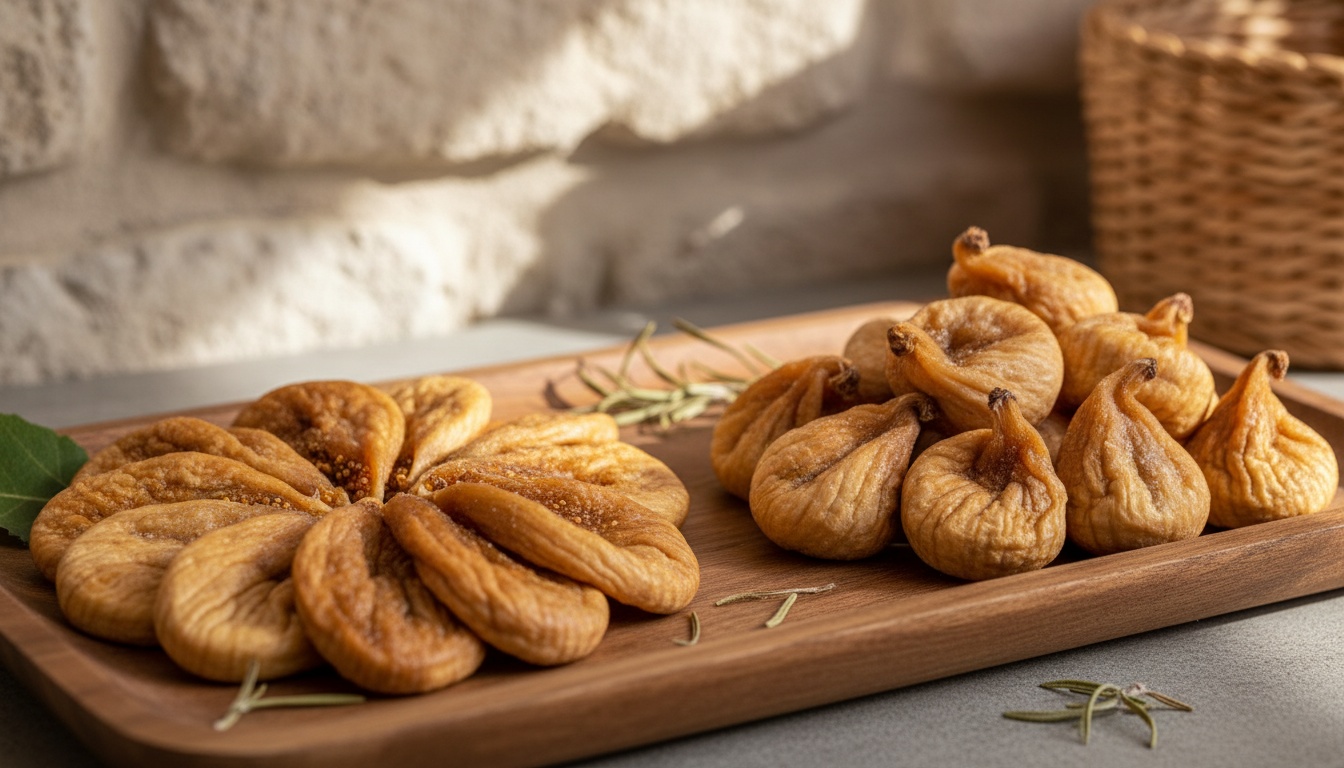
Dried figs are graded on diameter, and the diameter grade is nearly the whole price conversation. Turkish Aydın figs — the origin that dominates world trade — come in a size ladder running from Number 1 (smallest, roughly 22–24 mm) up through Number 2, 3, 4 and 5 to Number 6 and Protoben/Lerida grades at 32 mm and above, with piece count per kilo as the working expression of it: around 100 pieces/kg for the boldest grades out to 200+ for small. On top of diameter sits the classification: Lerida is the pressed, flattened, cleaned and shaped grade destined for retail and gifting, where colour uniformity and skin condition are inspected; Natural is left in its harvested shape and is the volume grade; Garland (strung on a cord) serves specific retail and festive presentations; and industrial or 'pulled' figs — undersize, misshapen, off-colour — are the honest and much cheaper choice for paste, bars and filling. Moisture normally runs 22–26%, higher than most of this family, which is why fig lots are sulphured (typically ≤ 1,000 ppm SO₂, or lower where a retail programme caps it) or supplied SO₂-free with the shorter shelf-life and darker colour that implies.
Buy by whether the fig is seen. Lerida Number 4 and above in a presentation box or a retail tray is a gifting and premium-retail product where you are paying for shape, a pale golden-amber skin and uniform size. Natural grade covers snack packs, trail mixes and general retail. Industrial and pulled grades are the right buy for fig paste, fig rolls and biscuit filling, energy bars, chutney and cereal inclusions — where the fruit is milled and the diameter grade you paid for is destroyed in the first process step. Aflatoxin is the material risk on figs specifically: they are among the highest-risk dried fruits, EU limits sit at 6 ppb B1 and 10 ppb total, and the trade uses UV (BGYF) screening at grading to pull suspect fruit before it ever reaches a lab. We source from lots that have been UV-sorted rather than relying on a certificate after the fact. Every lot ships against SGS or Intertek certification of diameter grade and count, moisture, SO₂ ppm, aflatoxin to destination, foreign matter, insect damage, mould and yeast, with fumigation and phytosanitary documentation, in 5 kg, 6 kg and 10 kg lined cartons and trays, dry or reefer container, on FOB, CFR and CIF terms.
Excluded origins are not offered, including product re-exported, blended or re-processed through a third country. Every lot moves with a certificate of origin naming the producing plant, mine or grower country, and nothing is quoted before the seller and loading point are known.
Indicative reference
$3,400–6,200 USD / MT
as at September 2026
Reference level only — not an offer, and reviewed quarterly. Levels shown are as at September 2026. Firm pricing is quoted per RFQ, subject to volume, terms and inspection.
Typical Specification
Specifications are indicative and adjusted to the agreed contract and destination requirements. Final spec confirmed on COA / SGS.
Available Grades
Applications
- Retail packing & gifting trays
- Snack & trail mixes
- Fig rolls, biscuit filling & bakery
- Energy & cereal bars
- Chutney & sauce bases
Category
Agri-Foods, Spices & Nuts
Incoterms
FOB · CFR · CIF
Pricing basis
USD / MT
Inspection
SGS / Intertek at load port
Dried Figs — buyer questions
What do the fig numbers — No. 3, No. 4, No. 5 — mean?
Diameter. The Turkish size ladder runs from Number 1 at roughly 22–24 mm up to Number 6 and Protoben/Lerida grades at 32 mm and above, expressed in practice as pieces per kilo — about 100/kg for the boldest out to 200+/kg for small. A bigger fig is a rarer fig, so the number is the price. Nothing about kernel or fruit quality changes across the ladder.
What is the difference between Lerida and Natural figs?
Lerida is pressed, flattened, cleaned and shaped for retail and gifting, where uniform pale golden colour and skin condition are inspected piece by piece. Natural is left in its harvested shape and is the volume grade for snack packs and mixes. If the fig sits in a presentation tray, buy Lerida; if it goes in a bag with other fruit, Natural does the same job for less.
Which grade should I use for fig paste or fig rolls?
Industrial or pulled figs — the undersize, misshapen and off-colour fruit. It is milled in the first process step, so the diameter grade and skin condition you would pay a premium for are destroyed immediately. This is the single biggest overspend we see on figs: buying Lerida No. 5 for a biscuit filling.
How is aflatoxin controlled on dried figs?
Figs are among the highest-risk dried fruits and EU limits sit at 6 ppb aflatoxin B1 and 10 ppb total. The trade's real control is UV (BGYF) screening at the grading line, which fluoresces suspect fruit so it can be pulled physically before it ever reaches a lab. We source from lots that have been UV-sorted and certify at load port, rather than relying on a sample certificate to catch what is a patchy, fruit-by-fruit contamination.
Ready to source Dried Figs?
Send your quantity, specification, preferred Incoterms and destination port. Qualified requirements receive a workable offer against verified supply.
Have Dried Figs to sell? Submit an offer — we'll match it against live buyer demand.
More in Dry Fruits & Nuts
Cashew Nuts
W180 to W450 wholes, plus SW, butts, splits & LWP
Almonds
Nonpareil, Independence & Carmel by count per ounce
Walnuts
Light halves, in-shell & kernel by colour grade
Pistachios
Californian & Turkish, open-shell by count per ounce
Dates
Medjool, Ajwa, Safawi & Zahidi by grade and moisture
W320 Cashew Kernels
300–320 kernels/lb — the world benchmark grade
Premium Whole Cashews (W180 / W210 / W240)
170–240 kernels/lb — the gifting & premium retail sizes
Cashew Pieces & Splits
LWP, SWP, butts & splits — the processing grades
Nonpareil Almonds
California's premium variety — clean blanching, uniform kernel
California Type Almonds
Carmel, Monterey & Independence — the volume grades
Walnut Kernels
Colour-graded ELH to Amber — halves, quarters & pieces
In-Shell Walnuts
30 mm, 32 mm & 34 mm+ — Chandler & Hartley
Hazelnuts (Kernels & In-Shell)
Turkish Giresun & Levant kernels, natural or roasted, 11-13 & 13-15 mm
Macadamia Nuts (NIS & Kernel)
Nut-in-shell and kernel styles 0 to 8 from South Africa, Australia, Kenya & China
Pecans (In-Shell & Kernels)
In-shell and halves by count per pound from the USA, Mexico & South Africa
Brazil Nuts
Shelled kernels by count per pound from Bolivia, Peru & Brazil
Raw Cashew Nuts (RCN, In-Shell)
In-shell RCN by outturn (KOR lbs/80 kg), nut count & moisture
Pine Nuts (Kernels & In-Shell)
Chinese Pinus koraiensis kernels and Pakistani chilgoza, species-declared
Dried Apricots
Turkish Malatya, sulphured or natural, sizes 1 to 8
Prunes (Dried Plums)
Chilean, Californian, Agen & Argentine prunes by count per pound
Date Paste (Bulk, for Bars, Bakery & Fillings)
100% pitted, minced dates in vacuum blocks, bought on moisture, pit fragments, mince size and variety