
Macadamia Nuts (NIS & Kernel)
Nut-in-shell and kernel styles 0 to 8 from South Africa, Australia, Kenya & China
Macadamias trade in two forms that go to different buyers. Nut-in-shell (NIS, HS 0802.61) is bought by crackers and by in-shell snack markets, and is priced on sound kernel recovery, moisture and nut size; kernel (HS 0802.62) is bought by food manufacturers and packers and is graded by style. The 2024 export declarations show South Africa leading both: NIS exports across reporters total USD 279 million, with South Africa USD 133 million and 44,104 MT and Australia USD 81 million and 25,270 MT; kernel exports total USD 396 million, with South Africa USD 160 million and 18,508 MT, Australia USD 77 million and 7,117 MT, Kenya USD 55 million and 7,431 MT and China USD 34 million and 2,984 MT. About half of South Africa's crop is exported in-shell, mostly to China and elsewhere in Asia, and half as kernel. Kenya is a kernel-only origin: its Agriculture and Food Authority reinstated the ban on exporting raw in-shell macadamia in July 2025, so Kenyan supply is processed kernel. Harvest runs from March in both South Africa (to about July) and Australia (to about August).
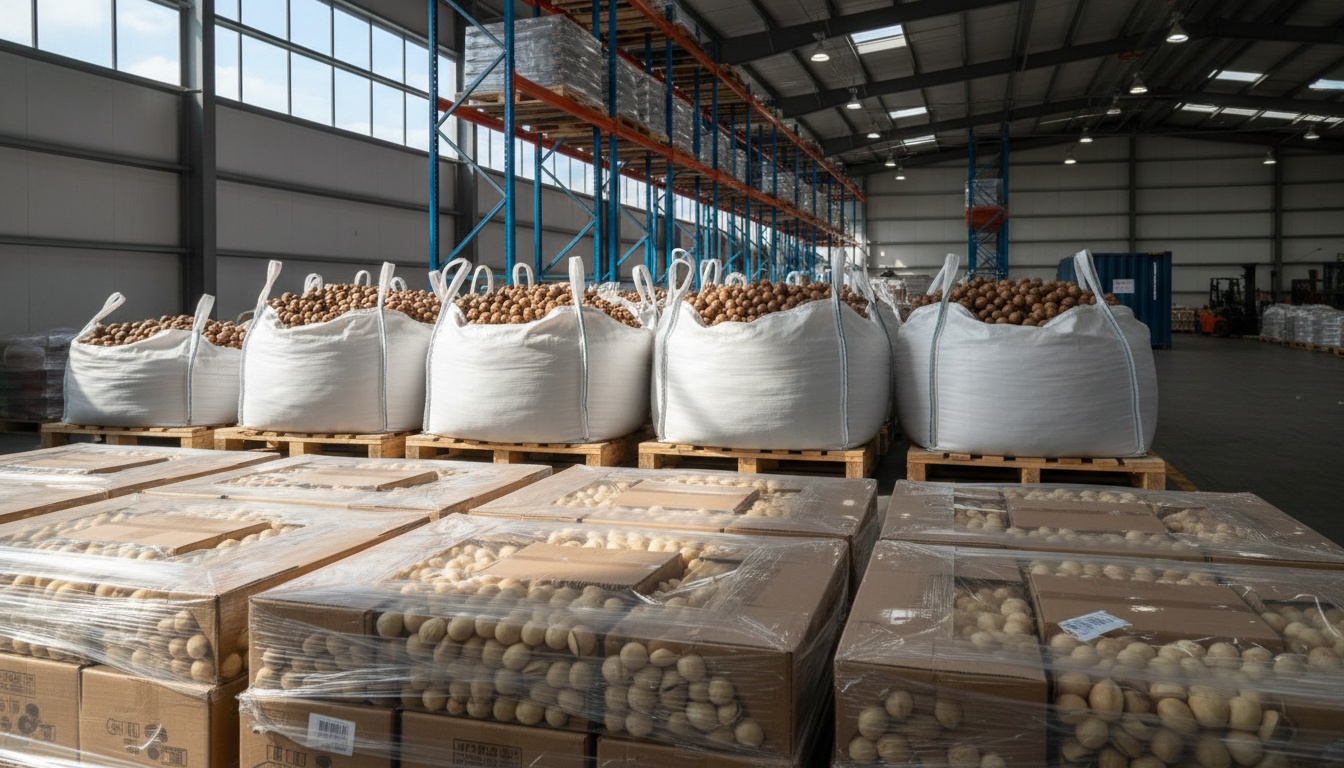
Kernel is sold by style, and the style is size and wholeness. Under the World Macadamia Organisation style guide, Style 0 is at least 95% whole kernel above 20 mm, Style 1 at least 90% whole at 16-20 mm, Style 1S at least 90% whole at 13-18 mm, Styles 2 and 3 are mixes of wholes and halves, Style 4L is at least 80% halves above 13 mm and 4S at least 50% halves at 10-14 mm, and Styles 5, 6 and 7 are pieces at 8-12 mm, 5-9 mm and 3-6 mm, with Style 8 the fines and meal below 3 mm. Wholes (0 and 1) go to premium snack and chocolate-coated lines; halves and pieces go to bakery, cookies, ice cream and confectionery; fines go to paste and meal. UNECE standard DDP-23 caps kernel moisture at 2.0%, and the Australian NIS quality standard requires in-shell nuts held longer than 90 days to be stored below 15°C. In the EU, macadamias fall under the general tree-nut aflatoxin limits in Regulation (EU) 2023/915: 2.0 µg/kg B1 and 4.0 µg/kg total for nuts placed on the market, 5.0 / 10.0 µg/kg for nuts to be sorted. CBIL is a commodity brokerage company and brokers macadamia NIS and kernel from South African, Australian, Kenyan and Chinese processors against a certificate of analysis for style, moisture, aflatoxin and microbiology, a phytosanitary certificate and a certificate of origin. Kernel ships vacuum-packed or nitrogen-flushed in cartons and NIS in bulk bags, both container-load on FOB, CFR and CIF terms. Send the form, style or NIS specification, volume and discharge port, and the enquiry is screened and worked against it.
Excluded origins are not offered, including product re-exported, blended or re-processed through a third country. Every lot moves with a certificate of origin naming the producing plant, mine or grower country, and nothing is quoted before the seller and loading point are known.
Indicative reference
Per lot, on grade and crop USD / MT
as at September 2026
Reference level only — not an offer, and reviewed quarterly. Levels shown are as at September 2026. Firm pricing is quoted per RFQ, subject to volume, terms and inspection.
Typical Specification
Specifications are indicative and adjusted to the agreed contract and destination requirements. Final spec confirmed on COA / SGS.
Available Grades
Applications
- Premium snack & roasted nuts
- Chocolate-coated confectionery
- Cookies, bakery & ice cream
- Macadamia paste & meal
- In-shell snack markets (NIS)
Category
Agri-Foods, Spices & Nuts
Incoterms
FOB · CFR · CIF
Pricing basis
USD / MT
Inspection
SGS / Intertek at load port
Macadamia Nuts (NIS & Kernel) — buyer questions
What do macadamia kernel styles 0 to 8 mean?
Style is size and wholeness. Style 0 is at least 95% whole kernel above 20 mm, Style 1 at least 90% whole at 16-20 mm, Styles 2 and 3 are wholes-and-halves mixes, Style 4L and 4S are halves, Styles 5 to 7 are pieces from 8-12 mm down to 3-6 mm, and Style 8 is fines and meal below 3 mm. Lower style numbers are larger and dearer.
Should I buy nut-in-shell or kernel?
NIS is for crackers and for in-shell snack markets, and is priced on sound kernel recovery and moisture. Food manufacturers and packers buy kernel by style. Note that Kenya bans the export of raw in-shell macadamia, so Kenyan supply is kernel; NIS comes mainly from South Africa and Australia.
What aflatoxin limit applies to macadamias in the EU?
Macadamias fall under the general tree-nut limits in Regulation (EU) 2023/915: 2.0 µg/kg aflatoxin B1 and 4.0 µg/kg total for nuts placed on the market, and 5.0 and 10.0 µg/kg for nuts to be sorted or physically treated first.
When is new-crop macadamia available?
Both main origins are southern-hemisphere: South Africa harvests from March to about July and Australia from March to about August, so new-crop NIS and kernel offers come through in the second and third quarters.
Ready to source Macadamia?
Send your quantity, specification, preferred Incoterms and destination port. Qualified requirements receive a workable offer against verified supply.
Have Macadamia to sell? Submit an offer — we'll match it against live buyer demand.
More in Dry Fruits & Nuts
Cashew Nuts
W180 to W450 wholes, plus SW, butts, splits & LWP
Almonds
Nonpareil, Independence & Carmel by count per ounce
Walnuts
Light halves, in-shell & kernel by colour grade
Pistachios
Californian & Turkish, open-shell by count per ounce
Dates
Medjool, Ajwa, Safawi & Zahidi by grade and moisture
Dried Figs
Turkish Lerida & Natural by diameter grade
W320 Cashew Kernels
300–320 kernels/lb — the world benchmark grade
Premium Whole Cashews (W180 / W210 / W240)
170–240 kernels/lb — the gifting & premium retail sizes
Cashew Pieces & Splits
LWP, SWP, butts & splits — the processing grades
Nonpareil Almonds
California's premium variety — clean blanching, uniform kernel
California Type Almonds
Carmel, Monterey & Independence — the volume grades
Walnut Kernels
Colour-graded ELH to Amber — halves, quarters & pieces
In-Shell Walnuts
30 mm, 32 mm & 34 mm+ — Chandler & Hartley
Hazelnuts (Kernels & In-Shell)
Turkish Giresun & Levant kernels, natural or roasted, 11-13 & 13-15 mm
Pecans (In-Shell & Kernels)
In-shell and halves by count per pound from the USA, Mexico & South Africa
Brazil Nuts
Shelled kernels by count per pound from Bolivia, Peru & Brazil
Raw Cashew Nuts (RCN, In-Shell)
In-shell RCN by outturn (KOR lbs/80 kg), nut count & moisture
Pine Nuts (Kernels & In-Shell)
Chinese Pinus koraiensis kernels and Pakistani chilgoza, species-declared
Dried Apricots
Turkish Malatya, sulphured or natural, sizes 1 to 8
Prunes (Dried Plums)
Chilean, Californian, Agen & Argentine prunes by count per pound
Date Paste (Bulk, for Bars, Bakery & Fillings)
100% pitted, minced dates in vacuum blocks, bought on moisture, pit fragments, mince size and variety