
Food-Grade rPET Pellets (Bottle-to-Bottle, EFSA / FDA Authorised Process)
Bottle-grade rPET pellets from EFSA-assessed and FDA-cleared recycling processes, sold on IV, AA, colour and register numbers
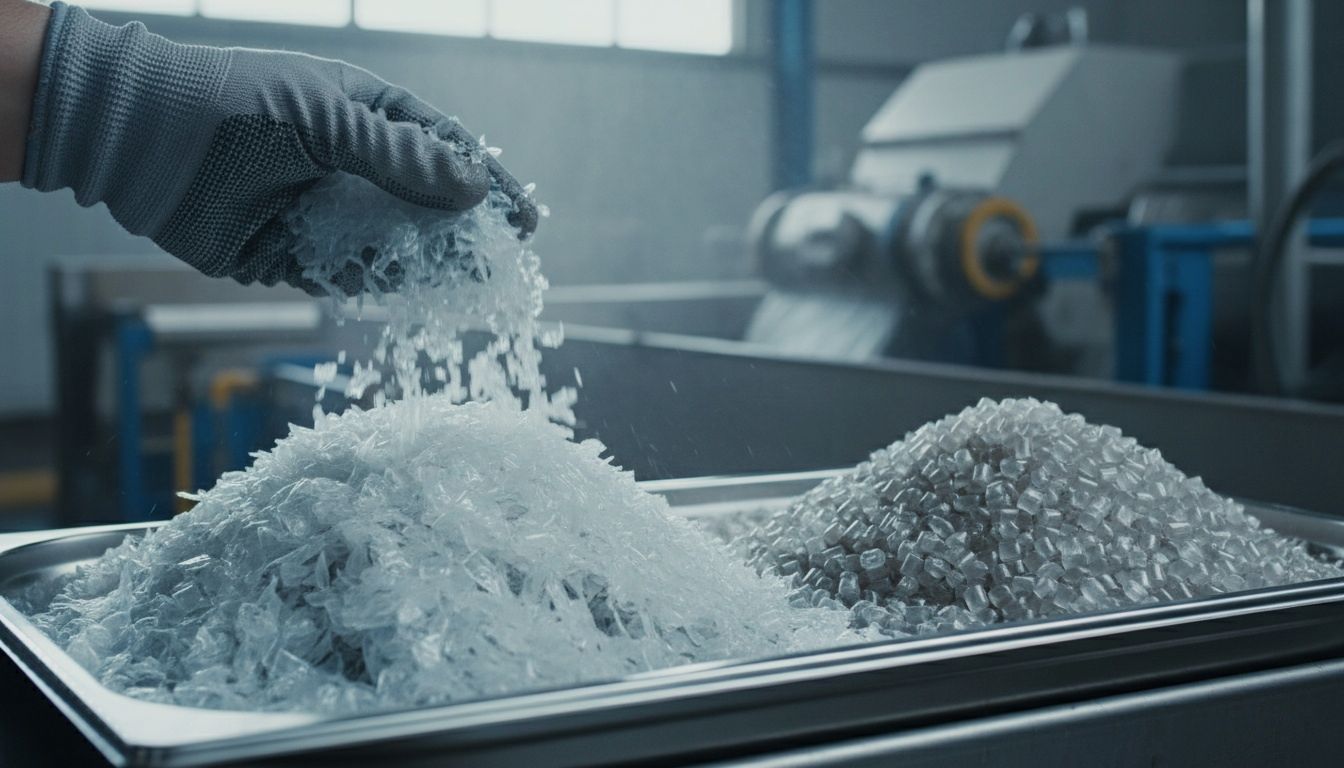
What makes an rPET pellet food-grade is the process, not the pellet. A pellet from an ordinary extruder and a pellet from an authorised bottle-to-bottle line can show the same IV and colour on a certificate of analysis; only the second one may be used in food packaging. In the EU the rule is Regulation (EU) 2022/1616 on recycled plastic materials intended to contact food. It applies in every EU member state. A recycler must run a recycling technology that has been assessed by EFSA, and the individual recycling process must be authorised by the Commission and entered in the Union register under Article 24, which lists recyclers, recycling installations and authorised processes by number. A buyer who hears "EFSA approved" should ask which number: EFSA gives an opinion on a process, and the operator-level proof is the register entry for that plant plus its compliance statement. In the USA the FDA reviews a recycling process and issues a letter of no objection, with the conditions of use, and a seller either holds its own letter or runs a technology whose letter covers users under stated conditions. A typical bottle-grade specification reads IV of 0.78 to 0.86 dL/g after solid-state polycondensation, acetaldehyde below 1 ppm, colour reported as L* and b* on the CIELAB scale, moisture below 0.02% at delivery in sealed packing, and a stated melting point and filtration mesh. The pellets are polymer in primary form under HS 3907.61 when the viscosity number is 78 ml/g or higher, and 3907.69 below that, so they clear as a raw material, not as plastic waste.
Buyers also check the recycled-content claim itself. RecyClass certifies the recycling process and the traceability of recycled content along the chain, and a brand or converter that wants to state a percentage of recycled content usually asks for that certificate. Spain gives the claim a cash value: its special tax on non-reusable plastic packaging charges EUR 0.45 per kilogram of non-recycled plastic, and the Agencia Tributaria's guidance on the taxable base excludes recycled plastic only where an accredited body certifies it. Demand in Europe sits with three groups: preform and bottle makers, brand owners who inject their own preforms, and sheet and film extruders making food trays. Directive (EU) 2019/904 on single-use plastics, applied by each member state, requires PET beverage bottles to contain at least 25% recycled plastic from 2025 and 30% from 2030. Many large converters run their own bottle-to-bottle lines, so open-market pellet goes to plants whose own recycling does not cover their targets. CBIL is a commodity brokerage company and brokers food-grade rPET pellets from authorised recyclers in the EU, the UK, Turkey, the USA and Japan, against the seller's Union register or FDA reference, its RecyClass or equivalent recycled-content certificate, and a certificate of analysis per lot showing IV, acetaldehyde, colour and moisture. Pellets move in bulk silo trucks, octabins or big bags, by road inside Europe and in 20-ft or 40-ft containers by sea, on FCA, FOB, CFR and CIF terms; minimum lots are confirmed per pack. Send the target IV, colour limits, monthly volume, delivery point and the certificate set the buyer requires, and the enquiry is screened and worked against it.
Excluded origins are not offered, including product re-exported, blended or re-processed through a third country. Every lot moves with a certificate of origin naming the producing plant, mine or grower country, and nothing is quoted before the seller and loading point are known.
Indicative reference
Per MT, on grade and certificate set USD / MT
as at September 2026
Reference level only — not an offer, and reviewed quarterly. Levels shown are as at September 2026. Firm pricing is quoted per RFQ, subject to volume, terms and inspection.
Typical Specification
Specifications are indicative and adjusted to the agreed contract and destination requirements. Final spec confirmed on COA / SGS.
Available Grades
Applications
- PET preforms and beverage bottles
- Food and beverage sheet and trays
- Edible oil and household bottles
- Brand-owner in-house preform injection
Category
Petroleum & Energy
Incoterms
FCA · FOB · CFR · CIF
Pricing basis
USD / MT
Inspection
SGS / Intertek at load port
Food-Grade rPET Pellets (Bottle-to-Bottle, EFSA / FDA Authorised Process) — buyer questions
What makes an rPET pellet food-grade?
The recycling process, not the pellet. In the EU, Regulation (EU) 2022/1616 applies in every member state and requires an EFSA-assessed recycling technology and an authorised process entered in the Union register under Article 24. In the USA, the FDA issues a letter of no objection for a recycling process with its conditions of use. A pellet from a line without one of these is not food-grade, whatever its certificate of analysis shows.
Which documents should a buyer ask a food-grade rPET seller for?
The Union register numbers for the recycler and its installation and process under Regulation (EU) 2022/1616, or the FDA letter and whether it was issued to the seller or to the technology it runs; a RecyClass or equivalent recycled-content certificate from an accredited body; and a recent certificate of analysis showing IV, acetaldehyde, colour and moisture. A claim of EFSA approval without a register number is a process claim, not a plant claim.
What specification do preform makers expect?
IV of about 0.78 to 0.86 dL/g after solid-state polycondensation, acetaldehyde below 1 ppm, colour reported as L* and b*, and moisture below 0.02% in sealed packing so the pellet can go straight to the dryer. Filtration mesh and melting point are stated on the data sheet. The buyer runs a trial lot before a regular contract.
Why does certified recycled content matter in Spain?
Spain's special tax on non-reusable plastic packaging charges EUR 0.45 per kilogram of non-recycled plastic. The Agencia Tributaria's guidance on the taxable base excludes recycled plastic only where an accredited body certifies it, so a Spanish packer can deduct rPET content only if the certificate is in hand. That makes the certificate part of the price for a Spanish buyer.
What drives demand for food-grade rPET in Europe?
Directive (EU) 2019/904 on single-use plastics, applied by each member state, requires PET beverage bottles to contain at least 25% recycled plastic from 2025 and 30% from 2030. Brand owners set their own targets on top. Preform makers, brand owners injecting their own preforms and food-tray sheet extruders are the buyers, and many of the larger ones run captive bottle-to-bottle lines, so open-market pellet fills the gap between captive output and the target.
Ready to source Food-Grade rPET Pellets?
Send your quantity, specification, preferred Incoterms and destination port. Qualified requirements receive a workable offer against verified supply.
Have Food-Grade rPET Pellets to sell? Submit an offer — we'll match it against live buyer demand.
More in Recycled Plastics: PET Flakes, rPET, HDPE, PP & LDPE
PET Bottle Bales & Hot-Washed Flakes
Post-consumer PET bottle bales and hot-washed clear, light-blue and green flakes, bought on ppm and IV
Textile-Derived & Low-IV rPET Chip (Dark, Coloured and Fibre-Grade Pellet)
rPET chip from post-consumer polyester textiles and coloured bottle streams, sold on IV, colour, water content and GRS or RCS certificate
HDPE & PP Regrind and Repro Pellets (Natural & Mixed Colour, Drum, Crate & Bottle Grades)
HDPE and PP regrind and reprocessed pellets in natural or mixed colour, bought on MFI and density
LDPE Film Scrap & Agglomerate (Post-Industrial & Post-Consumer Film, Densified Agglomerate)
LDPE and LLDPE stretch and shrink film in bales or rolls, and densified film agglomerate