
Recycled Polyester Staple Fibre (rPSF): Hollow Conjugated Siliconised & Solid
Hollow conjugated siliconised and solid rPSF spun from PET bottle flakes, bought on denier, cut length, tenacity and GRS certificate
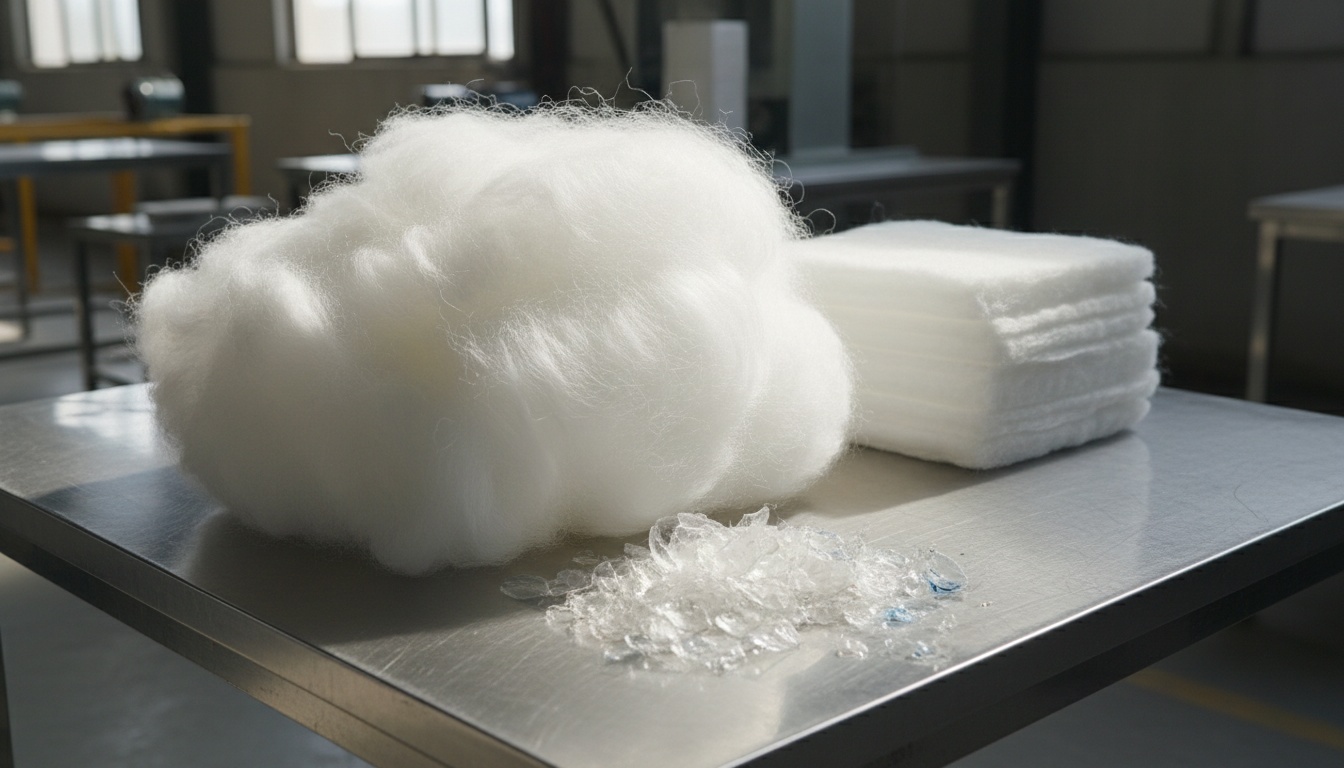
Recycled polyester staple fibre is the largest single outlet for PET bottle flake. Hot-washed flake is dried, melt-spun through a spinneret, drawn, crimped, heat-set and cut to length, and the fibre is sold by two numbers before anything else: denier, the weight in grams of 9,000 metres of a single filament, and cut length in millimetres. Two families are traded. Hollow conjugated siliconised fibre (HCS) is spun with a hollow core and two polymer streams of different shrinkage, so the fibre takes a three-dimensional spiral crimp, then finished with a silicone softener; it fills pillows, quilts, cushions, soft toys and jackets, and producers list it in 3, 6, 7, 10 and 15 denier at 32, 51, 64 and 76 mm, with a non-siliconised dry version for spray-bonded wadding. Solid fibre is the spinning and nonwoven grade: producers list 1.2 and 1.4 denier at 32, 38, 44 and 51 mm for ring and open-end spinning, and 3 to 15 denier for needlepunch, thermal-bond and geotextile lines. A recycled staple producer's technical sheet typically states tenacity of 3.5 to 4.5 grams per denier, elongation of 40 to 60%, oil pick-up of 0.20 to 0.35% and 3 to 5 crimps per centimetre, and the buyer specifies the denier tolerance, colour (raw white, optical white, black or dope-dyed) and the merge number. One Turkish recycler processing a million post-consumer bottles a day lists rPSF from 1.2 to 12 denier and 32 to 102 mm for home-textile and garment yarns; Pakistan's first rPSF plant, running since 2004, states 110 MT a day from 3.3 million bottles. The HS heading is 5503.20, polyester staple fibres not carded or combed, which does not itself separate recycled from virgin: the recycled origin is declared on the invoice and packing list and proven by the Global Recycled Standard or Recycled Claim Standard transaction certificate issued for the shipment. UN Comtrade 2024 export declarations under HS 5503.20 total USD 3.92 billion and about 3.5 million MT across 84 reporters, virgin and recycled together: China USD 1.32 billion and 1.32 million MT, the Republic of Korea USD 668 million and 560,000 MT, Thailand USD 426 million and 405,000 MT, India USD 274 million and 259,000 MT, Indonesia USD 218 million, Türkiye USD 163 million and 138,000 MT and Malaysia USD 131 million. Those are declared export values, not offers.
The feedstock is on this site already: hot-washed clear and light-blue flake from the PET bottle bales and flakes page is the standard HCS and solid-fibre input, and the low-IV and textile-derived chip on the textile and low-IV rPET chip page is taken by spinners as a blend share for dark and black fibre. Buyers are fibrefill and quilting plants, pillow and mattress makers, needlepunch and thermal-bond nonwoven lines for automotive felts, filtration and geotextiles, and spinning mills blending rPSF with cotton or viscose for recycled-content yarns; brand programmes require the GRS certificate on every step from flake to fibre. Two trade-remedy positions matter for routing. The United States has held anti-dumping duty orders on fine denier polyester staple fibre under 3.3 decitex from China, India, the Republic of Korea and Taiwan since July 2018, with countervailing duty orders on China and India, continued after the 2024 sunset review, so US-bound solid spinning fibre from those origins is landed at the order rate while coarser fibrefill deniers sit outside the scope. India's quality control order on polyester staple fibre (IS 17263) was rescinded by notification of 12 November 2025, so BIS marking is no longer a condition of import into India. CBIL is a commodity brokerage company and brokers recycled polyester staple fibre from producers in China, India, Vietnam, Pakistan and Türkiye against the producer's certificate of analysis per lot showing denier, cut length, tenacity, elongation, crimp, oil pick-up and moisture, the GRS or RCS transaction certificate, packing list by bale number and weight, a certificate of origin and a photographed pre-shipment inspection where the buyer asks for one. Fibre ships in compressed, strapped and wrapped bales in 40-ft high-cube containers on FOB, CFR and CIF terms; bale weight and container intake are stated per producer. Send the type (HCS siliconised, dry HCS or solid), denier and cut length, colour, certificate required, monthly tonnage and discharge port, and the enquiry is screened and worked against it.
Need the ship as well? Our chartering desk prices container freight and part cargo space on LaycanDesk.
Excluded origins are not offered, including product re-exported, blended or re-processed through a third country. Every lot moves with a certificate of origin naming the producing plant, mine or grower country, and nothing is quoted before the seller and loading point are known.
Indicative reference
Per MT, on type, denier and certificate USD / MT
as at September 2026
Reference level only — not an offer, and reviewed quarterly. Levels shown are as at September 2026. Firm pricing is quoted per RFQ, subject to volume, terms and inspection.
Typical Specification
Specifications are indicative and adjusted to the agreed contract and destination requirements. Final spec confirmed on COA / SGS.
Available Grades
Applications
- Pillow, quilt, cushion and toy fibrefill
- Mattress and furniture wadding
- Needlepunch and thermal-bond nonwovens, automotive felts, geotextiles
- Ring and open-end spinning of recycled-content yarns
- Filtration and insulation media
Category
Petroleum & Energy
Incoterms
FOB · CFR · CIF
Pricing basis
USD / MT
Inspection
SGS / Intertek at load port
Recycled Polyester Staple Fibre (rPSF): Hollow Conjugated Siliconised & Solid — buyer questions
What is the difference between hollow conjugated siliconised and solid rPSF?
HCS fibre is spun with a hollow core and two polymer streams of different shrinkage, which gives a spiral crimp, then finished with silicone so it stays soft and resilient; it is a filling fibre in 7 to 15 denier. Solid fibre has no hollow and is made finer, from 1.2 denier, for spinning into yarn and from 3 denier upward for needlepunch and thermal-bond nonwovens.
Which HS code covers recycled polyester staple fibre, and how is the recycled claim proven?
HS 5503.20, polyester staple fibres not carded or combed. The heading does not distinguish recycled from virgin fibre, so the recycled origin is declared on the documents and evidenced by a Global Recycled Standard or Recycled Claim Standard transaction certificate issued for that shipment.
Are there anti-dumping duties on polyester staple fibre?
The United States has had anti-dumping duty orders on fine denier polyester staple fibre, under 3.3 decitex, from China, India, the Republic of Korea and Taiwan since July 2018, plus countervailing duty orders on China and India, and continued them after the 2024 five-year review. Coarser fibrefill deniers are outside that scope. The importer's broker confirms the position for the destination and denier.
What feedstock goes into rPSF and where does it come from?
Hot-washed post-consumer PET bottle flake is the standard input; producers state one million to 3.3 million bottles a day at single plants. Dark and black fibre lines can take a share of low-IV or textile-derived rPET chip. Both feedstocks have their own pages on this site.
Which countries export the most polyester staple fibre?
UN Comtrade 2024 export declarations under HS 5503.20, virgin and recycled together, put China first at USD 1.32 billion and 1.32 million MT, then the Republic of Korea, Thailand, India, Indonesia, Türkiye and Malaysia. Vietnam and Pakistan do not appear as reporters in that pull, so their volumes are not shown.
Ready to source Recycled PSF (rPSF)?
Send your quantity, specification, preferred Incoterms and destination port. Qualified requirements receive a workable offer against verified supply.
Have Recycled PSF (rPSF) to sell? Submit an offer — we'll match it against live buyer demand.
More in Recycled Plastics: PET Flakes, rPET, HDPE, PP & LDPE
PET Bottle Bales & Hot-Washed Flakes
Post-consumer PET bottle bales and hot-washed clear, light-blue and green flakes, bought on ppm and IV
Food-Grade rPET Pellets (Bottle-to-Bottle, EFSA / FDA Authorised Process)
Bottle-grade rPET pellets from EFSA-assessed and FDA-cleared recycling processes, sold on IV, AA, colour and register numbers
Textile-Derived & Low-IV rPET Chip (Dark, Coloured and Fibre-Grade Pellet)
rPET chip from post-consumer polyester textiles and coloured bottle streams, sold on IV, colour, water content and GRS or RCS certificate
HDPE & PP Regrind and Repro Pellets (Natural & Mixed Colour, Drum, Crate & Bottle Grades)
HDPE and PP regrind and reprocessed pellets in natural or mixed colour, bought on MFI and density
LDPE Film Scrap & Agglomerate (Post-Industrial & Post-Consumer Film, Densified Agglomerate)
LDPE and LLDPE stretch and shrink film in bales or rolls, and densified film agglomerate
Chemically Recycled Textile-to-Textile PET Chip
Filament-grade PET chip repolymerised from polyester textile waste, GRS certified