
Textile-Derived & Low-IV rPET Chip (Dark, Coloured and Fibre-Grade Pellet)
rPET chip from post-consumer polyester textiles and coloured bottle streams, sold on IV, colour, water content and GRS or RCS certificate
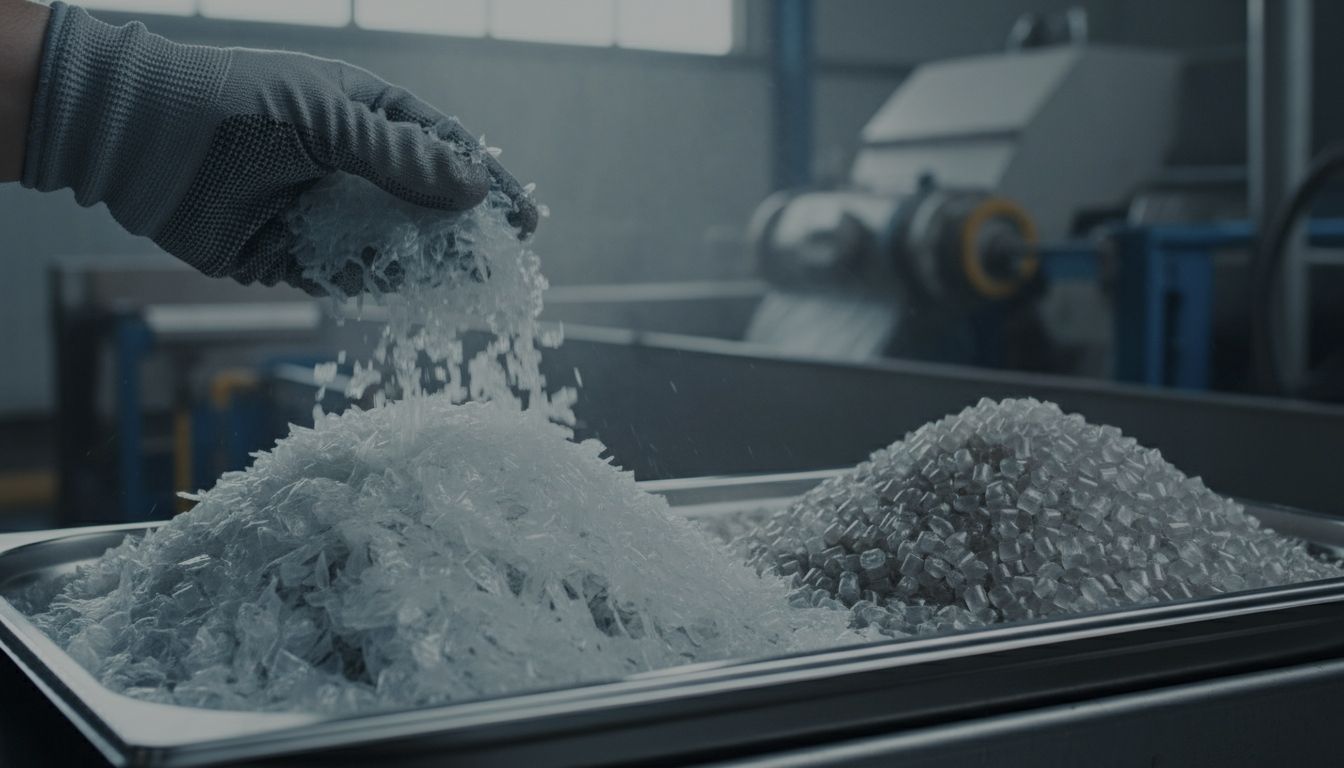
Not every rPET pellet is a bottle pellet. Two other streams are extruded into chip and traded on their own terms. The first is textile-derived chip: post-consumer polyester textiles such as uniforms, workwear, table linen, banners and sublimated sportswear, sorted to 100% polyester, shredded, melt-filtered and pelletised. The second is chip from coloured and mixed bottle flake that food-grade lines reject on colour. Both come out with a lower intrinsic viscosity than bottle grade, because the polyester has already been through one or more melt cycles and, in textiles, years of washing. Textile-derived chip typically sits at about 0.50 to 0.58 dL/g, coloured bottle chip a little higher, while bottle grade is 0.72 dL/g and above and strapping needs 0.80 or more. Polyester staple fibre spinning generally needs IV above about 0.60 dL/g, so a spinner either takes low-IV chip as a blend share with higher-IV flake or raises its IV in-house. Solid-state polycondensation does that: the chip is held for hours at 200 to 230 °C under vacuum or nitrogen, the chains lengthen, and IV climbs from the mid-0.50s to bottle or filament grade. A melt-phase reactor on the extruder gives a smaller lift. Colour is fixed and cannot be corrected: dark and black chip, reported as a low L* value, goes only into black or dark end-uses, coloured chip into pigmented products, and off-white or semi-dull chip with titanium dioxide from the original fibre keeps that dullness. Water content is reported per lot and the chip is dried before spinning. Because the viscosity number is below 78 ml/g, the chip is classified as other polyethylene terephthalate in primary form under HS 3907.69 and clears as a polymer, not as plastic waste.
The buyers fall into four groups. Polyester staple fibre and nonwoven spinners that run black or dark dope-dyed fibre for automotive felts, insulation, geotextile and fibrefill can absorb dark chip, often as a blend. Polyester polyol makers break the chip down by glycolysis for rigid PU and PIR foam, where IV does not matter and a brown polyol is normal; they compare the chip with coloured bottle flake on price. Strapping and sheet plants take chip only after an IV upgrade, or as a minority blend. Yarn spinners nominated by a clothing brand take textile-derived chip where the brand pays for a textile-to-textile claim. That claim rests on certification: the Global Recycled Standard and the Recycled Claim Standard verify recycled input and chain of custody through a transaction certificate on each shipment, and GRS adds social and chemical criteria at the plant. Neither proves IV, colour consistency or spinnability; those come from the certificate of analysis and a spinning trial. One plant offers lots from a few tens of tonnes to about 150 MT a month. CBIL is a commodity brokerage company and brokers textile-derived and low-IV rPET chip from recyclers in the UK, the EU, Turkey and India, against the recycler's certificate of analysis per lot showing IV, L* and b* colour, water content, melting point and TiO2 where present, the GRS or RCS transaction certificate, photographs and a 25 kg trial sample where the buyer asks for one. Chip moves in 1 MT big bags or octabins, by curtain-sider truck inside Europe and in 20-ft or 40-ft containers by sea, on FCA, FOB, CFR and CIF terms. Send the IV band, colour, water content, whether you have SSP on site, monthly volume and delivery point, and the enquiry is screened and worked against it.
Excluded origins are not offered, including product re-exported, blended or re-processed through a third country. Every lot moves with a certificate of origin naming the producing plant, mine or grower country, and nothing is quoted before the seller and loading point are known.
Indicative reference
Per MT, on IV, colour and certificate USD / MT
as at September 2026
Reference level only — not an offer, and reviewed quarterly. Levels shown are as at September 2026. Firm pricing is quoted per RFQ, subject to volume, terms and inspection.
Typical Specification
Specifications are indicative and adjusted to the agreed contract and destination requirements. Final spec confirmed on COA / SGS.
Available Grades
Applications
- Black and dark polyester staple fibre
- Nonwovens, automotive felts and insulation
- Polyester polyols for PU and PIR foam
- Strapping and sheet (after IV upgrade or as blend)
- Brand-nominated textile-to-textile yarn
Category
Petroleum & Energy
Incoterms
FCA · FOB · CFR · CIF
Pricing basis
USD / MT
Inspection
SGS / Intertek at load port
Textile-Derived & Low-IV rPET Chip (Dark, Coloured and Fibre-Grade Pellet) — buyer questions
What IV does a fibre spinner need, and what does SSP do?
Polyester staple fibre spinning generally needs IV above about 0.60 dL/g, filament higher and tighter, and strapping 0.80 dL/g or more. Textile-derived chip comes out at about 0.50 to 0.58 dL/g. Solid-state polycondensation holds the chip for hours at 200 to 230 °C under vacuum or nitrogen so the chains lengthen and IV rises to fibre or bottle grade. A spinner with SSP or a melt-phase reactor on site can take low-IV chip as is; one without can blend a share with higher-IV flake.
Who buys dark or black rPET chip?
Spinners running black or dark dope-dyed polyester staple fibre and nonwovens for automotive felts, insulation, geotextile and fibrefill; polyester polyol makers, who glycolyse the chip for rigid PU and PIR foam and do not need a set IV or colour; and strapping or sheet plants as a minority blend. Colour cannot be corrected, so dark chip stays in dark end-uses.
What do GRS and RCS certificates prove?
The Global Recycled Standard and the Recycled Claim Standard verify that the input was recycled material and track it through the chain of custody with a transaction certificate on each shipment; GRS also audits social, environmental and chemical practice at the plant. They do not prove IV, colour consistency, water content or spinnability. Those come from the certificate of analysis and a trial on the buyer's line.
Is textile-derived rPET chip a waste or a product for customs?
A product. Extruded, filtered chip is polyethylene terephthalate in primary form and, because its viscosity number is below 78 ml/g, falls under HS 3907.69. It sits outside the plastic waste entries of the Basel Convention and Regulation (EU) 2024/1157 that apply to bales and flakes. The importer confirms the treatment with its own authority.
What lot sizes are available?
One plant typically offers from a few tens of tonnes up to about 150 MT a month. A full curtain-sider or 40-ft container carries about 20 to 24 MT of chip in 1 MT big bags. Buyers usually take a 25 kg sample and one or two containers as a trial before a monthly contract.
Ready to source Textile & Low-IV rPET Chip?
Send your quantity, specification, preferred Incoterms and destination port. Qualified requirements receive a workable offer against verified supply.
Have Textile & Low-IV rPET Chip to sell? Submit an offer — we'll match it against live buyer demand.
More in Recycled Plastics: PET Flakes, rPET, HDPE, PP & LDPE
PET Bottle Bales & Hot-Washed Flakes
Post-consumer PET bottle bales and hot-washed clear, light-blue and green flakes, bought on ppm and IV
Food-Grade rPET Pellets (Bottle-to-Bottle, EFSA / FDA Authorised Process)
Bottle-grade rPET pellets from EFSA-assessed and FDA-cleared recycling processes, sold on IV, AA, colour and register numbers
HDPE & PP Regrind and Repro Pellets (Natural & Mixed Colour, Drum, Crate & Bottle Grades)
HDPE and PP regrind and reprocessed pellets in natural or mixed colour, bought on MFI and density
LDPE Film Scrap & Agglomerate (Post-Industrial & Post-Consumer Film, Densified Agglomerate)
LDPE and LLDPE stretch and shrink film in bales or rolls, and densified film agglomerate