
PET Bottle Bales & Hot-Washed Flakes
Post-consumer PET bottle bales and hot-washed clear, light-blue and green flakes, bought on ppm and IV
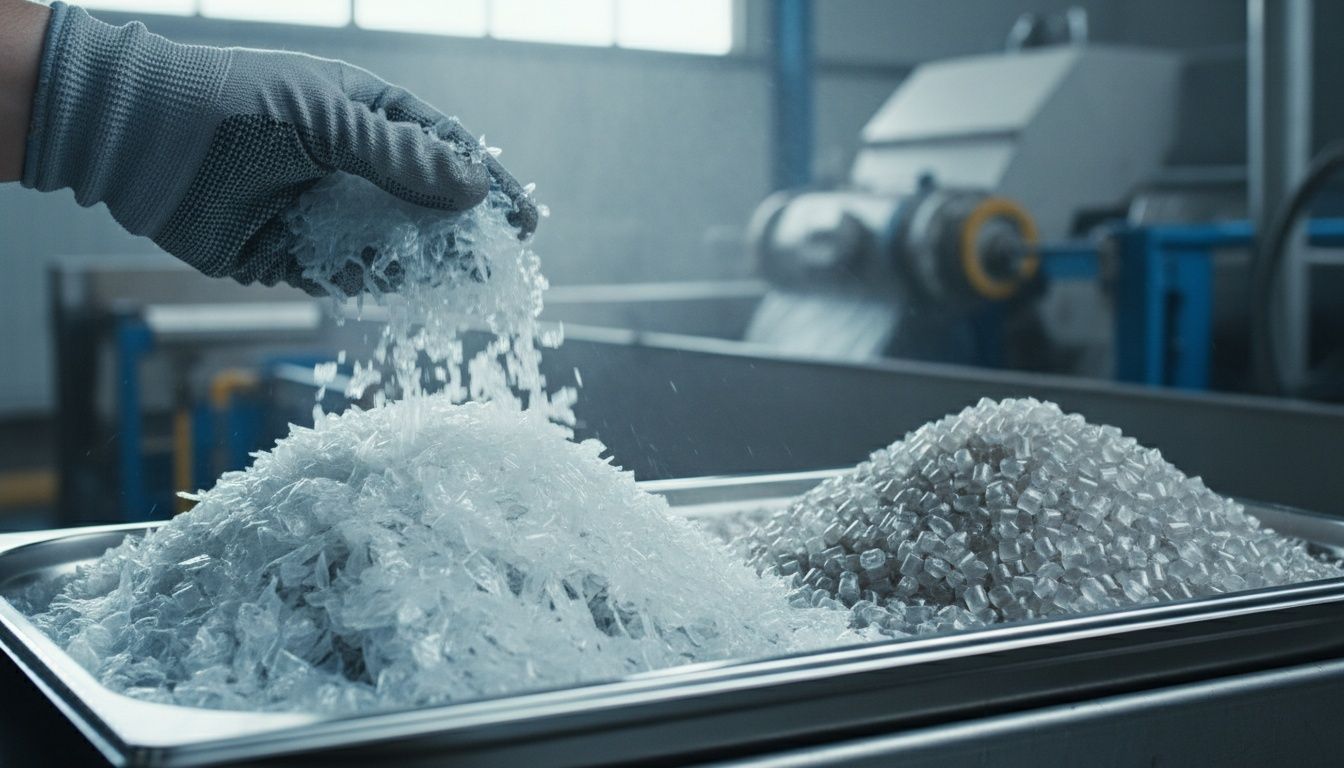
PET bottle recycling starts with two traded forms, and both are waste at the border. Bottle bales are sorted, pressed post-consumer bottles. Hot-washed flakes are those bottles ground, washed with caustic and detergent, sink-float separated from caps and labels, and dried. Both are declared as plastic waste and scrap under HS 3915.90, and both fall under the Basel Convention plastic waste entries: since 1 January 2021 clean, sorted PET is Annex IX entry B3011, the non-hazardous plastic waste entry, while contaminated or mixed plastic waste is Y48 or, where hazardous, A3210, and those two need the prior informed consent procedure. A typical hot-washed clear flake specification quoted by recyclers reads PVC below 30 ppm, glue below 20 ppm, metals below 10 ppm, moisture below 0.5% and IV of 0.70 to 0.72 dL/g. Flake-fed bottle-to-bottle lines look for IV of 0.72 dL/g or more, low PVC and a tight colour split, because their SSP stage raises IV but cannot remove PVC or colour. Bales are graded on the clear and light-blue split, PVC bottle content, moisture and press density. The 2024 export declarations under HS 3915.90, the residual plastic waste line that carries PET and PP scrap, total USD 1.68 billion across 124 reporters, led by Japan at USD 190 million, the USA at USD 134 million, the Netherlands at USD 115 million, Germany at USD 110 million, the UK at USD 90 million and Thailand at USD 84 million. Those are declared export values, not offers. Extruded pellets are a different product with a different customs code, and this site covers them on two separate pages: food-grade rPET pellets from authorised bottle-to-bottle processes at /commodities/recycled-plastics/food-grade-rpet-pellets, and textile-derived and low-IV rPET chip for fibre and glycolysis at /commodities/recycled-plastics/textile-and-low-iv-rpet-chip.
The buyer is a flake-fed bottle-to-bottle recycler, a sheet and thermoforming plant, a strapping maker or a polyester staple fibre and filament spinner, and the offer is a price per MT for a stated form, colour split, IV and contamination limit. CBIL is a commodity brokerage company and brokers PET bottle bales and hot-washed flakes from recyclers in the EU, the UK, the USA, Japan, Thailand and the UAE, against the recycler's certificate of analysis per lot, photographs of the material, a certificate of origin and the waste shipment documents the route requires. Bales and flakes from the EU follow Regulation (EU) 2024/1157 on shipments of waste, which bans non-hazardous plastic waste exports to non-OECD countries from 21 November 2026; Annex VII accompanies green-listed shipments within the rules, and consent is needed for notified waste. Destination rules decide the rest: Malaysia admits plastic waste only with SIRIM approval and pre-shipment inspection by a SIRIM-approved body; Thailand banned municipal plastic waste imports from 1 January 2025; Indonesia admits industrial non-hazardous plastic scrap under Ministry of Trade Regulations 84/2019 and 58/2020 only to licensed manufacturing recyclers holding an active API-P permit and approved quota, with origin pre-shipment stuffing inspection and a Laporan Surveyor issued through KSO SCISI (Sucofindo, Surveyor Indonesia, SGS), into Tanjung Perak and Tanjung Priok; India permits PET flake imports only with DGFT authorisation and an environment ministry NOC; and Viet Nam allows plastic scrap only to its own registered users under QCVN 32 with an environmental deposit. Bales and big-bag flakes move in 40-ft containers on FOB, CFR and CIF terms; for bottle bales the target payload is 22.0 to 24.5 MT per 40-ft high cube at a press density of 380 kg/m³ or more, and minimum lots are confirmed per product and pack. Send the form, colour split, IV, contamination limits, monthly volume and discharge port and the enquiry is screened and worked against it.
Need the ship as well? Our chartering desk prices container freight and part cargo space on LaycanDesk.
Excluded origins are not offered, including product re-exported, blended or re-processed through a third country. Every lot moves with a certificate of origin naming the producing plant, mine or grower country, and nothing is quoted before the seller and loading point are known.
Indicative reference
Per MT, on grade USD / MT
as at September 2026
Reference level only — not an offer, and reviewed quarterly. Levels shown are as at September 2026. Firm pricing is quoted per RFQ, subject to volume, terms and inspection.
Typical Specification
Specifications are indicative and adjusted to the agreed contract and destination requirements. Final spec confirmed on COA / SGS.
Available Grades
Applications
- Flake-fed bottle-to-bottle recycling
- Sheet and thermoforming
- PET strapping
- Polyester staple fibre and filament
- Non-woven and geotextile
Category
Petroleum & Energy
Incoterms
FOB · CFR · CIF
Pricing basis
USD / MT
Inspection
SGS / Intertek at load port
PET Bottle Bales & Hot-Washed Flakes — buyer questions
Are PET bales and flakes treated as waste or as raw material?
Both are waste. Bottle bales and hot-washed flakes are declared under HS 3915.90 as plastic waste and scrap and fall under the Basel Convention plastic waste entries: B3011 for clean sorted PET, Y48 or A3210 for mixed, contaminated or hazardous loads. The importer confirms with its own authority that it is licensed to receive plastic waste before contract. Extruded pellets are a polymer in primary form and are covered on the food-grade rPET pellet and textile rPET chip pages.
What specification applies to hot-washed clear PET flakes?
Recyclers commonly quote PVC below 30 ppm, glue below 20 ppm, metals below 10 ppm, moisture below 0.5% and IV of 0.70 to 0.72 dL/g. Flake-fed bottle-to-bottle lines look for IV of 0.72 dL/g or more and a tight colour split. The certificate of analysis per lot states the measured values.
How are PET bottle bales graded?
On the colour split (80/20 clear and light-blue, or 100% clear), PVC bottle content below 50 ppm preferred and 100 ppm maximum, moisture, and press density of 380 kg/m³ or more, which gives 22.0 to 24.5 net MT in a 40-ft high cube. Bales are bound with five or six galvanised steel wires. Photographs of the loaded bales accompany the offer.
Can EU PET bales and flakes still be exported to Asia?
Under Regulation (EU) 2024/1157, which governs shipments of waste from EU member states, exports of non-hazardous plastic waste to non-OECD countries are banned from 21 November 2026, and between 21 May and 21 November 2026 they need prior written notification and consent. Destination rules such as Malaysia's SIRIM approval, Indonesia's API-P and Laporan Surveyor regime and Thailand's 2025 import ban apply on top.
Does CBIL also broker rPET pellets?
Yes, on two separate pages. Food-grade rPET pellets from authorised bottle-to-bottle processes are at /commodities/recycled-plastics/food-grade-rpet-pellets. Textile-derived and low-IV rPET chip for fibre, nonwovens and polyester polyols is at /commodities/recycled-plastics/textile-and-low-iv-rpet-chip. Pellets are polymer in primary form under HS 3907 and sit outside the waste shipment rules that apply to bales and flakes.
Ready to source PET Bales & Flakes?
Send your quantity, specification, preferred Incoterms and destination port. Qualified requirements receive a workable offer against verified supply.
Have PET Bales & Flakes to sell? Submit an offer — we'll match it against live buyer demand.
More in Recycled Plastics: PET Flakes, rPET, HDPE, PP & LDPE
Food-Grade rPET Pellets (Bottle-to-Bottle, EFSA / FDA Authorised Process)
Bottle-grade rPET pellets from EFSA-assessed and FDA-cleared recycling processes, sold on IV, AA, colour and register numbers
Textile-Derived & Low-IV rPET Chip (Dark, Coloured and Fibre-Grade Pellet)
rPET chip from post-consumer polyester textiles and coloured bottle streams, sold on IV, colour, water content and GRS or RCS certificate
HDPE & PP Regrind and Repro Pellets (Natural & Mixed Colour, Drum, Crate & Bottle Grades)
HDPE and PP regrind and reprocessed pellets in natural or mixed colour, bought on MFI and density
LDPE Film Scrap & Agglomerate (Post-Industrial & Post-Consumer Film, Densified Agglomerate)
LDPE and LLDPE stretch and shrink film in bales or rolls, and densified film agglomerate
Chemically Recycled Textile-to-Textile PET Chip
Filament-grade PET chip repolymerised from polyester textile waste, GRS certified
Recycled Polyester Staple Fibre (rPSF): Hollow Conjugated Siliconised & Solid
Hollow conjugated siliconised and solid rPSF spun from PET bottle flakes, bought on denier, cut length, tenacity and GRS certificate