
Rapeseed & Canola Meal
Canadian, EU and Indian rapeseed meal by protein, glucosinolates and fibre
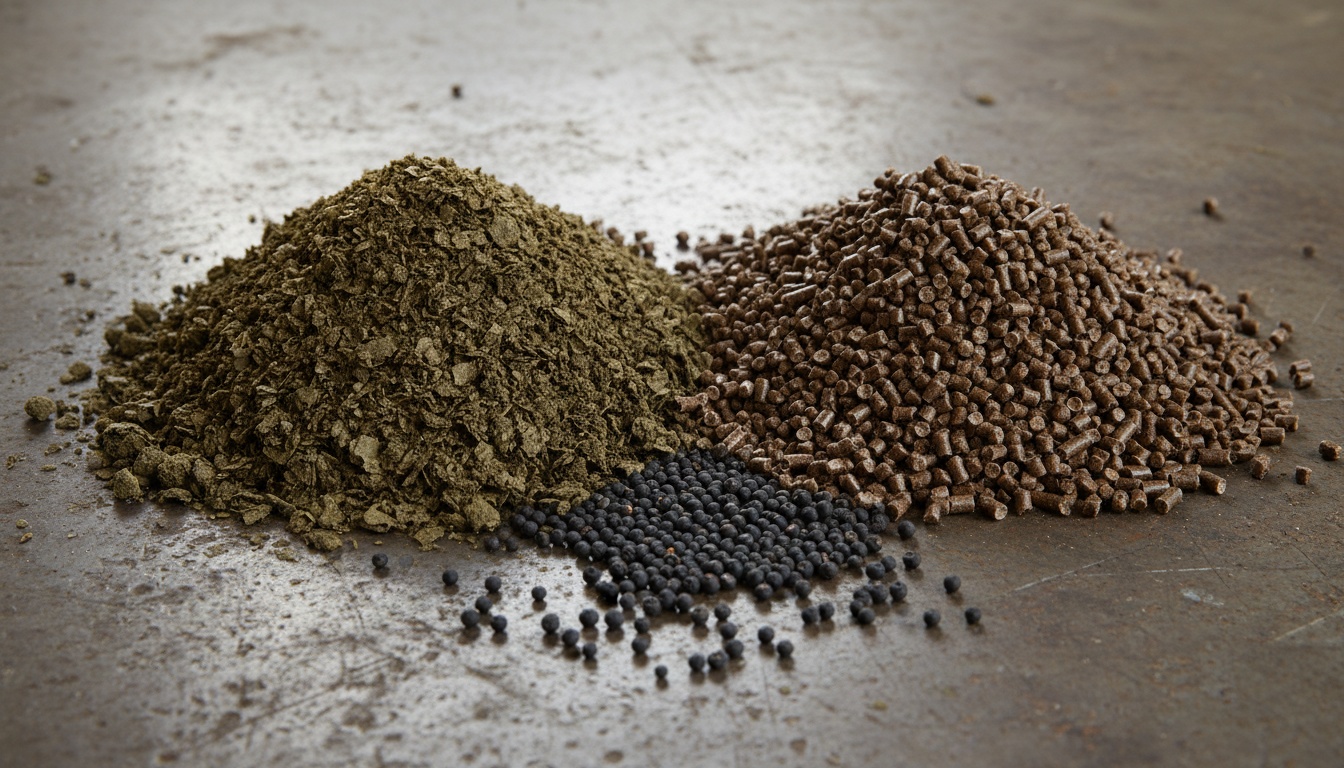
Rapeseed meal is the second protein meal of the world after soybean meal, and the canola name marks the low-erucic, low-glucosinolate varieties bred in Canada: by definition canola meal carries under 30 µmol/g of glucosinolates, and the Canola Council of Canada puts the processed average at 3.6 µmol/g against a minimum crude protein guarantee of 36% at 12% moisture, with actual protein usually 37–40%. European double-zero rapeseed meal trades on the same basis at 34–36% protein; Indian mustard de-oiled cake (DOC) runs 36–38% protein but from Brassica juncea, whose glucosinolate load is higher and must be declared, and it is bought mainly by dairy and layer mills that formulate for it. The sheet carries protein, fat (1–3% solvent-extracted; expeller cake keeps 8–12%), crude fibre (10–12%), moisture (≤ 12%), glucosinolates in µmol/g, and erucic acid where the destination asks; EU Directive 2002/32/EC governs undesirable substances including volatile mustard oil in feed materials, and Canadian meal is generally sold with an amino-acid profile because its methionine and cysteine are its selling point. UN Comtrade 2024 export declarations under HS 2306.41 (low-erucic) show Canada at 5.76 million MT at an average USD 338/MT, Germany 1.67 million MT at USD 302, Belgium 0.75 million MT at USD 318, France 0.45 million MT at USD 341, Czechia 0.37 million MT and Romania 0.30 million MT at USD 283; under HS 2306.49 (other rapeseed meal) India declared 1.58 million MT at USD 274/MT. The Canola Council's 2025 destination table shows where Canadian meal goes: the United States 4.13 million MT, China 0.74 million MT, the EU 0.62 million MT, the United Kingdom 157,000 MT, Vietnam 116,000 MT, South Korea 76,000 MT and Chile 49,000 MT; China applied a 100% tariff to Canadian canola meal on 20 March 2025 and its intake fell to less than half of 2024, and a Canada–China agreement covering canola was reported by USDA FAS in January 2026. India's Solvent Extractors' Association reports 581,000 MT of rapeseed meal shipped to China in April–October 2025 against 14,886 MT a year earlier.
The buyers are dairy mills in the US Pacific Northwest and California, compounders in the EU and UK, and feed groups in Vietnam, Korea, Thailand and Bangladesh who take canola meal for its rumen-bypass protein and price it at a discount to soybean meal on a protein basis. CBIL is a commodity brokerage company and brokers canola and rapeseed meal from Canadian crushers, EU crushers in Germany, Belgium, France and Romania, Indian mustard extraction plants and a UAE crusher on the Fujairah side, against SGS or Intertek certification of protein, fat, fibre, moisture, glucosinolates and mycotoxins at the load port, on GAFTA, FOSFA or the buyer's own contract terms. Parcels are structured as Handysize and Supramax bulk on FOB and CFR out of Vancouver, Hamburg, Ghent, Rouen, Constanța and Kandla, and in containers bulk-loaded with liners or in 50 kg bags for South and Southeast Asian mills; because CBIL also runs a chartering desk (LaycanDesk), the freight leg can be quoted with the cargo. Send your protein floor, glucosinolate ceiling, fat and fibre bands and the monthly tonnage and we will work the crusher to it.
Need the ship as well? Our chartering desk prices bulk feed ingredient freight on LaycanDesk.
Excluded origins are not offered, including product re-exported, blended or re-processed through a third country. Every lot moves with a certificate of origin naming the producing plant, mine or grower country, and nothing is quoted before the seller and loading point are known.
Indicative reference
Per MT, on protein and origin USD / MT
as at September 2026
Reference level only — not an offer, and reviewed quarterly. Levels shown are as at September 2026. Firm pricing is quoted per RFQ, subject to volume, terms and inspection.
Typical Specification
Specifications are indicative and adjusted to the agreed contract and destination requirements. Final spec confirmed on COA / SGS.
Available Grades
Applications
- Dairy rations (rumen-bypass protein)
- Swine grower-finisher feed
- Broiler & layer feed
- Aquafeed (salmon, tilapia)
- Beef & sheep feed
Category
Agriculture & Fertilizers
Incoterms
FOB · CFR · CIF
Pricing basis
USD / MT
Inspection
SGS / Intertek at load port
Rapeseed & Canola Meal — buyer questions
What is the difference between rapeseed meal and canola meal?
Canola is the trade name for rapeseed varieties bred to be low in erucic acid in the oil and low in glucosinolates in the meal — under 30 µmol/g by definition, and the Canola Council of Canada reports a processed average of 3.6 µmol/g. European double-zero rapeseed is the same class of plant and trades on the same protein basis. Indian mustard de-oiled cake comes from Brassica juncea and carries more glucosinolates, so it is bought by mills that formulate around it, largely for dairy cattle and layers. Ask for glucosinolates in µmol/g on every certificate, not just protein.
Who exports canola and rapeseed meal, and where does Canada's go?
UN Comtrade 2024 export declarations under HS 2306.41: Canada 5.76 million MT at USD 338/MT, Germany 1.67 million MT at USD 302, Belgium 0.75 million MT, France 0.45 million MT, Czechia 0.37 million MT and Romania 0.30 million MT; India declared 1.58 million MT under HS 2306.49 at USD 274. The Canola Council's 2025 table puts Canadian meal into the United States at 4.13 million MT, China 0.74 million MT, the EU 0.62 million MT, the UK 157,000 MT, Vietnam 116,000 MT and Korea 76,000 MT. India shipped 581,000 MT of rapeseed meal to China in April–October 2025 (SEA), filling the gap that China's 100% tariff on Canadian meal opened in March 2025.
How is canola meal priced against soybean meal?
On protein delivered: canola meal at 36–38% protein sits below 46–48% soybean meal by roughly the protein ratio, with a further discount for its higher fibre and lower energy, and a premium in dairy rations for its rumen-undegradable protein and methionine. The buyer's arithmetic is the substitution value against soybean meal at the discharge port on the day, adjusted for the ration's energy. We quote both against the same freight so the comparison is like for like.
What parcel sizes and freight terms do you work?
Handysize 25–35,000 MT and Supramax 50–55,000 MT out of Vancouver, Hamburg, Ghent, Rouen, Constanța and Kandla on FOB and CFR terms; combination cargoes with DDGS or soybean meal into the same discharge port; 20-foot containers bulk-loaded with liners or in 50 kg bags for Vietnamese, Bangladeshi and Sri Lankan mills taking 500–3,000 MT a month. Because CBIL also runs a chartering desk, the freight can be quoted with the cargo.
Ready to source Rapeseed Meal?
Send your quantity, specification, preferred Incoterms and destination port. Qualified requirements receive a workable offer against verified supply.
Have Rapeseed Meal to sell? Submit an offer — we'll match it against live buyer demand.
More in Feed By-products: PKE, DDGS, Rice Bran, Fishmeal & Fish Oil
Palm Kernel Expeller (PKE)
Indonesian & Malaysian PKE by protein, fibre, shell and aflatoxin
DDGS (Distillers Dried Grains with Solubles)
US corn DDGS by protein, fat, fibre, colour and mycotoxins
Rice Bran & De-Oiled Rice Bran (DORB)
Full-fat rice bran and de-oiled rice bran for feed, by protein, oil and FFA
Fishmeal (Steam-Dried Super Prime, Prime & Standard)
Anchovy and pelagic fishmeal by protein, TVN, histamine and antioxidant, in bags or bulk
Fish Oil (Crude Anchovy & Pelagic Fish Oil, Feed and Refining Grades)
Crude fish oil by EPA+DHA, FFA, peroxide and anisidine, in flexitanks and ISO tanks
Sunflower Meal (Pellets & Meal)
Black Sea, Danube and Argentine sunflower meal by protein, fibre and hull share
Copra Meal (Coconut Expeller & Extraction)
Philippine and Indonesian copra meal by protein, oil, fibre and aflatoxin
Cottonseed Meal & Cake
Decorticated and undecorticated cottonseed meal by protein, fibre and free gossypol
Corn Gluten Feed (CGF)
US and EU wet-mill corn gluten feed pellets by protein, fibre and starch