
Copper Scrap
Millberry, Candy and Birch/Cliff to ISRI/ReMA grade
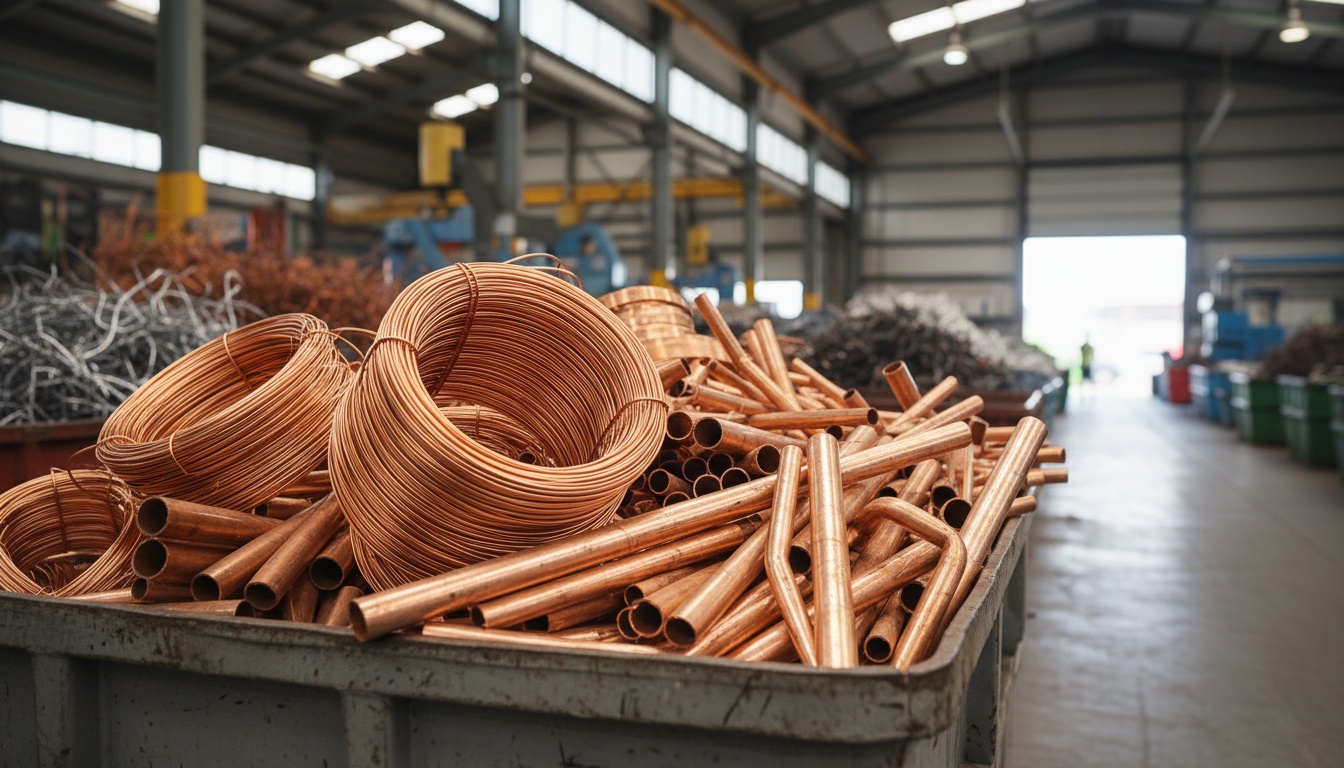
Copper scrap grading is a language, and the words carry prices. Millberry is No. 1 bare bright copper wire: clean, unalloyed, uncoated and untinned, minimum 16 gauge, running 99.9% copper — the top of the book and the grade secondary refiners and rod mills want most. Berry covers No. 1 copper wire and nodules of the same chemistry in different form. Candy is No. 1 heavy copper solids — clean unalloyed tube, bus bar, clippings and heavy sheet, minimum 1.6 mm thick, free of solder, paint and coatings. Birch/Cliff sits below at No. 2: copper of 96% minimum content that may be tinned, soldered, painted or slightly oxidised, and which the trade almost always buys as the mixed Birch/Cliff designation rather than as separate lots. The distinctions are not cosmetic — tinned wire alone drops material out of No. 1 and into No. 2, and a single drum of tinned or soldered content in a Millberry container is enough to reprice the box.
Pricing is arithmetic off the exchange. Copper scrap trades as a percentage of the LME Grade A cash settlement — Millberry in the mid-to-high nineties, Candy a step below, Birch/Cliff in the high eighties to low nineties — with the discount reflecting refining loss, moisture and the recovery a refiner expects from the grade. That is why we quote against a stated pricing date and LME reference rather than a flat number, and why the assay matters: we XRF at purchase, verify gauge and coating at loading, and take a sample on volume lots. Free-of clauses cover moisture and burnt material, iron and other metallic attachments, and any radioactive or hazardous content, with radiation scanning certified at stuffing. Sourcing runs through yards, electrical and telecom contractors, transformer and motor dismantlers and industrial decommissioning across Europe, the UK and North America. Copper is dense and valuable, so containers load out on weight and on insurance limits rather than on volume — typically 20–24 MT in a 20ft box — and we work LC at sight, CAD and part-payment structures on FOB, CFR and CIF terms.
Need the ship as well? Our chartering desk prices Misurata to Izmir scrap freight on LaycanDesk.
Excluded origins are not offered, including product re-exported, blended or re-processed through a third country. Every lot moves with a certificate of origin naming the producing plant, mine or grower country, and nothing is quoted before the seller and loading point are known.
Indicative reference
$8,300–9,400 USD / MT
as at September 2026
Reference level only — not an offer, and reviewed quarterly. Levels shown are as at September 2026. Firm pricing is quoted per RFQ, subject to volume, terms and inspection.
Typical Specification
Specifications are indicative and adjusted to the agreed contract and destination requirements. Final spec confirmed on COA / SGS.
Available Grades
Applications
- Secondary copper refining
- Copper rod & wire mills
- Brass & bronze alloying
- Foundry & casting
Category
Metals & Recycled Scrap
Incoterms
FOB · CFR · CIF
Pricing basis
USD / MT
Inspection
SGS / Intertek at load port
Copper Scrap — buyer questions
Which origins do you not handle?
Scrap of excluded origin is not offered, including material collected, processed or re-exported through a third country. Each lot moves with a certificate of origin and a radiation-free certificate, and the seller declares where the scrap was generated before a price is discussed.
What is the difference between Millberry, Candy and Birch/Cliff?
Chemistry and form. Millberry is No. 1 bare bright wire — unalloyed, uncoated, untinned, minimum 16 gauge, 99.9% copper. Candy is No. 1 heavy solids: clean tube, bus bar and sheet at minimum 1.6 mm and 99% copper. Birch/Cliff is No. 2 at 96% minimum, where tinned, soldered, painted or lightly oxidised material is allowed. Tinning alone moves a lot from No. 1 to No. 2, so the grade is decided by what is in the box, not by how bright it looks.
How do you price copper scrap?
As a percentage of the LME Grade A cash settlement on an agreed pricing date, not as a flat figure. Millberry typically prices in the mid-to-high nineties percent, Candy below that, Birch/Cliff in the high eighties to low nineties — the discount covering refining loss, moisture and expected recovery. Quoting this way means you can see exactly what you are paying for the grade rather than guessing at the spread when the exchange moves.
Can you supply against an XRF or melt assay?
Yes. We XRF at purchase, verify gauge and coating at loading, and draw a sample on volume lots. For refiners who settle on assay we can structure the contract on an outturn basis with the inspection agency drawing and sealing samples at stuffing, so the payable metal follows the analysis rather than the description.
How much copper scrap fits in a container?
Between 20 and 24 MT in a 20ft box, and the constraint is weight and cargo-insurance limits rather than space. It is common to load a single 20ft container well under its volume capacity because the value concentration is high — for large positions we split across multiple boxes rather than reaching for 40ft equipment, which does not help on a weight-limited cargo.
Ready to source Copper Scrap?
Send your quantity, specification, preferred Incoterms and destination port. Qualified requirements receive a workable offer against verified supply.
Have Copper Scrap to sell? Submit an offer — we'll match it against live buyer demand.
More in Metal Scrap
Zinc Ash, Zinc Dross & Skimmings (Galvanizing Residues)
Secondary galvanizing residues (65–85% Zn) for zinc chemical, sulphate and oxide producers
Vessel & Ship Metal Scrap
End-of-life vessels on LDT and the plate, machinery and bronze they yield
HMS 1 & 2 Steel Scrap
Heavy melting steel in 80:20 and 70:30 mixes for EAF charges
Stainless Steel Scrap
304, 316, 310 and 430 solids and turnings, XRF-verified
Cast Iron Scrap
Motor blocks, heavy breakable cast and foundry borings
Insulated Copper Wire Scrap
ICW and cable priced on verified copper recovery
Aluminium Scrap
Taint/Tabor, 6063 extrusion, Zorba, Twitch and wheels
UBC Aluminium Scrap (Used Beverage Cans)
Mill-spec baled used beverage cans for closed-loop can sheet
Brass Scrap
Honey yellow brass, Ebony red brass and Ocean radiators
Lead Scrap (Soft Scrap Lead, Sheets, Plates & Cable)
ISRI RACKS, RADIO, RELAY, chemical sheet and secondary smelter feed under HS 7802.00 & Basel compliance
Electric Motor Scrap
Mixed motors, alternators and starters priced on the copper inside
Compressor & Sealed Unit Scrap
Drained, degassed, non-CFC refrigeration and AC compressors — nothing else
Aluminium Cable & ACSR Scrap
Bare EC wire, insulated aluminium cable and ACSR with the steel core accounted for
6063 Aluminium Extrusion Scrap
Clean, painted and thermal-break 6063 for extruders that cast their own billet
Used Rail Scrap
Cut melting rail and R50/R65 and UIC re-rolling sections
Aluminium 6xxx Swarf & Turnings (ISRI Teens / Telic)
Segregated 6061, 6063 and 6082 machining swarf, loose, dried or briquetted, priced on tested melt recovery