
Vessel & Ship Metal Scrap
End-of-life vessels on LDT and the plate, machinery and bronze they yield
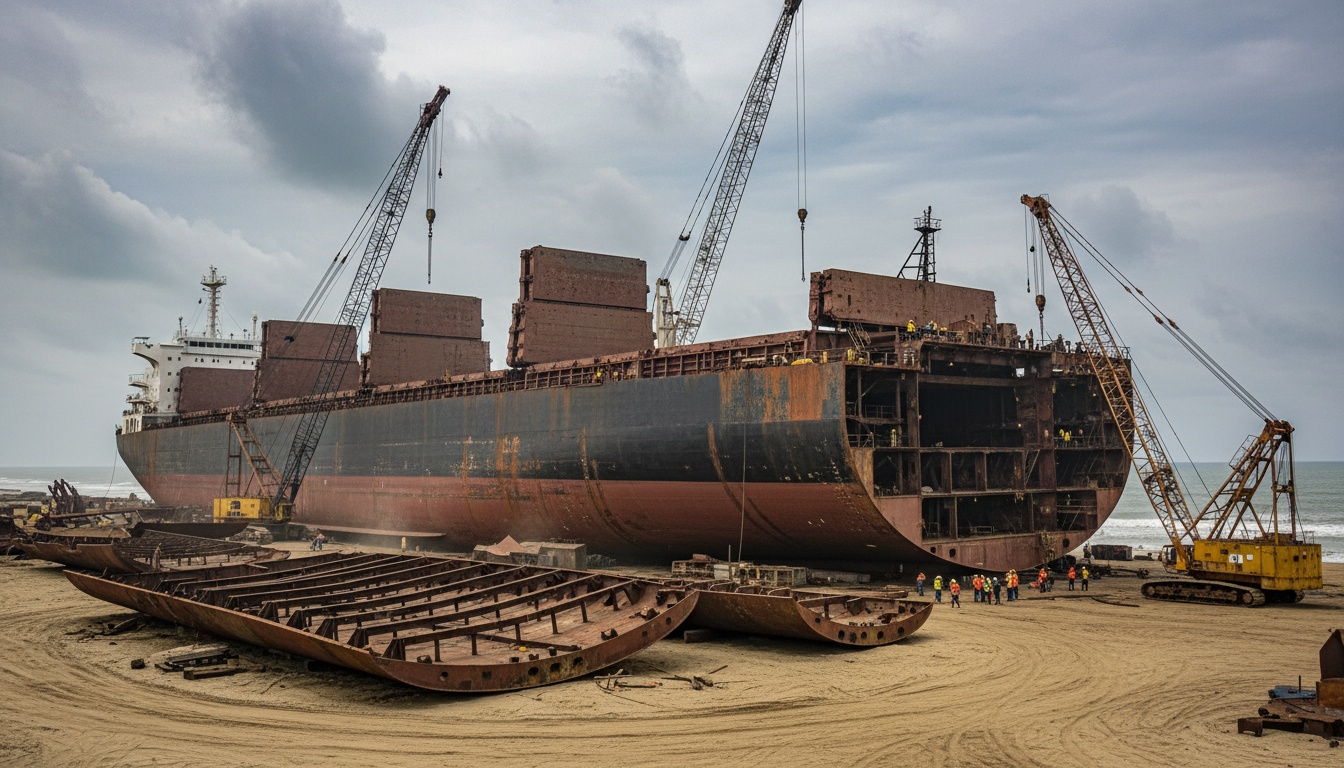
Ships are not bought by the tonne of scrap. They are bought on light displacement tonnage — the weight of the vessel herself, empty of cargo, bunkers and stores — because LDT is the closest available proxy for the steel that will come out of her, and the market quotes in US dollars per LDT rather than per tonne. As a rough frame, a Panamax bulker runs somewhere around 9,000–12,000 LDT, a Capesize 18,000–25,000, a VLCC 35,000–45,000, with feeder container ships, ferries, tugs, barges and offshore units filling the smaller end from a few hundred LDT upward. What moves an individual ship away from the headline market level is her composition: the ratio of re-rollable plate to melting scrap, how much machinery is aboard and whether the main engine is intact, the non-ferrous content — a large propeller alone can be 15–25 tonnes of manganese or nickel-aluminium bronze — the stainless in pipework and galley, and the bunkers remaining on board at delivery, which are separately valued and can be a meaningful line on a big ship. LDT itself is verified from the stability booklet and general arrangement plan rather than taken on trust. Sales conclude "as is where is" on a memorandum of agreement — commonly BIMCO's RECYCLECON or DEMOLISHCON form — with the vessel delivered under her own power to the anchorage off the recycling yard, or handed over at a nominated port such as Fujairah or Singapore for the last voyage.
The output is where most of our buyers actually sit. A typical dry-cargo vessel gives up roughly 60–70% of her LDT as re-rollable steel plate: hull and deck plate cut to size and sold straight to re-rolling mills, above all the rolling belt around Bhavnagar in Gujarat, where it becomes rebar and light sections without ever passing through a furnace. That is why re-rollable commands a premium over melting scrap — the buyer is paying for steel that skips the melt entirely, with the energy cost and yield loss that implies. Another 15–20% comes off as melting scrap in HMS 1 & 2 form for electric-arc and induction charges, generally clean, thick, unalloyed plate that a melt shop is happy to see. The balance carries a second-hand value rather than a scrap value: main and auxiliary engines, generators, pumps, compressors, winches, windlasses, anchors and chain, navigation and safety equipment. Then the non-ferrous fraction — propellers, copper cabling looms running the length of the ship, brass and bronze valves and fittings, aluminium superstructure and accommodation panelling. We work both ends of that chain: sourcing vessels for recycling yards and cash buyers, and sourcing the cut output — re-rollable plate, ship-plate HMS, marine non-ferrous — for mills, foundries and traders who never want to touch a ship.
Compliance is now the gate, not the paperwork that follows the deal. The Hong Kong International Convention for the Safe and Environmentally Sound Recycling of Ships entered into force on 26 June 2025, and a vessel going for recycling under it needs a maintained Inventory of Hazardous Materials (IHM Part I), a Ship Recycling Plan prepared by the facility for that specific ship, and an International Ready for Recycling Certificate — sold into a yard holding a valid Document of Authorisation to conduct Ship Recycling. EU-flagged tonnage sits under a stricter regime again: Regulation (EU) No 1257/2013 requires recycling at a facility on the European List, which covers yards in Europe, the UK, Türkiye and the USA and does not currently include any facility in India, Bangladesh or Pakistan — a fact that decides the destination before the price does. A ship destined for scrapping can additionally be waste under the Basel Convention depending on where she is when the decision to scrap is taken, which is why the timing and place of sale matter as much as the number. Practically, that means surveying and declaring asbestos, PCBs, ozone-depleting substances and TBT antifouling, removing residual oils, sludge and bilge, and issuing a gas-free-for-hot-work certificate before a torch is lit. We place vessels only with yards that can produce their authorisation, arrange class-society Statements of Compliance and IHM survey where they are missing, and structure payment through LC or staged TT against delivery.
Need the ship as well? Our chartering desk prices Misurata to Izmir scrap freight on LaycanDesk.
Excluded origins are not offered, including product re-exported, blended or re-processed through a third country. Every lot moves with a certificate of origin naming the producing plant, mine or grower country, and nothing is quoted before the seller and loading point are known.
Indicative reference
$380–520 USD / LDT
as at September 2026
Reference level only — not an offer, and reviewed quarterly. Levels shown are as at September 2026. Firm pricing is quoted per RFQ, subject to volume, terms and inspection.
Typical Specification
Specifications are indicative and adjusted to the agreed contract and destination requirements. Final spec confirmed on COA / SGS.
Available Grades
Applications
- Ship recycling & dismantling yards
- Re-rolling mills (rebar & sections)
- EAF & induction steelmaking
- Second-hand marine machinery trade
- Non-ferrous refining & foundry
Category
Metals & Recycled Scrap
Incoterms
As Is Where Is · FOB · CFR · CIF
Pricing basis
USD / LDT
Inspection
SGS / Intertek at load port
Vessel & Ship Metal Scrap — buyer questions
Which origins do you not handle?
Scrap of excluded origin is not offered, including material collected, processed or re-exported through a third country. Each lot moves with a certificate of origin and a radiation-free certificate, and the seller declares where the scrap was generated before a price is discussed.
Why are vessels priced per LDT instead of per tonne?
Light displacement tonnage is the weight of the ship herself — hull, machinery and equipment, empty of cargo, bunkers and stores — so it is the best available proxy for the steel that will come out of her before anyone has cut a plate. The market therefore quotes dollars per LDT. We verify the figure against the stability booklet and general arrangement plan rather than accepting the seller's number, because on a 20,000 LDT ship a small discrepancy is worth real money.
What does a ship actually yield when she is broken?
Roughly 60–70% of LDT as re-rollable steel plate, 15–20% as HMS 1 & 2 melting scrap, and the balance as machinery, equipment and non-ferrous. The non-ferrous is small by weight and large by value — a big propeller alone can be 15–25 tonnes of manganese or nickel-aluminium bronze, plus copper cabling running the length of the ship and bronze valves throughout. The exact split varies with vessel type, age and how much machinery is left aboard.
What is re-rollable plate and why does it price above melting scrap?
It is hull and deck plate cut to size and sold directly to re-rolling mills, which roll it into rebar and light sections without melting it. The buyer is skipping the furnace entirely — no energy cost, no melt loss — so re-rollable carries a premium over the same steel sold as HMS. It is the reason the Bhavnagar rolling belt grew up next to Alang, and the reason plate thickness and condition are worth specifying in the contract.
What changed when the Hong Kong Convention came into force?
It took effect on 26 June 2025 and turned good practice into a requirement. A vessel now goes for recycling with a maintained Inventory of Hazardous Materials, a Ship Recycling Plan written by the facility for that specific ship, and an International Ready for Recycling Certificate — into a yard holding a valid Document of Authorisation. We will not place a vessel with a facility that cannot produce its authorisation, and we arrange class-society Statements of Compliance and IHM survey where a ship arrives without them.
Can you handle an EU-flagged vessel?
Yes, but the destination is decided before the price is. Regulation (EU) No 1257/2013 requires EU-flagged ships to be recycled at a facility on the European List, which covers yards in Europe, the UK, Türkiye and the USA — and currently includes no facility in India, Bangladesh or Pakistan. That normally points to Aliaga or a European yard, at a different price level from the sub-continent. We will tell you what the flag costs you up front rather than after you have fixed.
Do you sell whole vessels or the cut material?
Both, and they are different customers. We source end-of-life vessels for recycling yards and cash buyers on an LDT basis, and we source the cut output — re-rollable plate, ship-plate HMS, marine non-ferrous and second-hand machinery — for mills, foundries and traders who want the material without the ship. Tell us which side of that you are on and we will quote to it.
Ready to source Vessel Scrap?
Send your quantity, specification, preferred Incoterms and destination port. Qualified requirements receive a workable offer against verified supply.
Have Vessel Scrap to sell? Submit an offer — we'll match it against live buyer demand.
More in Metal Scrap
Zinc Ash, Zinc Dross & Skimmings (Galvanizing Residues)
Secondary galvanizing residues (65–85% Zn) for zinc chemical, sulphate and oxide producers
HMS 1 & 2 Steel Scrap
Heavy melting steel in 80:20 and 70:30 mixes for EAF charges
Stainless Steel Scrap
304, 316, 310 and 430 solids and turnings, XRF-verified
Cast Iron Scrap
Motor blocks, heavy breakable cast and foundry borings
Copper Scrap
Millberry, Candy and Birch/Cliff to ISRI/ReMA grade
Insulated Copper Wire Scrap
ICW and cable priced on verified copper recovery
Aluminium Scrap
Taint/Tabor, 6063 extrusion, Zorba, Twitch and wheels
UBC Aluminium Scrap (Used Beverage Cans)
Mill-spec baled used beverage cans for closed-loop can sheet
Brass Scrap
Honey yellow brass, Ebony red brass and Ocean radiators
Lead Scrap (Soft Scrap Lead, Sheets, Plates & Cable)
ISRI RACKS, RADIO, RELAY, chemical sheet and secondary smelter feed under HS 7802.00 & Basel compliance
Electric Motor Scrap
Mixed motors, alternators and starters priced on the copper inside
Compressor & Sealed Unit Scrap
Drained, degassed, non-CFC refrigeration and AC compressors — nothing else
Aluminium Cable & ACSR Scrap
Bare EC wire, insulated aluminium cable and ACSR with the steel core accounted for
6063 Aluminium Extrusion Scrap
Clean, painted and thermal-break 6063 for extruders that cast their own billet
Used Rail Scrap
Cut melting rail and R50/R65 and UIC re-rolling sections
Aluminium 6xxx Swarf & Turnings (ISRI Teens / Telic)
Segregated 6061, 6063 and 6082 machining swarf, loose, dried or briquetted, priced on tested melt recovery