
Used Rail Scrap
Cut melting rail and R50/R65 and UIC re-rolling sections
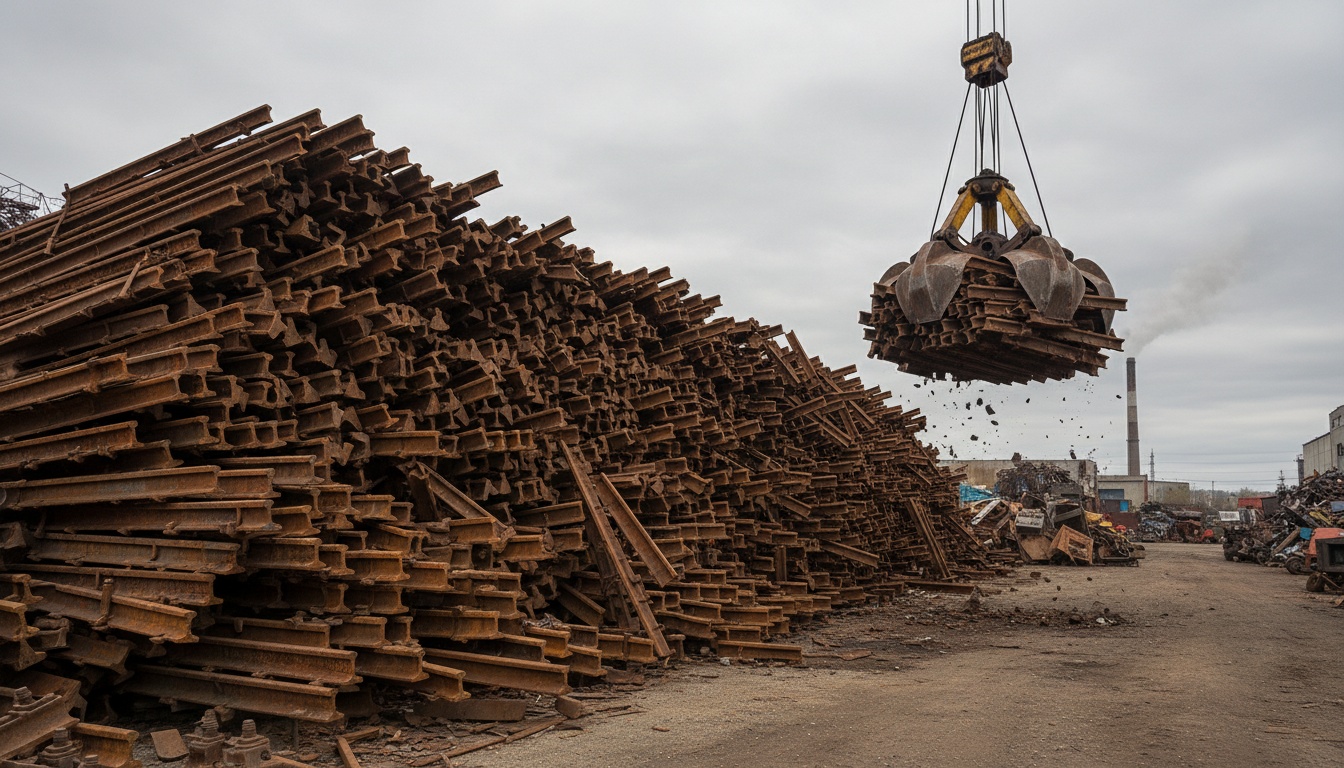
Used rail is the cleanest heavy ferrous scrap in circulation, and it trades two ways. Taken up from track at the end of its life, rail steel is high-carbon and manganese-bearing — on the common R260 grade, carbon around 0.62–0.80% and manganese around 0.7–1.2% — thick, dense and almost free of coatings, attachments and tramp copper. That makes it prized melting scrap: cut to 2ft, 3ft or 5ft lengths for charging, it charges densely, melts predictably and brings carbon and manganese into the bath that a melt shop would otherwise have to add. The second route skips the furnace. Heavy rail sections — R50 and R65, and the UIC 54 and UIC 60 profiles, at roughly 50–65 kg per metre — are sold to re-rolling mills in India, Bangladesh and Pakistan, which reheat the rail and roll it straight into bars, angles and flats. Re-rolling buyers pay for length, section and head wear more than for tonnage: long, straight, uncracked rail with limited head wear carries a premium over cut melting rail, while bent, cracked or heavily worn lengths fall back to the melting price. Fishplates, tie plates, clips and bolts come off before loading or are declared, and so do switch and crossing pieces, whose cast high-manganese components a re-roller does not want.
The declaration follows the use. Rails imported as goods for re-rolling are commonly entered under HS 7302.10 as rails, while rails bound for the melt shop are declared as ferrous scrap under 7204.49 — so the heading depends on whether the buyer re-rolls or melts, and the buyer's customs broker confirms it before shipment. Some destinations restrict the import of rails for re-rolling or set quality rules on re-rolled product, so the destination's import policy is checked before a re-rolling lot is contracted. Supply comes from rail networks, track-renewal contractors and mining and port railways in the USA, the UK, Europe, Australia, South Africa and Brazil. Cut melting rail travels in 20ft containers at around 24–26 MT, loading on weight rather than volume; long re-rolling rail and large melting lots move in bulk on Handysize and Supramax tonnage, and for those bulk lots CBIL also runs a chartering desk, LaycanDesk. Every lot carries a radiation-free certificate and the standard free-of clauses — no explosives, sealed containers or hazardous residues — with inspection-agency supervision at loading on request, and LC at sight is the common payment basis. Rail prices as a premium to the HMS 1&2 80:20 benchmark, with the premium set by length, section and condition.
Need the ship as well? Our chartering desk prices scrap freight, bulk ships and containers on LaycanDesk.
Excluded origins are not offered, including product re-exported, blended or re-processed through a third country. Every lot moves with a certificate of origin naming the producing plant, mine or grower country, and nothing is quoted before the seller and loading point are known.
Indicative reference
HMS 80:20 + premium USD / MT
as at September 2026
Reference level only — not an offer, and reviewed quarterly. Levels shown are as at September 2026. Firm pricing is quoted per RFQ, subject to volume, terms and inspection.
Typical Specification
Specifications are indicative and adjusted to the agreed contract and destination requirements. Final spec confirmed on COA / SGS.
Available Grades
Applications
- Re-rolling mills (bars, angles & flats)
- Electric-arc & induction steelmaking
- Foundry charge
- Carbon & manganese units for the melt
Category
Metals & Recycled Scrap
Incoterms
FOB · CFR · CIF
Pricing basis
USD / MT
Inspection
SGS / Intertek at load port
Used Rail Scrap — buyer questions
Which origins do you not handle?
Scrap of excluded origin is not offered, including material collected, processed or re-exported through a third country. Each lot moves with a certificate of origin and a radiation-free certificate, and the seller declares where the scrap was generated before a price is discussed.
Should I buy rails for re-rolling or for melting?
It depends on your mill. A re-roller pays for length, section and head wear, because the rail goes straight into bars, angles and flats without being melted; that is worth a premium only if the rail is long, straight and uncracked. A melt shop wants rail cut to charge — 2ft, 3ft or 5ft — for its density, clean chemistry and carbon and manganese. Worn, bent or cracked rail belongs in the melting category whatever it was sold as.
What is the chemistry of used rail steel?
High-carbon and manganese-bearing. On the common R260 grade, carbon runs around 0.62–0.80% and manganese around 0.7–1.2%, with very little copper or other tramp elements. For a melt shop that means a clean, predictable charge that brings carbon and manganese with it; switch and crossing pieces with cast high-manganese components are declared separately because they sit outside that range.
Which HS code do used rails clear under?
It depends on use. Rails imported for re-rolling are commonly entered under 7302.10 as rails; rails bound for melting are declared as ferrous scrap under 7204.49. Some destinations restrict the import of rails for re-rolling, so the heading and the destination's import policy are confirmed by your customs broker before a lot is contracted, not after it lands.
Do rails ship in containers or in bulk?
Both. Cut melting rail loads on weight at around 24–26 MT per 20ft container. Long re-rolling rail and large melting lots move in bulk on Handysize or Supramax tonnage, where the freight becomes a charter rather than a container booking. Tell us the tonnage, lengths and discharge port and the shipment can be sized to the right option.
Ready to source Used Rail Scrap?
Send your quantity, specification, preferred Incoterms and destination port. We'll verify supply and respond with a workable offer — usually within one business day.
Have Used Rail Scrap to sell? Submit an offer — we'll match it against live buyer demand.
More in Metal Scrap
Vessel & Ship Metal Scrap
End-of-life vessels on LDT and the plate, machinery and bronze they yield
HMS 1 & 2 Steel Scrap
Heavy melting steel in 80:20 and 70:30 mixes for EAF charges
Stainless Steel Scrap
304, 316, 310 and 430 solids and turnings, XRF-verified
Cast Iron Scrap
Motor blocks, heavy breakable cast and foundry borings
Copper Scrap
Millberry, Candy and Birch/Cliff to ISRI/ReMA grade
Insulated Copper Wire Scrap
ICW and cable priced on verified copper recovery
Aluminium Scrap
Taint/Tabor, 6063 extrusion, Zorba, Twitch and wheels
UBC Aluminium Scrap (Used Beverage Cans)
Mill-spec baled used beverage cans for closed-loop can sheet
Brass Scrap
Honey yellow brass, Ebony red brass and Ocean radiators
Lead Scrap & Drained Batteries
Soft lead, battery plates and RSLAB under Basel consent
Electric Motor Scrap
Mixed motors, alternators and starters priced on the copper inside
Compressor & Sealed Unit Scrap
Drained, degassed, non-CFC refrigeration and AC compressors — nothing else
Aluminium Cable & ACSR Scrap
Bare EC wire, insulated aluminium cable and ACSR with the steel core accounted for
6063 Aluminium Extrusion Scrap
Clean, painted and thermal-break 6063 for extruders that cast their own billet