
Electric Motor Scrap
Mixed motors, alternators and starters priced on the copper inside
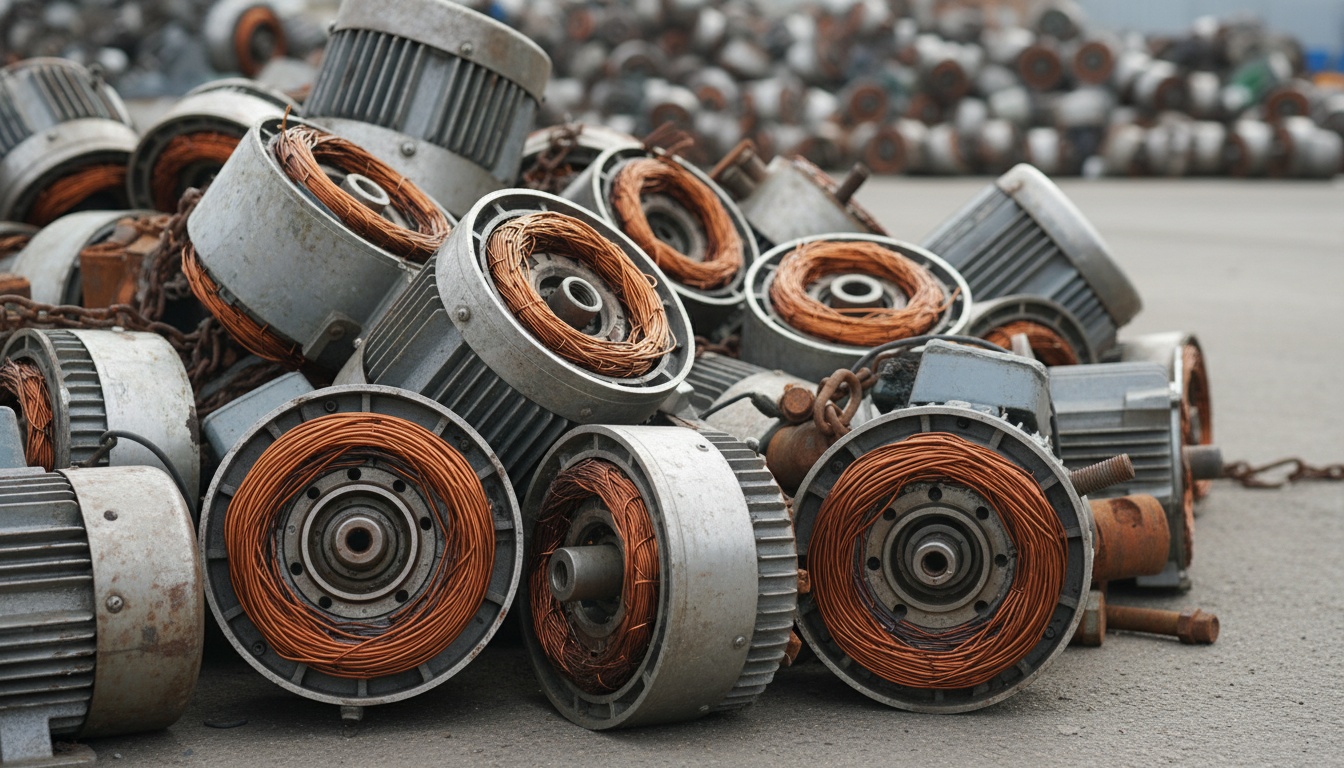
Electric motor scrap is bought for the copper winding inside a steel and cast-iron body, and every price conversation starts with how much copper that is. A typical mixed lot recovers roughly 8–15% copper by weight, with iron and steel making up almost all of the rest — laminations, housings, shafts and end bells — plus a small share of aluminium, insulation and dirt. Where a lot sits in that band depends on the mix. Small motors from appliances, power tools and fans carry more plastic and take more labour per kilogram of copper; medium industrial motors are the backbone of most containers; large motors are heavy on steel and slow to cut, but their windings are thick and clean once they are out. Alternators and starters trade alongside motors and are usually bagged separately because their copper share differs from the general mix. The single biggest value split is winding metal: aluminium-wound motors look identical from the outside and recover a fraction of the value, so a lot sold as copper-wound should be spot-cut at the yard, and a mixed lot should state its aluminium-wound share. Shredded motor scrap — the "meatball" fraction a shredder throws out because the copper is still tangled in the steel — trades as its own grade on an assayed copper figure rather than a count of motors.
The buyers sit in hand-dismantling economies. US and European yards cannot strip motors economically, so the grade is exported to melters in Pakistan, India, Türkiye and China, where labour recovers the copper windings and the steel separately — the copper to secondary refiners and rod casters, the steel and cast iron to induction furnaces. The flows are large: India imported 445,948 t of HS 7404 copper scrap in 2025, 24.6% of it from the USA (UN Comtrade, 2025 import declarations, reporter India), and US exporters declared 381,636 t of HS 7204.49 ferrous scrap to Pakistan in 2025 at an average $830/t (UN Comtrade, 2025 export declarations, reporter USA) — about two and a half times the unit value of the same code shipped to Türkiye, a gap consistent with a large share of motor-bearing and other copper-bearing mixes in those boxes (our reading of the data). Classification follows that pattern: Pakistani importers commonly clear motors under PCT 7204.4990 as ferrous scrap, while elsewhere the same material is entered under 7204 or, where it is treated as waste electrical equipment, under 8549 — so the classification is the buyer's customs broker's call, confirmed in writing before a box is booked. On the export side, UK guidance generally treats motors taken out of waste electrical equipment like other WEEE components, meaning prior notification and consent rather than green-list paperwork; industrial motors are less clear-cut, and the exporter's position with its competent authority belongs on file. Loads run at about 20–24 MT per 40ft container, lower where road-weight limits at origin cap the box. Freight is container freight quoted through lines and forwarders; US East Coast to Karachi runs roughly 45–60 days via the Cape. Pakistani buy offers typically specify LC at sight, and in our reading CAD is used between established yards and their regular buyers. Each lot carries a radiation-free certificate, an oil-free statement and photographs of a sample cut.
Need the ship as well? Our chartering desk prices scrap freight, bulk ships and containers on LaycanDesk.
Excluded origins are not offered, including product re-exported, blended or re-processed through a third country. Every lot moves with a certificate of origin naming the producing plant, mine or grower country, and nothing is quoted before the seller and loading point are known.
Indicative reference
$1,100–1,450 USD / MT
as at September 2026
Reference level only — not an offer, and reviewed quarterly. Levels shown are as at September 2026. Firm pricing is quoted per RFQ, subject to volume, terms and inspection.
Typical Specification
Specifications are indicative and adjusted to the agreed contract and destination requirements. Final spec confirmed on COA / SGS.
Available Grades
Applications
- Hand dismantling & copper winding recovery
- Secondary copper refining & rod casting
- Induction furnace steel melting
- Cast iron & steel foundry charge
Category
Metals & Recycled Scrap
Incoterms
FOB · FCA · CFR · CIF
Pricing basis
USD / MT
Inspection
SGS / Intertek at load port
Electric Motor Scrap — buyer questions
Which origins do you not handle?
Scrap of excluded origin is not offered, including material collected, processed or re-exported through a third country. Each lot moves with a certificate of origin and a radiation-free certificate, and the seller declares where the scrap was generated before a price is discussed.
How much copper is actually in a container of motor scrap?
A mixed lot typically recovers 8–15% copper by weight, so a 22 MT box holds somewhere around 1.8–3.3 MT of copper, with the rest iron, steel and a little aluminium and insulation. The spread is the mix — small appliance motors, medium industrial motors, large motors, alternators and starters all sit differently — which is why the contracted figure should come from a sample cut on the actual lot, not from a general description.
How do I keep aluminium-wound motors out of a copper-wound lot?
By making the winding metal a contract term. Aluminium-wound motors look the same from outside and recover a fraction of the value, so the seller declares the aluminium-wound share, spot-cuts a sample at the yard and photographs it. A lot sold as copper-wound that turns out mixed has been mis-described; a lot sold as mixed is priced on the declared split.
Which HS code does motor scrap clear under?
That is your customs broker's decision, and it should be confirmed in writing before a box is booked. Pakistani importers commonly clear motors under PCT 7204.4990 as ferrous scrap; elsewhere the same material is entered under 7204 or, where it is treated as waste electrical equipment, under 8549, which carries different rules. A lot whose paper does not match the declared code is a lot that can be held or sent back.
What are motor "meatballs" and are they worth buying?
They are the fraction a shredder throws out when it hits motors — copper windings still tangled in steel laminations, too mixed for the magnet line to clean. They trade on an assayed copper figure rather than a count of motors. They suit a buyer with the labour or separation equipment to finish the job; bought without either, they are steel with copper you cannot reach.
Ready to source Electric Motor Scrap?
Send your quantity, specification, preferred Incoterms and destination port. We'll verify supply and respond with a workable offer — usually within one business day.
Have Electric Motor Scrap to sell? Submit an offer — we'll match it against live buyer demand.
More in Metal Scrap
Vessel & Ship Metal Scrap
End-of-life vessels on LDT and the plate, machinery and bronze they yield
HMS 1 & 2 Steel Scrap
Heavy melting steel in 80:20 and 70:30 mixes for EAF charges
Stainless Steel Scrap
304, 316, 310 and 430 solids and turnings, XRF-verified
Cast Iron Scrap
Motor blocks, heavy breakable cast and foundry borings
Copper Scrap
Millberry, Candy and Birch/Cliff to ISRI/ReMA grade
Insulated Copper Wire Scrap
ICW and cable priced on verified copper recovery
Aluminium Scrap
Taint/Tabor, 6063 extrusion, Zorba, Twitch and wheels
UBC Aluminium Scrap (Used Beverage Cans)
Mill-spec baled used beverage cans for closed-loop can sheet
Brass Scrap
Honey yellow brass, Ebony red brass and Ocean radiators
Lead Scrap & Drained Batteries
Soft lead, battery plates and RSLAB under Basel consent
Compressor & Sealed Unit Scrap
Drained, degassed, non-CFC refrigeration and AC compressors — nothing else
Aluminium Cable & ACSR Scrap
Bare EC wire, insulated aluminium cable and ACSR with the steel core accounted for
6063 Aluminium Extrusion Scrap
Clean, painted and thermal-break 6063 for extruders that cast their own billet
Used Rail Scrap
Cut melting rail and R50/R65 and UIC re-rolling sections