
Lead Scrap (Soft Scrap Lead, Sheets, Plates & Cable)
ISRI RACKS, RADIO, RELAY, chemical sheet and secondary smelter feed under HS 7802.00 & Basel compliance
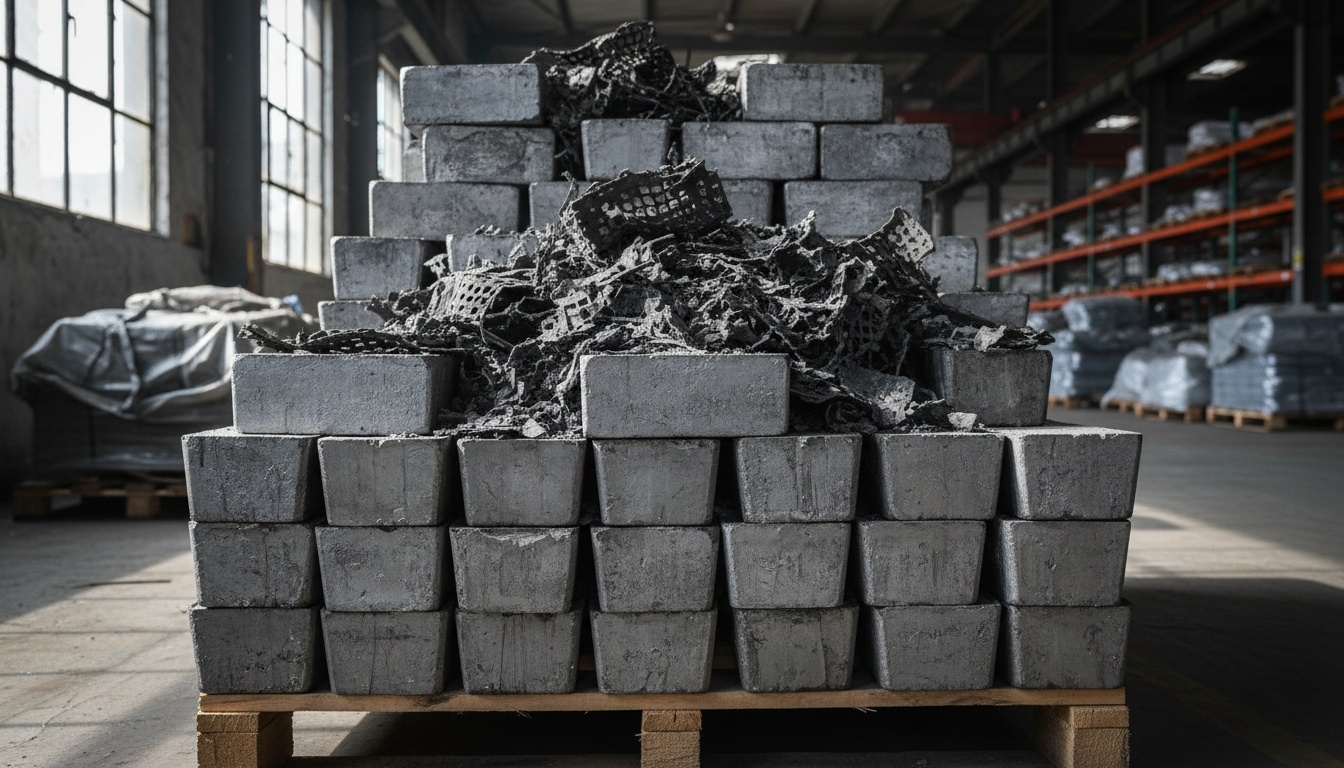
Lead scrap breaks down into distinct industrial categories defined by melting characteristics, recovery yields, and regulatory classification. Clean unalloyed soft lead scrap — comprising sheet lead, lead pipe, hospital radiation shielding, roof flashing, marine keel ballast, and chemical vessel linings (ASTM B29) — assays at ≥ 99.0% to 99.94% Pb. In the secondary rotary or reverberatory furnace, soft lead exhibits an exceptionally low melting point of 327.5°C (621.5°F) and delivers net metal recovery rates exceeding 95–98%, requiring minimal fluxing or dross skimming. Under ISRI specifications, RACKS covers clean soft lead free from foreign materials, drosses, battery plates, collapsible tubes, aluminum, zinc, and iron. Cable strippings (ISRI RELAY) provide pure lead sheathing stripped from decommissioned subsea and underground power cables, typically testing at ≥ 99.5% Pb with ultra-low antimony (Sb < 0.05%). By contrast, ISRI RADIO encompasses mixed hard and soft scrap, containing antimonial lead from industrial valves, type metal, and castings, traded on a certified assay recovery basis with structured penalty deductions for antimony, tin, and copper. ISRI ROPES (lead wheel weights) carries steel spring clips, yielding ≈ 80–85% recoverable metal after magnetic clip separation or sweat-melting.
A critical commercial and compliance boundary separates metallic lead scrap from spent battery waste. Solid clean scrap lead, sheet, pipe, and stripped cable sheathing are classified under HS 7802.00 and operate under the OECD / Basel Convention "Green List" of wastes (Annex IX, entry B1020). These non-hazardous metallic shipments require no multi-month Prior Informed Consent (PIC) notifications and can be exported directly from licensed scrap yards in the UK, Europe and Africa into industrial smelting clusters and Free Trade Zones (such as the Alexandria Public Free Zone in Egypt, Sohar Freezone in Oman, or European secondary smelters) with ordinary commercial invoices, packing lists, Certificate of Analysis (CoA), and radiation-free inspection certificates. In stark contrast, whole drained lead-acid batteries (RSLAB under HS 8549.11) and battery paste/plates are classified under Basel Annex VIII (entry A1160) as hazardous waste. Transboundary movements of RSLAB require formal bilateral state-to-state notification, written consent from exporting, transit, and importing national competent authorities, and strict facility licensing. CBIL enforces this regulatory gate mechanically: Green list non-battery scrap is mobilized on fast-turn containerized schedules, while battery scrap is contracted only when complete Basel consents are legally perfected.
Because elemental lead has an extraordinary specific gravity of 11.34 g/cm³, freight logistics demand rigorous structural handling. A standard 20ft dry container carries a payload rating of 21.5 to 26.5 MT. At this weight, 23 MT of solid lead scrap occupies merely ≈ 2.03 m³ — less than 6% of the container's interior volume. Concentrating this mass on an isolated section of the plywood floor can crack steel crossmembers, cause catastrophic floor failure, and breach road axle-weight regulations during inland transport. Every container load of sheet, pipe, or bundled lead scrap must be strapped to reinforced hardwood skid pallets with longitudinal timber dunnage laid across the floor corrugations to spread point loads evenly across the bottom side rails. Palletized stacks are banded with heavy-duty high-tensile steel strapping and secured with timber blocking and chocking to prevent cargo shifting during heavy sea motion. Shipments are surveyed at stuffing with pre-shipment radiation monitoring (≤ 0.20 µSv/hr background clearance), weighing on calibrated weighbridges, and XRF multi-point scanning.
Need the ship as well? Our chartering desk prices Misurata to Izmir scrap freight on LaycanDesk.
Excluded origins are not offered, including product re-exported, blended or re-processed through a third country. Every lot moves with a certificate of origin naming the producing plant, mine or grower country, and nothing is quoted before the seller and loading point are known.
Indicative reference
$1,450–1,950 USD / MT
as at September 2026
Reference level only — not an offer, and reviewed quarterly. Levels shown are as at September 2026. Firm pricing is quoted per RFQ, subject to volume, terms and inspection.
Typical Specification
Specifications are indicative and adjusted to the agreed contract and destination requirements. Final spec confirmed on COA / SGS.
Available Grades
Applications
- Secondary lead rotary & reverberatory smelting
- Refined pure lead ingot production (99.97% / 99.99% Pb)
- Lead-acid battery grid & plate manufacturing
- Radiation shielding (medical X-ray & nuclear facilities)
- Chemical-resistant vessel linings & acoustic barriers
- Counterweights, ballast & marine keel casting
Category
Metals & Recycled Scrap
Incoterms
FOB · CFR · CIF
Pricing basis
USD / MT
Inspection
SGS / Intertek at load port
Lead Scrap (Soft Scrap Lead, Sheets, Plates & Cable) — buyer questions
What is the difference between ISRI RACKS soft lead and ISRI RADIO mixed scrap?
ISRI RACKS consists strictly of clean, soft lead scrap free from drosses, battery plates, cable sheathing, collapsible tubes, type metals, and all foreign metals (iron, zinc, aluminum). It assays at 99.0%+ Pb with negligible antimony (Sb < 0.05%), melting cleanly at 327.5°C with 95–98% furnace recovery. ISRI RADIO is mixed hard and soft lead containing antimonial lead from valves, castings, and battery parts. RADIO requires pricing on an assayed metal recovery basis with contractual deductions for antimony, tin, and copper separation.
Why do secondary lead smelters in Free Zones (e.g. Alexandria Public Free Zone) prefer soft scrap over spent batteries?
Spent lead-acid batteries (RSLAB under HS 8549.11) are classified as hazardous waste under Basel Annex VIII, requiring months of bilateral state-to-state notifications and permits before shipping. In contrast, non-battery lead scrap (sheet, plate, pipe, stripped sheathing under HS 7802.00) is non-hazardous Green List metal scrap. Smelters in export processing zones can import it duty-free on rapid container transit schedules, melt it at low energy consumption, and immediately refine it into pure 99.97% ingots or battery alloys for global re-export.
How is a 20ft container protected from structural failure when loading 23–25 MT of dense lead?
Lead has a density of 11.34 g/cm³, meaning 23 MT occupies only about 2.03 cubic meters. Placing this concentrated mass in the center of a container floor can break crossmembers and puncture the floor. We enforce strict load-distribution protocols: lead sheets and bundles are strapped to heavy-duty hardwood skid pallets, and longitudinal wooden dunnage timbers are placed underneath to distribute point loads across the container floor sills. Heavy-duty steel banding and wooden chocking prevent cargo shifting during maritime transit.
What chemical impurities attract penalties or furnace rejection?
Secondary lead refiners closely monitor antimony (Sb), tin (Sn), copper (Cu), bismuth (Bi), arsenic (As), and zinc (Zn). For soft lead smelting into 99.97% pure lead, high antimony and tin require extensive oxidative refining (drossing) with caustic soda and sodium nitrate, creating metal loss and slag waste. High copper (>0.05%) requires sulfur addition for dross removal, while bismuth cannot be easily removed pyrometallurgically and remains in the final lead. Attachments of iron clips, oil, grease, or dirt above 0.5% are deducted directly from payable weight.
What documents are required to clear HS 7802.00 lead scrap at destination?
Standard shipments of non-hazardous lead scrap clear customs with: 1) Commercial Invoice stating exact ISRI grade and net metal weight; 2) Packing List with individual pallet and container weights; 3) Clean Bill of Lading; 4) Certificate of Origin; 5) Pre-shipment Certificate of Analysis (CoA / XRF assay); and 6) Radiation-Free Inspection Certificate confirming background radiation < 0.20 µSv/hr issued by an independent surveyor (e.g. SGS, Intertek, or Cotecna) at the loading yard.
How do you verify payable metal weight on mixed lead scrap?
Payable weight is established through double weighbridge scale tickets at origin (gross and tare) and certified moisture/attachment assays. For lots with potential inclusions (such as wheel weights with steel clips or cable sheathing with minor bitumen/tar), representative samples are melted under laboratory supervision to determine net recoverable lead yield (typically 80–85% for wheel weights), and the commercial contract prices net metal recovered rather than gross receiving weight.
Ready to source Lead Scrap?
Send your quantity, specification, preferred Incoterms and destination port. Qualified requirements receive a workable offer against verified supply.
Have Lead Scrap to sell? Submit an offer — we'll match it against live buyer demand.
More in Metal Scrap
Zinc Ash, Zinc Dross & Skimmings (Galvanizing Residues)
Secondary galvanizing residues (65–85% Zn) for zinc chemical, sulphate and oxide producers
Vessel & Ship Metal Scrap
End-of-life vessels on LDT and the plate, machinery and bronze they yield
HMS 1 & 2 Steel Scrap
Heavy melting steel in 80:20 and 70:30 mixes for EAF charges
Stainless Steel Scrap
304, 316, 310 and 430 solids and turnings, XRF-verified
Cast Iron Scrap
Motor blocks, heavy breakable cast and foundry borings
Copper Scrap
Millberry, Candy and Birch/Cliff to ISRI/ReMA grade
Insulated Copper Wire Scrap
ICW and cable priced on verified copper recovery
Aluminium Scrap
Taint/Tabor, 6063 extrusion, Zorba, Twitch and wheels
UBC Aluminium Scrap (Used Beverage Cans)
Mill-spec baled used beverage cans for closed-loop can sheet
Brass Scrap
Honey yellow brass, Ebony red brass and Ocean radiators
Electric Motor Scrap
Mixed motors, alternators and starters priced on the copper inside
Compressor & Sealed Unit Scrap
Drained, degassed, non-CFC refrigeration and AC compressors — nothing else
Aluminium Cable & ACSR Scrap
Bare EC wire, insulated aluminium cable and ACSR with the steel core accounted for
6063 Aluminium Extrusion Scrap
Clean, painted and thermal-break 6063 for extruders that cast their own billet
Used Rail Scrap
Cut melting rail and R50/R65 and UIC re-rolling sections
Aluminium 6xxx Swarf & Turnings (ISRI Teens / Telic)
Segregated 6061, 6063 and 6082 machining swarf, loose, dried or briquetted, priced on tested melt recovery