
Black Cardamom (Badi Elaichi)
Fire-dried, smoky — a different species entirely
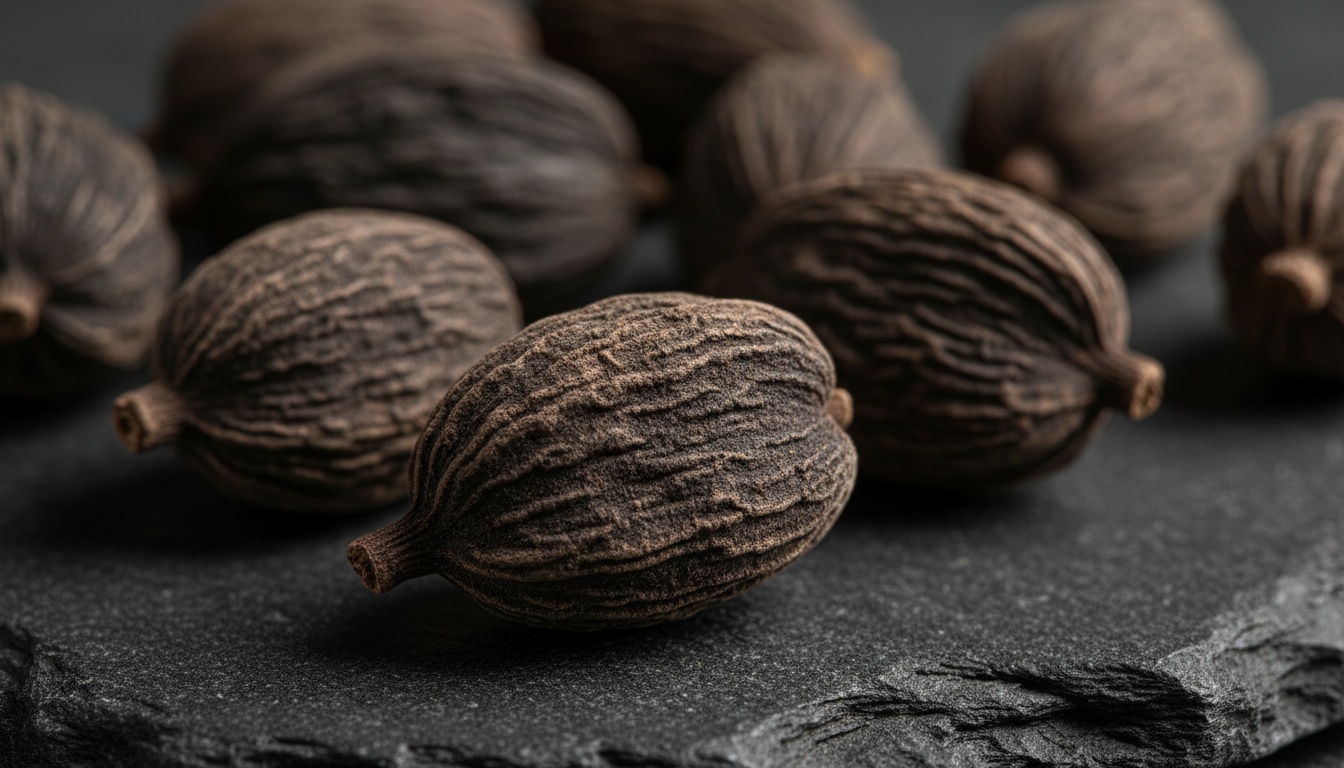
Black cardamom is not a coarser grade of green cardamom — it is a different plant. Amomum subulatum produces a much larger, ridged brown-black capsule, and it is traditionally dried over open wood fire, which is where its defining smoky, camphorous, resinous character comes from. Capsules run 20–25 mm against roughly 8 mm for bold green, with volatile oil of 2–3% and moisture ≤ 14%. Nepal is the largest producer, alongside Sikkim, Darjeeling and Bhutan, and the trade grades it on capsule size, colour and how clean the drying was — over-smoked material tastes acrid rather than aromatic, and that is the quality variable that matters most.
Its uses are savoury and robust: biryanis and pulaos, slow-cooked meat dishes, dals, garam masala blends, and Chinese and Vietnamese braises where its smokiness works in the same register as star anise. It holds up under long cooking in a way green cardamom does not, which is precisely why the two are not interchangeable — green is floral and volatile and belongs in desserts, tea and delicate preparations, where black would overwhelm everything. Commercially, black cardamom trades at roughly half the price of green, which occasionally tempts substitution in blends; the result is immediately obvious to anyone who cooks with it. Buy on capsule size, uniform colour and a clean rather than acrid smoke profile, and ask for a sample if you have not bought from an origin before, because drying practice varies more than any specification captures. CBIL supplies against certification of capsule size, moisture, volatile oil and foreign matter, in 10 kg and 25 kg lined cartons or bags, on FOB, CFR and CIF terms.
Excluded origins are not offered, including product re-exported, blended or re-processed through a third country. Every lot moves with a certificate of origin naming the producing plant, mine or grower country, and nothing is quoted before the seller and loading point are known.
Indicative reference
$7,500–13,000 USD / MT
as at September 2026
Reference level only — not an offer, and reviewed quarterly. Levels shown are as at September 2026. Firm pricing is quoted per RFQ, subject to volume, terms and inspection.
Typical Specification
Specifications are indicative and adjusted to the agreed contract and destination requirements. Final spec confirmed on COA / SGS.
Available Grades
Applications
- Biryani & pulao
- Slow-cooked meat dishes & dals
- Garam masala blends
- Chinese & Vietnamese braises
- Savoury spice manufacture
Category
Agri-Foods, Spices & Nuts
Incoterms
FOB · CFR · CIF
Pricing basis
USD / MT
Inspection
SGS / Intertek at load port
Black Cardamom (Badi Elaichi) — buyer questions
Is black cardamom just a lower grade of green?
No — different genus, different plant, different flavour. Green is Elettaria cardamomum, floral and sweet; black is Amomum subulatum, fire-dried, smoky and resinous, with capsules two to three times the size. The price gap tempts substitution in blends, but the result is obvious to anyone who cooks with it. Buy the one your recipe actually calls for.
What separates a good lot from a poor one?
The drying. Traditional open-fire drying gives the smoky character, but over-smoked capsules taste acrid and harsh rather than aromatic, and no specification sheet captures that. Capsule size, uniform colour and low foreign matter are the contractible numbers; the smoke profile needs a sample. Ask for one before committing to a new origin or a new season.
Why is it so much cheaper than green cardamom?
Yield and labour. Amomum subulatum crops far more heavily per hectare and the fire-drying process is simpler and less exacting than the careful controlled drying green cardamom needs to retain its colour. Neither product is over- or under-priced relative to the other — they are different crops with different economics.
Where does the volume come from?
Nepal is the largest producer, with Sikkim, Darjeeling and Bhutan supplying the rest of the significant trade. It is a fairly concentrated origin base, so crop conditions in the eastern Himalaya move the price more sharply than they would for a spice with several unrelated growing regions. Worth factoring into a term programme.
Ready to source Black Cardamom?
Send your quantity, specification, preferred Incoterms and destination port. Qualified requirements receive a workable offer against verified supply.
Have Black Cardamom to sell? Submit an offer — we'll match it against live buyer demand.
More in Spices: Pepper, Cinnamon, Cloves, Nutmeg, Vanilla & Chilli
Turmeric
Fingers, bulbs & powder by curcumin percentage
Red Chilli
Teja, Byadgi & Guntur by ASTA colour and heat
Cumin Seeds
Singapore & Europe quality, 99/1 and 99/2 purity
Coriander Seeds
Eagle & Scooter grades, single and double parrot
Black Pepper
Malabar Garbled, TGSEB & white pepper by density
Fennel Seeds
Bold green Lucknowi & Europe-quality saunf
Fenugreek Seeds
Methi seed for spice, extraction & nutraceutical use
Cardamom
Green 8mm bold & black cardamom by capsule size
Teja Chilli (S17)
75,000–100,000 SHU — the pungency grade
Byadgi Chilli
ASTA colour 45–90, low heat — the colour grade
Guntur Sannam Chilli (S4)
S4 / 334 at 25,000–40,000 SHU — the volume grade
Kashmiri Chilli
Deep red, barely hot — ASTA 60–80 at 1,500–2,000 SHU
Alleppey Finger Turmeric
3.5–5.5% curcumin — the extraction grade
Erode & Salem Finger Turmeric
2.5–3.5% curcumin, bright yellow — the culinary grade
Tellicherry Black Pepper
TGSEB — the bold berry, 550–570 g/l
Malabar Black Pepper (MG1)
MG1 at 500–550 g/l — the volume trade grade
White Pepper
Decorticated 600–620 g/l — heat without dark specks
Green Cardamom
8mm AGEB bold — graded on size & colour
Cinnamon & Cassia (Ceylon, Korintje, Vietnam, China)
Ceylon quills by SLS 81 grade, cassia by origin and oil
Cloves (Indonesia, Madagascar, Zanzibar)
Hand-picked and FAQ cloves by origin, oil and headless count
Nutmeg & Mace (Indonesia, Grenada, India)
ABCD, SS and BWP nutmeg and mace blades, aflatoxin-tested
Star Anise (China, Vietnam)
Whole and broken Illicium verum, spring and autumn crop
Vanilla Beans (Madagascar, Uganda, Indonesia, PNG)
Gourmet black and extraction red vanilla by moisture and vanillin
Paprika (Spain, China, Peru)
Powder and pods by ASTA colour, Pimentón de la Vera PDO
Black Pepper: Vietnam, Brazil & Indonesia
Vietnam 500/550 g/l, Brazil ASTA 570, Lampung black and Muntok white