
White Pepper
Decorticated 600–620 g/l — heat without dark specks
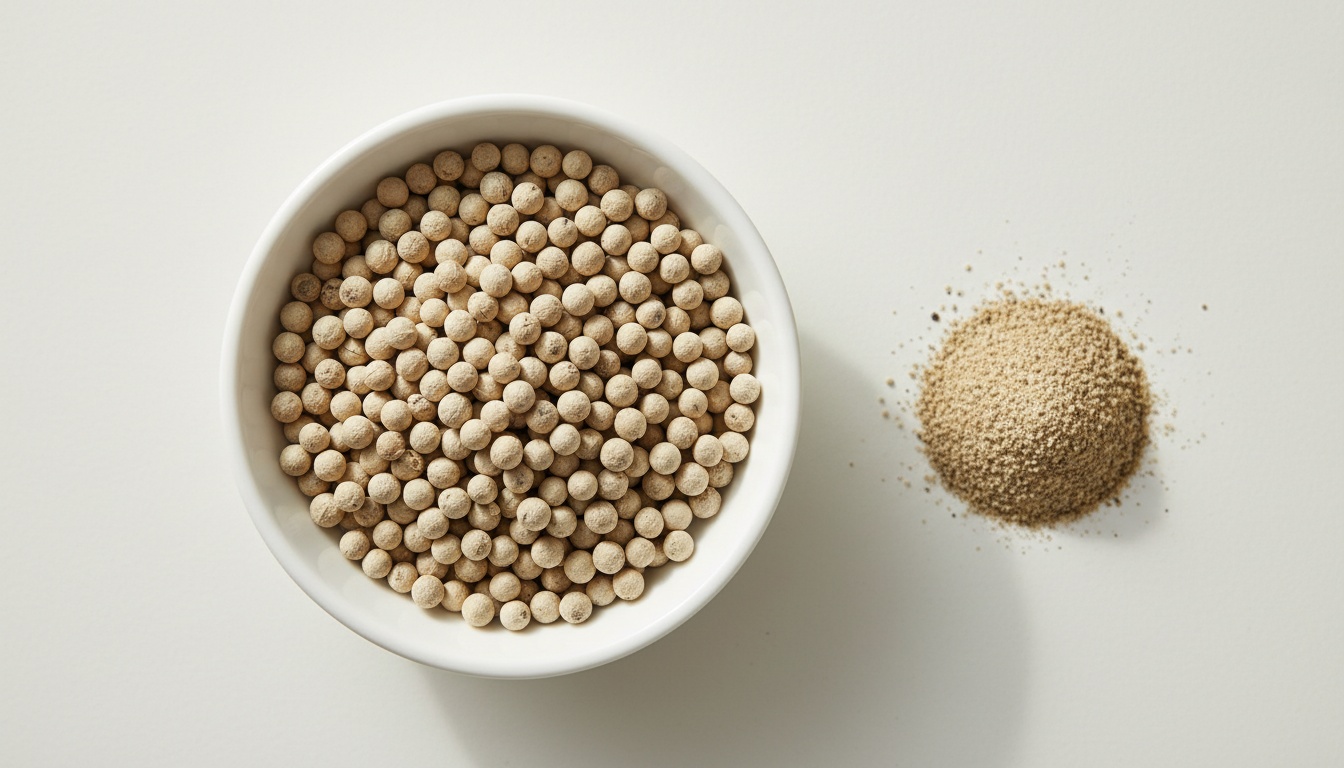
White pepper is black pepper with its skin taken off. The berries are harvested riper, soaked to loosen the outer pericarp, then decorticated and dried, leaving the pale inner corn. Removing the skin removes much of the volatile oil that gives black pepper its fragrance, while the piperine that carries the heat sits mostly in the corn and remains — so white pepper is sharper and less aromatic, with a distinctive earthy note the soaking process contributes. Bulk density runs 600–620 g/l, higher than black pepper because the corn is denser, with moisture ≤ 13%, piperine 4–6% and extraneous matter ≤ 0.5%. Muntok from Indonesia and Vietnamese white are the principal traded origins.
The reason to buy white rather than black is almost always visual. In a white or pale sauce, a cream soup, a light-coloured processed food or a classical French or Chinese preparation, black specks read as contamination to the customer even though they are simply pepper — white pepper delivers the heat without them. That is a real functional requirement, not a preference, and it is why food manufacturers keep both on the ingredient list. Where it is the wrong choice is anywhere aroma is wanted: white pepper cannot substitute for a fresh-ground black over a steak, and a formulation built on volatile oil should stay on black. It also costs more, because decortication is a processing step with a yield loss. CBIL supplies against SGS or Intertek certification of bulk density, moisture, piperine, extraneous matter and microbiology, in 25 kg bags, container-load, on FOB, CFR and CIF terms.
Excluded origins are not offered, including product re-exported, blended or re-processed through a third country. Every lot moves with a certificate of origin naming the producing plant, mine or grower country, and nothing is quoted before the seller and loading point are known.
Indicative reference
$5,500–7,800 USD / MT
as at September 2026
Reference level only — not an offer, and reviewed quarterly. Levels shown are as at September 2026. Firm pricing is quoted per RFQ, subject to volume, terms and inspection.
Typical Specification
Specifications are indicative and adjusted to the agreed contract and destination requirements. Final spec confirmed on COA / SGS.
Available Grades
Applications
- White & cream sauces
- Soups & light processed food
- Classical French & Chinese cuisine
- Meat & poultry processing
- Retail ground white pepper
Category
Agri-Foods, Spices & Nuts
Incoterms
FOB · CFR · CIF
Pricing basis
USD / MT
Inspection
SGS / Intertek at load port
White Pepper — buyer questions
Why does white pepper cost more than black?
Processing and yield loss. The berries are harvested riper, soaked to loosen the pericarp, decorticated and re-dried — several steps that black pepper skips, and the skin removed is weight that does not reach you. That processing cost plus the lower yield per tonne of fresh berry is the whole price difference.
Can I substitute white for black one-for-one?
For heat, roughly. For aroma, no. Decortication removes most of the volatile oil, so white pepper is sharper and much less fragrant, with an earthy note from the soaking stage. Substituting in a formulation that relies on pepper aroma will change the product noticeably. Substituting where pepper provides heat and the appearance matters is exactly the intended use.
What is double-washed white pepper?
An additional washing stage that produces a cleaner, paler corn with lower microbial load and less of the fermented note that soaking can leave. It costs more and is worth it for premium retail and for applications where colour uniformity is visible. For an industrial sauce base, standard FAQ grade is usually sufficient.
Muntok or Vietnamese?
Muntok from Indonesia is the traditional benchmark and carries a slightly greyer, more characterful profile that classical cuisine often specifies. Vietnamese white is generally paler and cleaner-tasting, with larger and more consistent supply. If your specification names Muntok, buy Muntok; if it just says white pepper, price both.
Ready to source White Pepper?
Send your quantity, specification, preferred Incoterms and destination port. Qualified requirements receive a workable offer against verified supply.
Have White Pepper to sell? Submit an offer — we'll match it against live buyer demand.
More in Spices: Pepper, Cinnamon, Cloves, Nutmeg, Vanilla & Chilli
Turmeric
Fingers, bulbs & powder by curcumin percentage
Red Chilli
Teja, Byadgi & Guntur by ASTA colour and heat
Cumin Seeds
Singapore & Europe quality, 99/1 and 99/2 purity
Coriander Seeds
Eagle & Scooter grades, single and double parrot
Black Pepper
Malabar Garbled, TGSEB & white pepper by density
Fennel Seeds
Bold green Lucknowi & Europe-quality saunf
Fenugreek Seeds
Methi seed for spice, extraction & nutraceutical use
Cardamom
Green 8mm bold & black cardamom by capsule size
Teja Chilli (S17)
75,000–100,000 SHU — the pungency grade
Byadgi Chilli
ASTA colour 45–90, low heat — the colour grade
Guntur Sannam Chilli (S4)
S4 / 334 at 25,000–40,000 SHU — the volume grade
Kashmiri Chilli
Deep red, barely hot — ASTA 60–80 at 1,500–2,000 SHU
Alleppey Finger Turmeric
3.5–5.5% curcumin — the extraction grade
Erode & Salem Finger Turmeric
2.5–3.5% curcumin, bright yellow — the culinary grade
Tellicherry Black Pepper
TGSEB — the bold berry, 550–570 g/l
Malabar Black Pepper (MG1)
MG1 at 500–550 g/l — the volume trade grade
Green Cardamom
8mm AGEB bold — graded on size & colour
Black Cardamom (Badi Elaichi)
Fire-dried, smoky — a different species entirely
Cinnamon & Cassia (Ceylon, Korintje, Vietnam, China)
Ceylon quills by SLS 81 grade, cassia by origin and oil
Cloves (Indonesia, Madagascar, Zanzibar)
Hand-picked and FAQ cloves by origin, oil and headless count
Nutmeg & Mace (Indonesia, Grenada, India)
ABCD, SS and BWP nutmeg and mace blades, aflatoxin-tested
Star Anise (China, Vietnam)
Whole and broken Illicium verum, spring and autumn crop
Vanilla Beans (Madagascar, Uganda, Indonesia, PNG)
Gourmet black and extraction red vanilla by moisture and vanillin
Paprika (Spain, China, Peru)
Powder and pods by ASTA colour, Pimentón de la Vera PDO
Black Pepper: Vietnam, Brazil & Indonesia
Vietnam 500/550 g/l, Brazil ASTA 570, Lampung black and Muntok white