
Brazil Arabica (Santos)
Santos NY 2/3, screen 17/18, natural & pulped natural
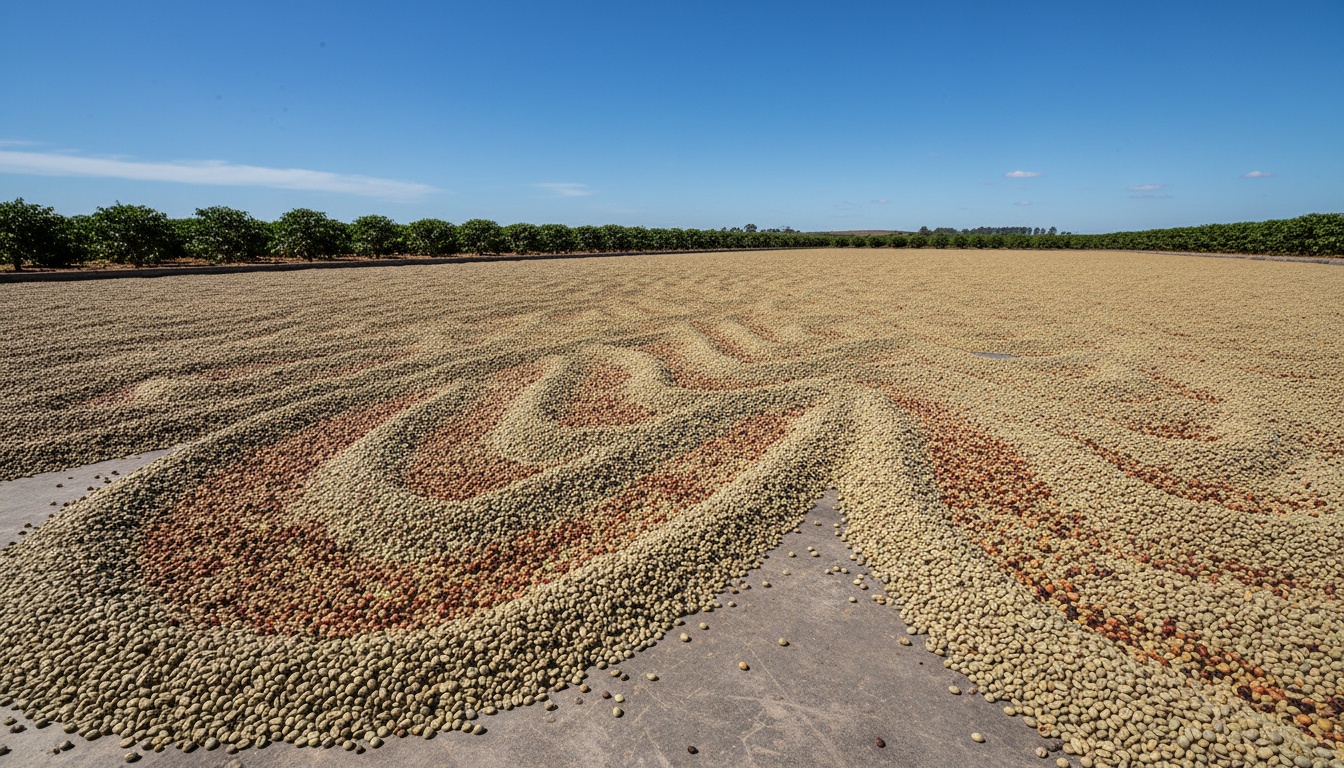
Brazil is roughly a third of world coffee production and its Santos-marked arabica is the reference physical against which the ICE "C" contract is most often traded. Lots are contracted on a short, well-understood sheet: defect count on the New York scale — NY 2 permits about 6 full defects per 300 g sample, NY 3 about 13 — screen size, normally 17/18 for the export grades with 14/16 moving as a cheaper cut, moisture at 10–12%, water activity at or below 0.60, and a cup descriptor, usually "fine cup", "good cup" or "strictly soft". Process is predominantly natural (dried in the cherry) or pulped natural, both of which give the heavy body, low acidity and chocolate-and-nut sweetness that make Brazil the workhorse base of commercial espresso. Ship weight is the classic 60 kg jute bag, with bulk container liners at around 21.6 MT for volume programmes.
Buy Brazil when you need dependable body and sweetness at the lowest arabica differential available, which is most commercial blending: espresso bases, filter blends where a washed origin supplies the acidity, private-label retail roasting and soluble manufacture. What it will not give you is the bright, clean acidity of a washed Colombian or the floral character of an Ethiopian — for those you pay a materially higher differential and you should, because the cup is genuinely different. The two things to be disciplined about are crop year and screen. Brazilian coffee ages faster in a hot origin than buyers expect, so past-crop lots trade at a discount for good reason; and a lot sold as 17/18 that screens 15/16 is a downgrade that costs you both in the roaster and in the cup. CBIL brokers Brazilian arabica against independent verification of defect count, screen distribution, moisture, water activity and cup grade, quoted as a differential to the ICE "C", on FOB Santos, CFR and CIF terms.
Excluded origins are not offered, including product re-exported, blended or re-processed through a third country. Every lot moves with a certificate of origin naming the producing plant, mine or grower country, and nothing is quoted before the seller and loading point are known.
Indicative reference
$6,500–8,500 USD / MT
as at September 2026
Reference level only — not an offer, and reviewed quarterly. Levels shown are as at September 2026. Firm pricing is quoted per RFQ, subject to volume, terms and inspection.
Typical Specification
Specifications are indicative and adjusted to the agreed contract and destination requirements. Final spec confirmed on COA / SGS.
Available Grades
Applications
- Commercial espresso bases
- Filter & retail blends
- Private-label roasting
- Soluble & instant manufacture
- Volume blending stock
Category
Agri-Foods, Spices & Nuts
Incoterms
FOB · CFR · CIF
Pricing basis
USD / MT
Inspection
SGS / Intertek at load port
Brazil Arabica (Santos) — buyer questions
What does NY 2/3 actually mean?
It is a defect count on the New York scale, assessed on a 300 g sample. NY 2 permits roughly 6 full defects, NY 3 roughly 13 — a full defect being one black bean, or an equivalent count of lesser defects like broken or insect-damaged beans. It says nothing about cup quality on its own, which is why contracts pair it with a cup descriptor such as fine cup or strictly soft. Buy on both, never on the defect grade alone.
Why is Brazil cheaper than Colombia or Ethiopia?
Scale and process. Brazil produces about a third of world coffee on mechanised, flat-terrain farms with natural drying, which is far cheaper than the hand-picked, washed, high-altitude production behind Colombian and Ethiopian lots. The cup is genuinely different — heavier body, lower acidity — rather than worse. For an espresso base that difference is an advantage, not a compromise.
How is the price actually quoted?
As a differential to the ICE "C" contract in US cents per pound, not as a flat price — for example "NY + 15c/lb for September". You are agreeing the premium and the pricing month; the flat price is fixed later when you or we fix against the exchange. If a supplier quotes only a flat USD/MT figure with no reference month, ask what "C" level it assumes, because it will move.
Does crop year matter as much as buyers say?
Yes, and in Brazil more than most. Coffee stored in a hot origin fades faster — the cup flattens and bagginess creeps in — so past-crop lots trade at a real discount. That discount is honest when it is disclosed and priced. Put the crop year in the contract and, for anything you will roast for filter rather than espresso, insist on current crop.
Ready to source Brazil Arabica?
Send your quantity, specification, preferred Incoterms and destination port. Qualified requirements receive a workable offer against verified supply.
Have Brazil Arabica to sell? Submit an offer — we'll match it against live buyer demand.
More in Green Coffee Beans
Colombia Arabica (Supremo & Excelso)
Supremo scr 17/18 & Excelso scr 14/16, fully washed
Ethiopia Arabica
Yirgacheffe, Sidamo & Guji — G1/G2, washed & natural
Vietnam Robusta
Grade 1 scr 18 & Grade 2 scr 13, 5% black & broken
Uganda Robusta
Screen 18 natural robusta — cleaner cup than Asian origin
Central America Arabica (SHG / SHB)
Honduras, Guatemala & Nicaragua — SHG/SHB, EP washed
India Coffee (Plantation & Monsooned)
Plantation A, Cherry AB & Monsooned Malabar
Instant Coffee (Soluble Coffee)
Spray-dried, agglomerated & freeze-dried — bulk and private label
Roasted Coffee Beans (Private Label)
Whole bean & ground, private label — valve bags, roast to profile
Indonesia Sumatra Coffee (Mandheling, Gayo & Lampung)
Wet-hulled Mandheling & Gayo arabica, Lampung robusta
Peru & Honduras Arabica (Organic, Fairtrade, SHB & SHG)
Washed arabica — organic & Fairtrade volume, SHB / SHG grades
Kenya & Tanzania Arabica (AA, AB & Peaberry)
AA, AB & PB washed arabica — Nairobi and Moshi auctions
Decaffeinated Green Coffee (Swiss Water, CO2 & Sugarcane EA)
Swiss Water, CO2 & sugarcane ethyl acetate decaf, unroasted