India Coffee (Plantation & Monsooned)
Plantation A, Cherry AB & Monsooned Malabar
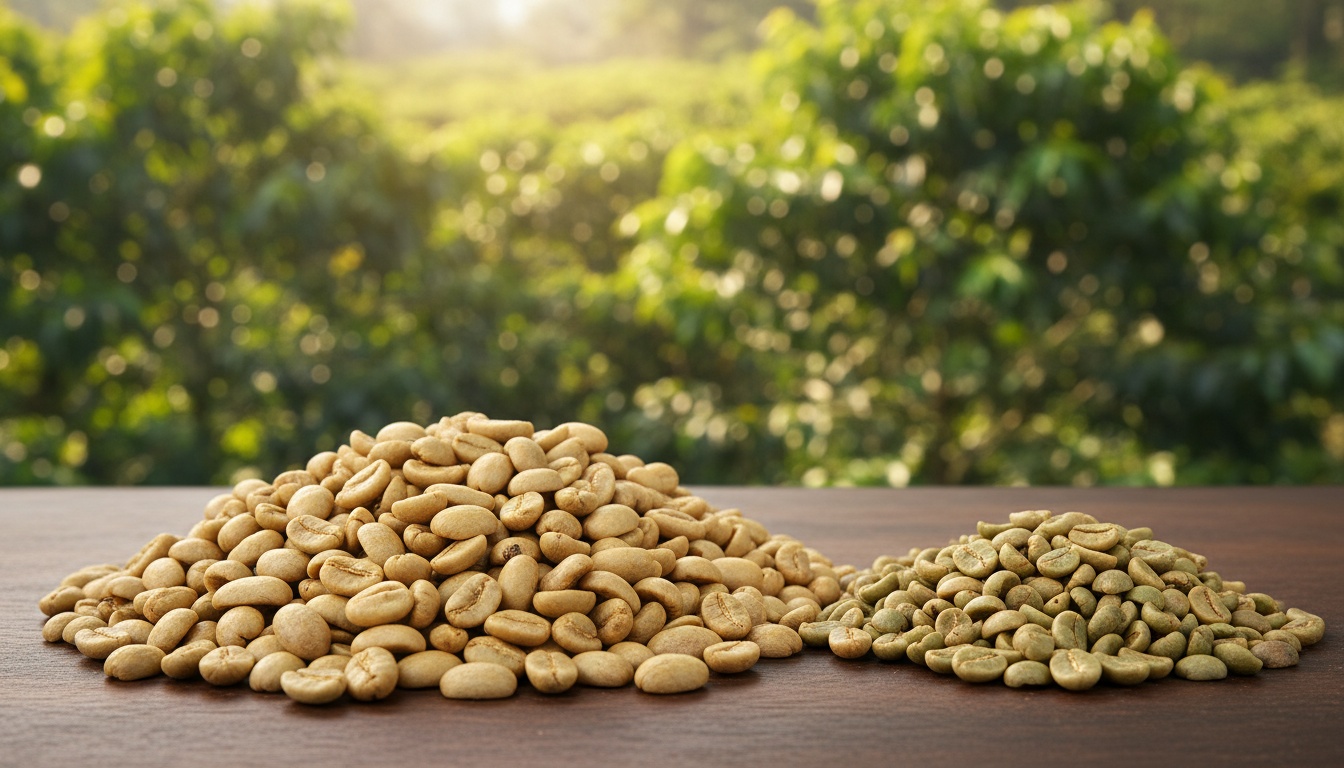
India's coffee nomenclature is its own and confuses buyers who assume it follows Latin American convention. Washed coffees are called Parchment — Plantation A is washed arabica, Robusta Parchment AB is washed robusta — while natural, dry-processed coffees are called Cherry: Arabica Cherry AB and Robusta Cherry AB. Grades A, AB, B and C denote screen size within each. Nearly all of it is shade-grown under a canopy in Karnataka, Kerala and Tamil Nadu, which slows maturation and is a genuine agronomic and biodiversity distinction rather than marketing. The origin's singular product is Monsooned Malabar AA: green coffee deliberately exposed to the south-west monsoon in open warehouses for several months, swelling the beans, bleaching them pale gold and stripping acidity almost entirely to leave a heavy, musty, low-acid cup with pronounced body. Nothing else in the trade tastes like it.
Buy Indian coffee for two quite separate reasons. Plantation A and the robusta grades are solid, sensibly priced blend components with good body — India is the third-largest robusta producer and its washed robusta in particular cups cleaner than most, making it useful in espresso. Monsooned Malabar is bought for what it is: the low-acid, heavy-bodied specialist that Italian-style espresso houses and certain traditional blends specifically call for, and which no substitute replicates. It is not a general-purpose coffee — buyers wanting brightness will hate it, and that is the point. The practical note on India is that shade-grown production and its associated documentation increasingly matter for EU-bound business under deforestation-diligence rules, where canopy-grown coffee with clear land history is easier to evidence than frontier planting. CBIL brokers Indian arabica and robusta against grade, screen, moisture, defect count and cup assessment, on FOB Cochin and Chennai, CFR and CIF terms.
Excluded origins are not offered, including product re-exported, blended or re-processed through a third country. Every lot moves with a certificate of origin naming the producing plant, mine or grower country, and nothing is quoted before the seller and loading point are known.
Indicative reference
$5,000–8,000 USD / MT
as at September 2026
Reference level only — not an offer, and reviewed quarterly. Levels shown are as at September 2026. Firm pricing is quoted per RFQ, subject to volume, terms and inspection.
Typical Specification
Specifications are indicative and adjusted to the agreed contract and destination requirements. Final spec confirmed on COA / SGS.
Available Grades
Applications
- Espresso blends (washed robusta)
- Italian-style traditional blends
- Monsooned Malabar specialist roasting
- Body component in blends
- Shade-grown certified programmes
Category
Agri-Foods, Spices & Nuts
Incoterms
FOB · CFR · CIF
Pricing basis
USD / MT
Inspection
SGS / Intertek at load port
India Coffee (Plantation & Monsooned) — buyer questions
What is the difference between Plantation, Parchment and Cherry?
It is India's naming for processing, not for quality. Plantation means washed arabica, Parchment means washed robusta, and Cherry means natural or dry-processed for either species. A, AB, B and C then denote screen size within each. Buyers used to Latin American convention routinely misread these, so confirm what a quote actually refers to before comparing prices.
What is Monsooned Malabar and who buys it?
Green coffee deliberately exposed to the south-west monsoon in open warehouses for several months. The beans swell, bleach to pale gold and lose almost all acidity, producing a heavy, musty, low-acid cup with big body. It is bought specifically by Italian-style espresso houses and traditional blends that call for exactly that character. It is a specialist product, not a general-purpose coffee, and buyers wanting brightness should avoid it entirely.
Is Indian robusta better than Vietnamese?
Different rather than better, and washed Indian robusta is the interesting case. Robusta Parchment cups noticeably cleaner than natural robusta, which makes it useful in espresso blends where the robusta should contribute body without harshness. For soluble manufacture Vietnam is generally cheaper and the cup difference is irrelevant. Match the grade to what the coffee is for.
Does shade-grown status matter commercially?
Increasingly, for EU-bound business. Indian coffee is largely grown under canopy, and coffee with clear land-use history is easier to evidence under deforestation-diligence requirements than production on cleared frontier land. If you are shipping into the EU, ask for the geolocation and land-history documentation up front — it is becoming a gating item rather than a nice-to-have.
Ready to source India Coffee?
Send your quantity, specification, preferred Incoterms and destination port. Qualified requirements receive a workable offer against verified supply.
Have India Coffee to sell? Submit an offer — we'll match it against live buyer demand.
More in Green Coffee Beans
Brazil Arabica (Santos)
Santos NY 2/3, screen 17/18, natural & pulped natural
Colombia Arabica (Supremo & Excelso)
Supremo scr 17/18 & Excelso scr 14/16, fully washed
Ethiopia Arabica
Yirgacheffe, Sidamo & Guji — G1/G2, washed & natural
Vietnam Robusta
Grade 1 scr 18 & Grade 2 scr 13, 5% black & broken
Uganda Robusta
Screen 18 natural robusta — cleaner cup than Asian origin
Central America Arabica (SHG / SHB)
Honduras, Guatemala & Nicaragua — SHG/SHB, EP washed
Instant Coffee (Soluble Coffee)
Spray-dried, agglomerated & freeze-dried — bulk and private label
Roasted Coffee Beans (Private Label)
Whole bean & ground, private label — valve bags, roast to profile
Indonesia Sumatra Coffee (Mandheling, Gayo & Lampung)
Wet-hulled Mandheling & Gayo arabica, Lampung robusta
Peru & Honduras Arabica (Organic, Fairtrade, SHB & SHG)
Washed arabica — organic & Fairtrade volume, SHB / SHG grades
Kenya & Tanzania Arabica (AA, AB & Peaberry)
AA, AB & PB washed arabica — Nairobi and Moshi auctions
Decaffeinated Green Coffee (Swiss Water, CO2 & Sugarcane EA)
Swiss Water, CO2 & sugarcane ethyl acetate decaf, unroasted