
Reinforcing Steel Bar (Rebar)
B500B, Grade 60 and Fe 500 deformed bar in 8–40 mm
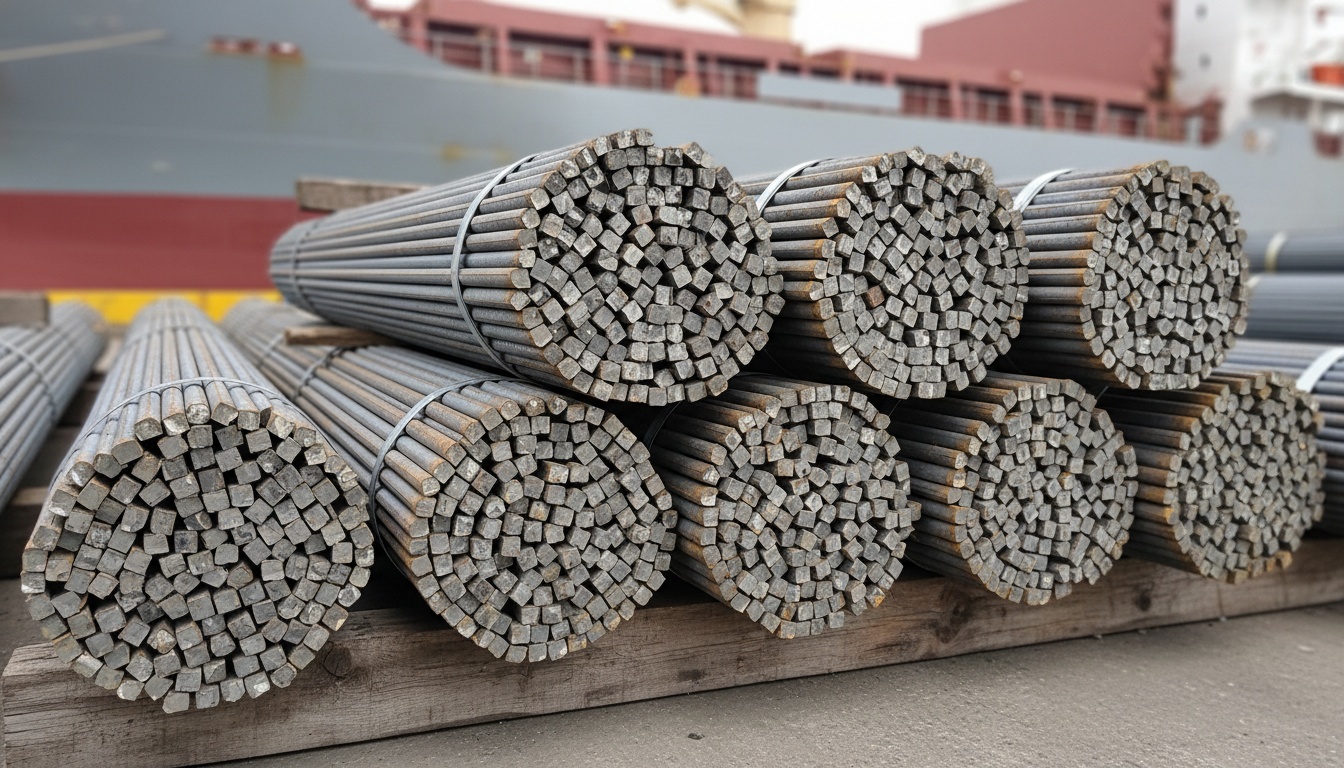
Rebar is the most standardised steel product in the trade and the one a buyer can least afford to get wrong, because it goes into concrete under a national code and the inspector checks the mill certificate against that code. BS 4449 B500B (yield 500 MPa, ductility class B) is the grade across the Gulf, East Africa, Sri Lanka and most Commonwealth markets; ASTM A615 Grade 60 (yield 420 MPa) rules the Americas and parts of the Middle East; IS 1786 Fe 500 / Fe 500D is the Indian standard; GB 1499 HRB400 is the Chinese one. Diameters run 8, 10, 12, 16, 20, 25, 32 and 40 mm, sold in 12 m straight lengths in bundles of about 2 MT, with 6 m and coiled bar (8–16 mm) for cut-and-bend yards. The chemistry that matters is carbon (≤ 0.24%), sulphur and phosphorus (≤ 0.050% each) and the carbon equivalent (≤ 0.52% for B500B), because that is what makes the bar weldable and bendable on site. Rib geometry and the mill's identification marks rolled into the bar are how a site inspector reads the origin and grade, and a buyer should insist on the rolled marks matching the certificate.
The 2025 seaborne rebar trade shows who is exporting and to whom. UN Comtrade 2025 export declarations put Malaysia at 1.73 Mt (USD 484/MT declared), Oman at 1.46 Mt (USD 624), Egypt at 0.84 Mt (USD 657), Kazakhstan at 0.58 Mt (USD 557), the USA at 0.27 Mt and Ghana at 0.26 Mt, out of 18 declaring origins. Malaysia's own declarations show that 75% of its tonnage goes to Singapore and 17% to Hong Kong, so Malaysian bar is a short-sea trade priced for those two markets; Omani and Egyptian bar is the tonnage that reaches the wider Gulf, East Africa and the Indian Ocean, and it declares USD 140–170/MT higher. CBIL brokers rebar from Gulf, Egyptian, Malaysian, Indian and Turkish mills to contractors, stockists and precast plants as a commodity brokerage company, against mill test certificates to the named standard and third-party inspection of diameter, mass per metre, tensile and bend tests. Parcels are worked in Handysize and Supramax breakbulk, bundles of about 2 MT, on FOB and CFR terms, and CBIL's chartering desk (LaycanDesk) quotes the freight alongside the cargo so a contractor gets one delivered number. Send your standard, diameter mix, lengths and the delivery window against your pour schedule.
Need the ship as well? Our chartering desk prices steel coil and plates breakbulk freight on LaycanDesk.
Indicative reference
$480–660 USD / MT
as at September 2026
Reference level only — not an offer, and reviewed quarterly. Levels shown are as at September 2026. Firm pricing is quoted per RFQ, subject to volume, terms and inspection.
Typical Specification
Specifications are indicative and adjusted to the agreed contract and destination requirements. Final spec confirmed on COA / SGS.
Available Grades
Applications
- Reinforced concrete construction
- Precast & prestressed elements
- Infrastructure & bridges
- Cut-and-bend yards
- Stockists & distributors
Category
Metals & Recycled Scrap
Incoterms
FOB · CFR · CIF
Pricing basis
USD / MT
Inspection
SGS / Intertek at load port
Reinforcing Steel Bar (Rebar) — buyer questions
B500B or Grade 60 — which do I specify?
Whichever your project code names, not whichever is cheaper that week. B500B is a 500 MPa yield bar with a ductility requirement and is written into most British-derived building codes across the Gulf, East Africa and South Asia; ASTM A615 Grade 60 is 420 MPa yield and is what American-derived codes call for. Mills dual-certify some sizes but not all. Send us the specification page from the project, and we will source bar whose rolled marks and certificate match it.
Why does Malaysian rebar declare so much cheaper than Omani?
Destination, not quality. UN Comtrade 2025 export declarations show Malaysia at USD 484/MT against Oman at USD 624, but Malaysia's own returns send 75% of its bar to Singapore and 17% to Hong Kong — a short-sea trade priced against those markets. Omani and Egyptian bar is what actually reaches the Gulf, East Africa and the Indian Ocean. For a buyer in those markets the relevant comparison is the delivered price from an origin that ships there.
What diameter mix and lengths should I order?
A structural job typically runs heaviest on 12, 16, 20 and 25 mm with 8 and 10 mm for links and 32 and 40 mm for columns and foundations — the bar-bending schedule sets the exact split. Buy 12 m for straight bar and slab work; a cut-and-bend yard can also take coil in 8–16 mm, which cuts waste. Do not buy a flat mix across all sizes; buy against the schedule.
What is the minimum parcel and how is it delivered?
Breakbulk in Handysize and Supramax tonnage, 5,000–40,000 MT parcels in strapped 12 m bundles of about 2 MT, on FOB and CFR terms. Because CBIL runs a chartering desk the freight is quoted with the cargo, which is what a contractor needs to price a tender. Smaller lots ride on multipurpose vessels or in containers where the sizes allow.
Ready to source Rebar?
Send your quantity, specification, preferred Incoterms and destination port. We'll verify supply and respond with a workable offer — usually within one business day.
Have Rebar to sell? Submit an offer — we'll match it against live buyer demand.
More in Steel Billets, Coil, Rebar & Wire Rod
Steel Billets (3SP / 5SP, Q235 / Q275)
Continuous-cast square billets for re-rolling mills
Hot-Rolled Steel Coil (HRC)
Commercial and structural HRC by gauge, width and grade
Steel Wire Rod (SAE 1006 / 1008, Mesh & High-Carbon)
Low-carbon drawing rod and mesh-quality rod in 5.5–16 mm coils
Steel Plates (AH36 / DH36, S275 / S355, A36, Boiler Plate)
Hot-rolled plate for shipyards, fabricators and pressure-vessel shops