
Steel Billets (3SP / 5SP, Q235 / Q275)
Continuous-cast square billets for re-rolling mills
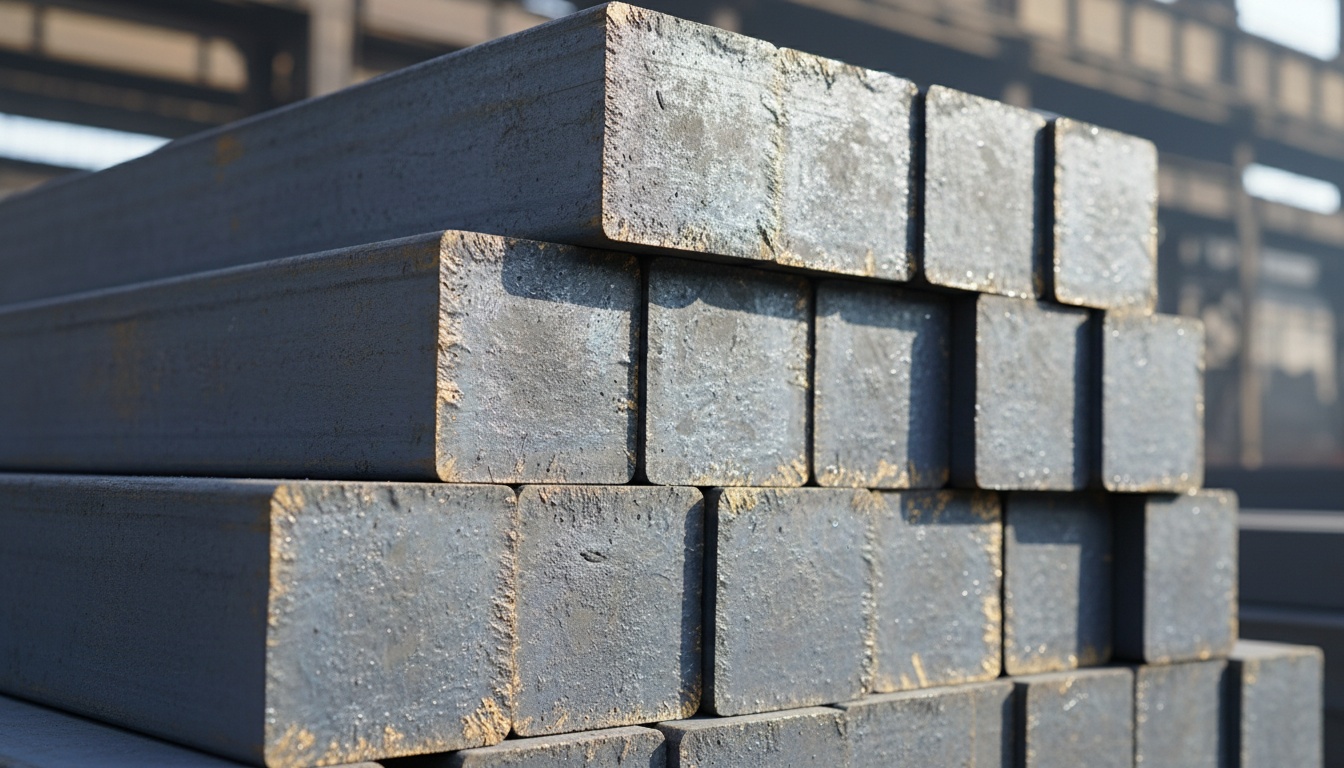
A steel billet is the semi-finished square you feed a re-rolling mill, and it is contracted on three things: chemistry, section and length. Chemistry is what the mill's downstream product needs — 3SP (carbon 0.14–0.22%, manganese 0.40–0.85%) is the everyday rebar and merchant-bar feed, 5SP (carbon 0.28–0.37%, manganese 0.50–0.80%) gives the strength for higher-yield bar without microalloying, and the Chinese Q235 / Q275 designations sit alongside them for the same end uses. Sulphur and phosphorus are held at or below 0.045–0.050% each, and a mill rolling B500B or ASTM A615 Grade 60 rebar will also specify a carbon-equivalent ceiling so the finished bar stays weldable. Section is 100, 120, 130 or 150 mm square, most re-rollers taking 130 mm, and length is 6 or 12 m to fit the reheat furnace. Surface condition — no cracks, laps or scale pockets beyond the tolerance — is inspected before loading because a surface defect on a billet becomes a seam on every bar rolled from it.
The seaborne billet trade is large and concentrated. UN Comtrade 2025 export declarations put Brazil at 7.40 Mt (USD 523/MT declared), Indonesia at 2.39 Mt (USD 442), Malaysia at 1.82 Mt (USD 544), Oman at 1.35 Mt (USD 606) and India at 1.08 Mt (USD 460), out of 13 declaring origins. Oman's own 2025 declarations show where a Gulf billet actually goes: 44% to Saudi Arabia and 32% to the UAE, with Australia, the Dominican Republic and Spain taking the rest. The spread between Indonesian and Omani declared values is the cost of DRI-based low-residual steel against induction-furnace scrap steel, and a re-roller pays it only where the finished product demands it. CBIL brokers billets between electric-arc and induction-furnace producers and re-rolling mills as a commodity brokerage company, against mill test certificates and third-party inspection of chemistry, section and surface. Parcels are worked in Handysize and Supramax breakbulk, bundled and strapped, on FOB and CFR terms, and because CBIL runs a chartering desk (LaycanDesk) the freight can be quoted alongside the cargo rather than left to a second negotiation. Send your grade, section, length and monthly draw and we will work the allocation to it.
Need the ship as well? Our chartering desk prices steel coil and plates breakbulk freight on LaycanDesk.
Indicative reference
$440–610 USD / MT
as at September 2026
Reference level only — not an offer, and reviewed quarterly. Levels shown are as at September 2026. Firm pricing is quoted per RFQ, subject to volume, terms and inspection.
Typical Specification
Specifications are indicative and adjusted to the agreed contract and destination requirements. Final spec confirmed on COA / SGS.
Available Grades
Applications
- Rebar re-rolling
- Wire rod rolling
- Merchant bar & sections
- Seamless tube feed
- Forging stock
Category
Metals & Recycled Scrap
Incoterms
FOB · CFR · CIF
Pricing basis
USD / MT
Inspection
SGS / Intertek at load port
Steel Billets (3SP / 5SP, Q235 / Q275) — buyer questions
3SP or 5SP — which billet do I need?
It is decided by the bar you sell. 3SP rolls ordinary rebar and merchant bar; its lower carbon keeps the bar ductile and weldable. 5SP carries more carbon and manganese and is the route to higher-yield bar without paying for vanadium or niobium microalloying. If you roll B500B or ASTM A615 Grade 60, tell us the carbon-equivalent ceiling in your own product standard and we will select the chemistry to it rather than the other way round.
Why is the declared price of an Omani billet so far above an Indonesian one?
UN Comtrade 2025 export declarations show Oman at USD 606/MT against Indonesia at USD 442. Gulf billets are largely direct-reduced-iron based with low residual copper, tin and nickel; a lot of Southeast Asian tonnage comes from induction furnaces melting scrap. For rebar the cheaper billet usually works. For wire rod going to drawing, or any product with a tight residuals limit, the low-residual billet earns its premium. The buyer chooses by the finished product, not the ticket price.
What section and length should I specify?
Match your mill, not the market. Most re-rollers take 130 mm square in 12 m because that fits a standard reheat furnace and gives the best yield per bar; 100 and 120 mm square suit smaller mills and 150 mm the larger ones. A 6 m length costs the same per tonne but carries more crop loss per bar rolled. Give us the furnace length and the section your rolls are set for.
What parcel size do you work and how is it shipped?
Breakbulk in Handysize and Supramax tonnage, 10,000–50,000 MT parcels, billets bundled and strapped for the crane. Supply is structured on FOB and CFR terms around your discharge port, and because CBIL runs a chartering desk the freight is quoted with the cargo. Smaller lots on multipurpose vessels are possible where a lane already exists.
Ready to source Steel Billets?
Send your quantity, specification, preferred Incoterms and destination port. We'll verify supply and respond with a workable offer — usually within one business day.
Have Steel Billets to sell? Submit an offer — we'll match it against live buyer demand.
More in Steel Billets, Coil, Rebar & Wire Rod
Hot-Rolled Steel Coil (HRC)
Commercial and structural HRC by gauge, width and grade
Reinforcing Steel Bar (Rebar)
B500B, Grade 60 and Fe 500 deformed bar in 8–40 mm
Steel Wire Rod (SAE 1006 / 1008, Mesh & High-Carbon)
Low-carbon drawing rod and mesh-quality rod in 5.5–16 mm coils
Steel Plates (AH36 / DH36, S275 / S355, A36, Boiler Plate)
Hot-rolled plate for shipyards, fabricators and pressure-vessel shops